


Key takeaways
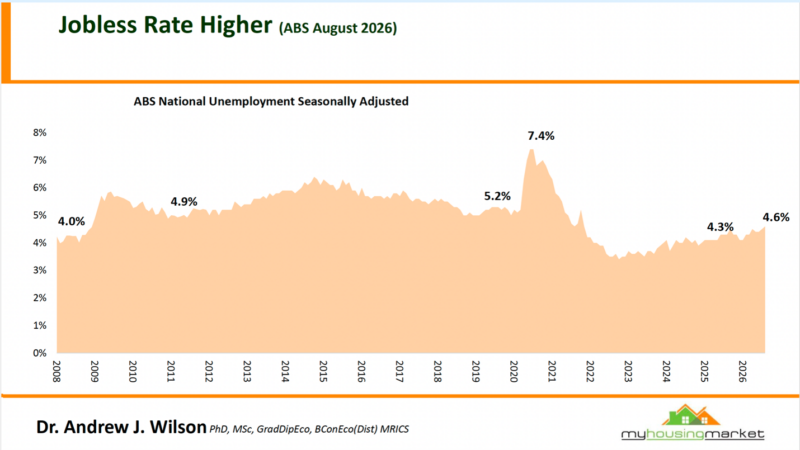
Australia's unemployment rate rose from 4.5% to 4.6% in August, even though 39,000 new jobs were created during the month.
The participation rate climbed to 67.1%, near historic highs, which means more people are looking for work and that explains much of the rise in unemployment.
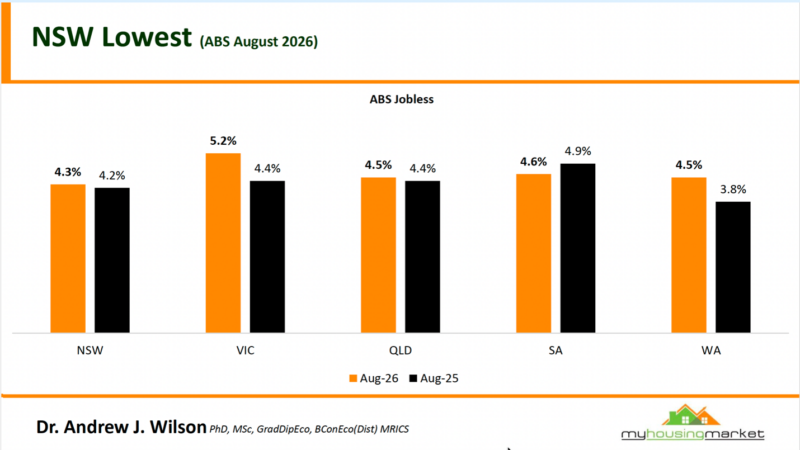
Victoria's jobless rate jumped to 5.2%, up from 4.4% a year ago, while New South Wales has the lowest rate of the states at 4.3%.
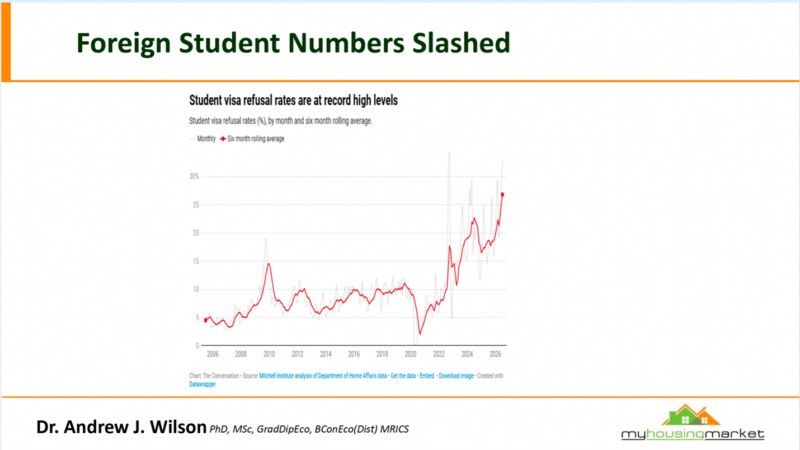
Student visa refusal rates are at record highs, which will reduce rental demand in parts of our capital cities, particularly around universities and in the inner-city apartment market.
National auction clearance rates are averaging around 50% in September, well down from 72% at the same time last year, handing buyers more negotiating power than they've had in years.
Melbourne continues to lead the nation on clearance rates, with a September monthly average of 61.6%.
Australia’s unemployment rate has risen again, even as the country added jobs.
At the same time, fewer overseas students are coming into our education system, raising questions about demand for rental accommodation.
Neither development gives us a simple forecast for property prices. But together with this weekend’s auction results, they show why buyers and investors need to look past the national headlines.
In this week’s Property Insiders, Dr Andrew Wilson and I examine what the latest labour figures say about the economy, where falling student numbers

The labour market is still easing
Australia's unemployment rate edged up again in August, rising from 4.5% to 4.6% according to the ABS, which is the highest level since late 2021.
At first glance that sounds like a jobs market in trouble, but watch this week's Property Insider chat as Dr. Andrew Wilson explains that employment actually rose by around 39,000 during the month, which was roughly double what economists had been expecting.
The reason unemployment still went up is that the number of people looking for work grew even faster, with the unemployed rising by about 28,000 over the month.
The participation rate climbed to 67.1%, just a whisker below the record high set in January 2025, and the ABS noted that an unusually high share of people who had been outside the labour force moved straight into looking for work.
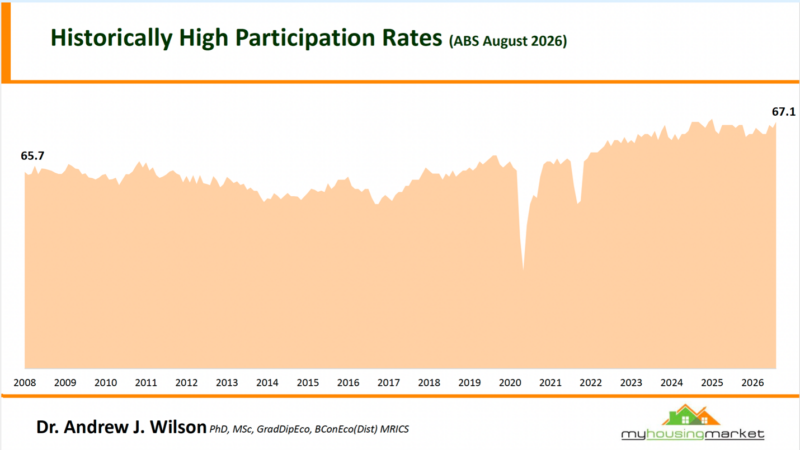
Cost-of-living pressures and higher interest rates are likely pushing more Australians into the workforce, even as the economy slows.
In other words, many households are looking for extra income to keep up with their mortgage repayments and grocery bills, and that's something every investor should keep in mind.
There are some softer details underneath the headline too, with part-time jobs rising by about 46,000 while full-time jobs fell by around 6,000.
It's also worth knowing the ABS has changed the way it runs its supplementary survey, and it has flagged that this may have had a small effect on the August figures, so the trend data remains the best guide.
Higher interest rates are now clearly feeding through to the labour market, and I agree with him.
Governor Michele Bullock has indicated that an unemployment rate somewhere between 4.5% and 5% would help take the heat out of prices, and August's result sits squarely inside that range.
From a property perspective, I don't see a jobless rate of 4.6% as a crisis, because it remains low by historical standards and well below the 5% to 6% levels we lived with through most of the 2010s.
What matters most for housing is that people keep their jobs and keep paying their mortgages, and with employment still growing, that remains the case for the vast majority of Australian households.
A tale of two states
When you look at the state figures, the most striking change over the past year has been in Victoria.
Victoria's unemployment rate is now 5.2%, up from 4.4% in August last year, making it the highest of the mainland states.
New South Wales has the lowest jobless rate at 4.3%, barely changed from 4.2% a year ago.
Western Australia has also seen a meaningful lift, from 3.8% to 4.5%, as the resources state comes off an exceptionally tight labour market.
South Australia is the only state where unemployment has actually fallen over the year, from 4.9% to 4.6%.
Foreign student numbers are being slashed
Watch this week's Property Insider chat. Dr. Andrew Wilson discusses the proposed sharp decrease in new overseas students coming to Australia.
Mitchell Institute analysis of Department of Home Affairs data shows student visa refusal rates are now at record highs.
The six-month rolling average refusal rate has climbed to around 27%, with some individual months above 30%, compared with a typical range of roughly 5% to 10% in the decade before COVID.
- Also read:Sydney housing market update | October 2026

- Also read:Melbourne housing market update | October 2026

- Also read:National Vacancy Rate Rises to 1.4% | SQM Research

- Also read:Australian housing market update | October 2026

- Also read:This week’s Australian Property Market Update – Latest Data, State by State October 13th 2026

The pressure has been building all year, with ICEF Monitor reporting that in February around one in three university applicants had their visa refused, while Chinese applications for higher education were down 39% on a year earlier.
This is a deliberate policy choice, as the federal government has been trying to bring net overseas migration down from its post-pandemic peak, and international students were the obvious lever to pull.
What fewer students means for property
Overseas students are a big source of rental demand in our capital cities, particularly in Sydney and Melbourne, so fewer new arrivals will take some pressure off parts of the rental market.
The impact won't be spread evenly, and the areas most exposed are CBD apartment towers, purpose-built student accommodation, and small apartments within walking distance of universities.
In my experience, these properties have always looked good on a spreadsheet because of their rental yields, but they rarely deliver strong long-term capital growth. They rely on a narrow tenant base, are usually surrounded by similar stock, and have little owner-occupier appeal, which is exactly why I've always steered investors away from them.
Weekend auction results
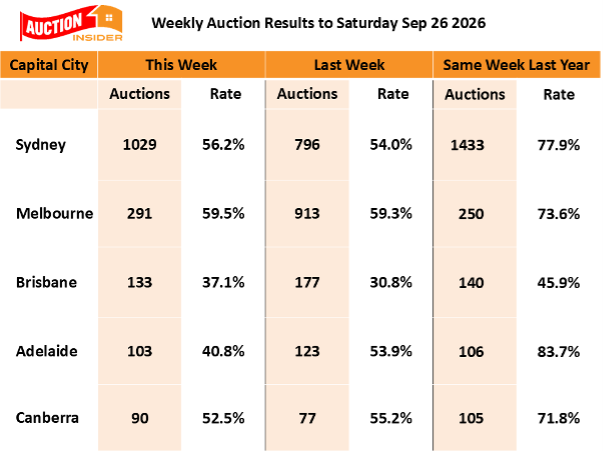
Capital City home auction markets produced predictably mixed results over the AFL Grand Final Week, with low auction numbers in Melbourne, fewer auctions in Brisbane and Adelaide, but a rise in auctions in Sydney and Canberra ahead of the NRL Grand Final.
The national weekend auction market reported an average clearance rate of 49.2% over the past week which was again lower than the 50.6% reported over the previous week and also again well below the 70.6% reported over the same week last year.
Generally subdued auction markets are set to be tested over the coming weeks if the RBA, as expected, raises interest rates at its meeting next week.
Monthly clearance rates tell the bigger story
Weekly numbers bounce around, so Andrew and I always like to look at the monthly averages to get a clearer sense of direction.
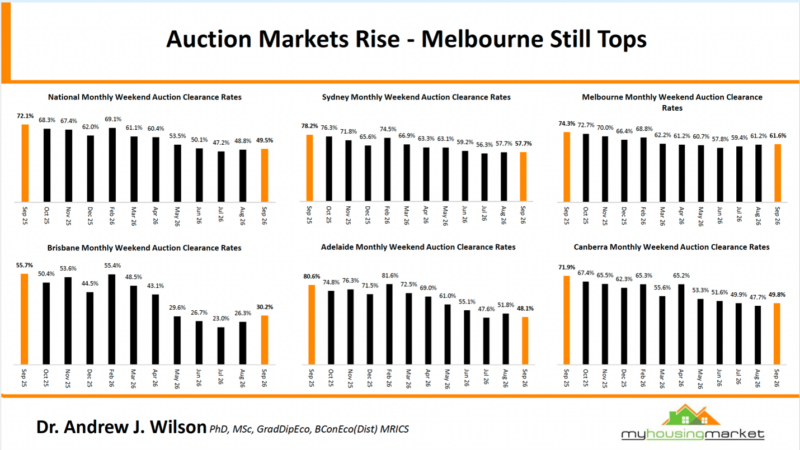
The national clearance rate averaged 49.5% in September, down from 72.1% a year ago, and it has been hovering around the 50% mark since June.
The encouraging sign is that July looks like it may have been the low point, with the national rate edging up in both August and September.
Melbourne has been the top-performing auction market for three consecutive months, lifting from 57.8% in June to 61.6% in September, which is a clear sign that buyer confidence there is slowly rebuilding.
Put simply, the auction markets are telling us that this is a buyer's market in most capital cities, with sellers needing to meet the market and buyers having time to do their due diligence and negotiate.
What this means for property investors
When you put this week's data together, you get a picture of an economy that is slowing gradually under the weight of higher interest rates, without falling off a cliff.
Unemployment is rising slowly, rates may still go a little higher, migration is being pulled back, and auction clearance rates are sitting around 50% nationally.
That's the sort of backdrop that keeps most buyers on the sidelines, and it's why the media headlines are so gloomy at the moment.
In my experience, these are the market conditions where strategic investors do their best buying, because there's less competition, more choice and more room to negotiate.
It's also a time to be conservative with your finance, so make sure you have cash flow buffers in place to see you through the possibility of one more rate rise, because the investors who do well over the long term are the ones who can hold on.
Markets move in cycles, and the time to position yourself is before the recovery shows up in the headlines.
Get the right advice before your next move
Markets like this one reward investors who have a clear strategy and punish those who make decisions based on the headlines.
Whether you're a beginner or a seasoned investor, the team at Metropole can help you build a personalised Strategic Property Plan that takes the guesswork out of what to buy, where to buy and how to finance it safely.
For more than two decades, Metropole has helped thousands of Australians grow, protect and pass on their wealth through strategic property and wealth advice.
Click here now to book a Wealth Discovery Session with one of our senior strategists at metropole.com.au.