

Key takeaways
Successful property investment begins with a long-term plan, a sound finance structure and careful asset selection. Buying a property without first deciding what you want your portfolio to achieve can leave you with assets that do not work together.
Capital growth builds the asset base, while cash flow gives you the holding power to remain invested. Most investors need both, although their relative importance will change as they move from accumulation to consolidation and finally to the lifestyle phase.
Australia is made up of many property markets. Performance varies by state, city, suburb, price point and property type, so broad headlines rarely tell you enough to make an investment decision.
Investment-grade property is scarce. I favour established properties in affluent, supply-constrained locations that appeal to owner-occupiers and offer the potential to manufacture capital growth.
Finance is becoming a greater constraint for investors. Lenders still assess new borrowers with a three percentage point serviceability buffer, while limits on high debt-to-income lending have applied since February 2026.
Tax benefits can help cash flow, but they should never be the reason for buying. Deductions, depreciation and capital gains tax depend on the property, its history and the investor's circumstances, so specialist advice remains essential.
Risk should be managed before you buy through cash buffers, appropriate insurance, thorough due diligence and a team of independent advisers who understand property investment.
Buying an investment property is easy. Buying the right property, holding it through several market cycles and using it as part of a coherent wealth strategy requires far more thought.
That helps explain why so many Australians become landlords, yet relatively few build a substantial portfolio.
They often begin with a property search when they should begin with a plan.
After more than five decades of investing and advising other investors, I have learned that lasting wealth is rarely created by chasing the latest hotspot or trying to pick the next short-term boom. It comes from owning the right assets, in the right locations, with the right finance and enough time for compounding to work.
This guide explains the foundations of property investment in Australia, from the ways property can make money through to risk management, tax, finance and the mistakes that prevent otherwise capable investors from progressing.

The current environment makes this discipline especially important.
Australian housing softened during 2026 after a strong rise, and the national figures conceal large differences between cities and market segments. At the same time, housing supply remains constrained, population growth continues to support demand and borrowing capacity is under pressure.
That combination will continue to produce a fragmented market. Some properties will outperform, some will tread water and others will lose value, even when they sit in the same city.
Step 1 Understand how property creates wealth
Property can make money in several ways, and a successful strategy usually draws on more than one of them.
Capital growth is the increase in the value of your property over time. For investors who want to build a substantial asset base, above-average long-term growth is the main engine of wealth creation.
That growth generally comes from sustained demand. Owner-occupiers are particularly important because they make up 70% of the market and are often prepared to pay a premium for lifestyle, amenity and scarcity.
Cash flow is the rent left after allowing for the costs of owning and operating the property. It helps you service debt and retain the asset, although many high-growth residential properties will have a cash flow shortfall, particularly in their early years.
Tax concessions can improve an investor's after-tax cash flow. Interest and a range of other expenses may be deductible when a property is genuinely available for rent, while eligible capital works and depreciating assets may be claimed over time. The rules are detailed and change according to the nature and timing of the expenditure, so tax should be treated as part of the structure rather than the investment case.
You can also manufacture capital growth by improving a well-located property through renovation or development. This requires careful feasibility work because overcapitalising, delays and rising construction costs can quickly erode the expected gain.
Finally, sensible leverage allows you to control a larger asset with a smaller amount of your own capital. Inflation can reduce the real value of a fixed debt over time, but leverage magnifies losses as well as gains and must be supported by dependable income and buffers.
Step 2 Recognise the three phases of a property strategy
A property portfolio should evolve as your objectives and financial position change.
- The accumulation phase: At this stage investors build an asset base by purchasing investment-grade properties with strong long-term growth prospects. This commonly takes 10 to 15 years, although the pace depends on income, borrowing capacity, buffers and life circumstances.
- The consolidation phase is about strengthening your balance sheet and improving your cash flow. That may involve allowing rents and incomes to rise, reducing non-deductible debt, selectively paying down investment debt or selling an underperforming asset where the numbers justify it.
- The lifestyle phase is when the portfolio helps fund your choices. Some investors live partly from net rent, while others sell selected assets and reinvest, reduce debt or use a diversified income strategy. The best approach depends on tax, estate planning, risk tolerance and the level of income required.
These phases should be considered before the first purchase because the assets and finance structures that help you accumulate wealth may not be the ones you eventually want to hold for income.
Step 3 Balance capital growth and cash flow
Investors are often encouraged to choose between capital growth and positive cash flow, but in my mind, that is too simplistic.

Note: You need capital growth to build wealth and enough cash flow to hold your assets through the inevitable difficult periods.
High-yield properties are frequently found in smaller or less affluent markets where purchase prices are lower. The yield can look attractive, yet demand from future owner-occupiers may be thinner, and long-term capital growth may disappoint.
Prime metropolitan properties usually deliver lower initial yields because buyers are prepared to pay more for scarcity, amenity and access to employment. When the asset is selected well, the stronger growth can create equity that supports the next stage of the portfolio.
My preference during the accumulation phase is to prioritise capital growth without ignoring cash flow. A property must remain affordable after allowing for interest, vacancy, maintenance, insurance, land tax and management costs.
Over time, rising rents, wage growth and carefully chosen improvements can strengthen the cash flow of a quality asset. A high yield, however, cannot change the underlying economic and demographic limitations of a poor location.
Cash flow keeps you in the game, while capital growth gives you more financial choices later.
Step 4 Understand property cycles
While timing the market should never be a key focus of any property investor, it is certainly helpful to understand that the property market moves in cycles.
Following the herd and buying when everyone else is on the property bandwagon doesn’t always work.
That’s often when the market is near its peak.
On the other hand, you have a better chance of grabbing a good deal in a buyer’s market, when the property is out of favour.
As the infamous Warren Buffet once said:
Be fearful when others are greedy and be greedy when others are fearful.
I personally have a strong view on investors trying to “time the market”, especially if they’re an established investor.
If you’re into real estate for the long haul (and that’s really the only way to play the property game) then time-in-the-market (owning a property that will outperform the averages in the long term) will trump timing-the-market (making a one-off capital gain, but then often missing out on strong, long term growth because you’ve bought in the wrong location).
Note: Time in the market is what delivers the most capital growth.
Step 5 Choose an investment grade property
The right property starts with the right location, but postcode selection alone is not enough. Two neighbouring properties can produce very different results because of their design, position, scarcity and appeal to future buyers.
Note: I begin by looking at the economic and demographic outlook, then identify the states and capital cities likely to benefit from population growth, diverse employment and sustained infrastructure investment. Within those cities, I favour suburbs with a long history of strong demand from affluent owner-occupiers.
These tend to be established inner and middle-ring locations with good transport, schools, shopping, recreation and walkable lifestyle amenities.
Gentrification can add another source of demand as higher-income residents move in and improve the housing stock.
I generally avoid relying on a short-term regional boom. Some regional markets will perform well, but many depend heavily on one industry, have a smaller buyer pool and experience more volatile demand. That makes asset selection and exit risk particularly important.
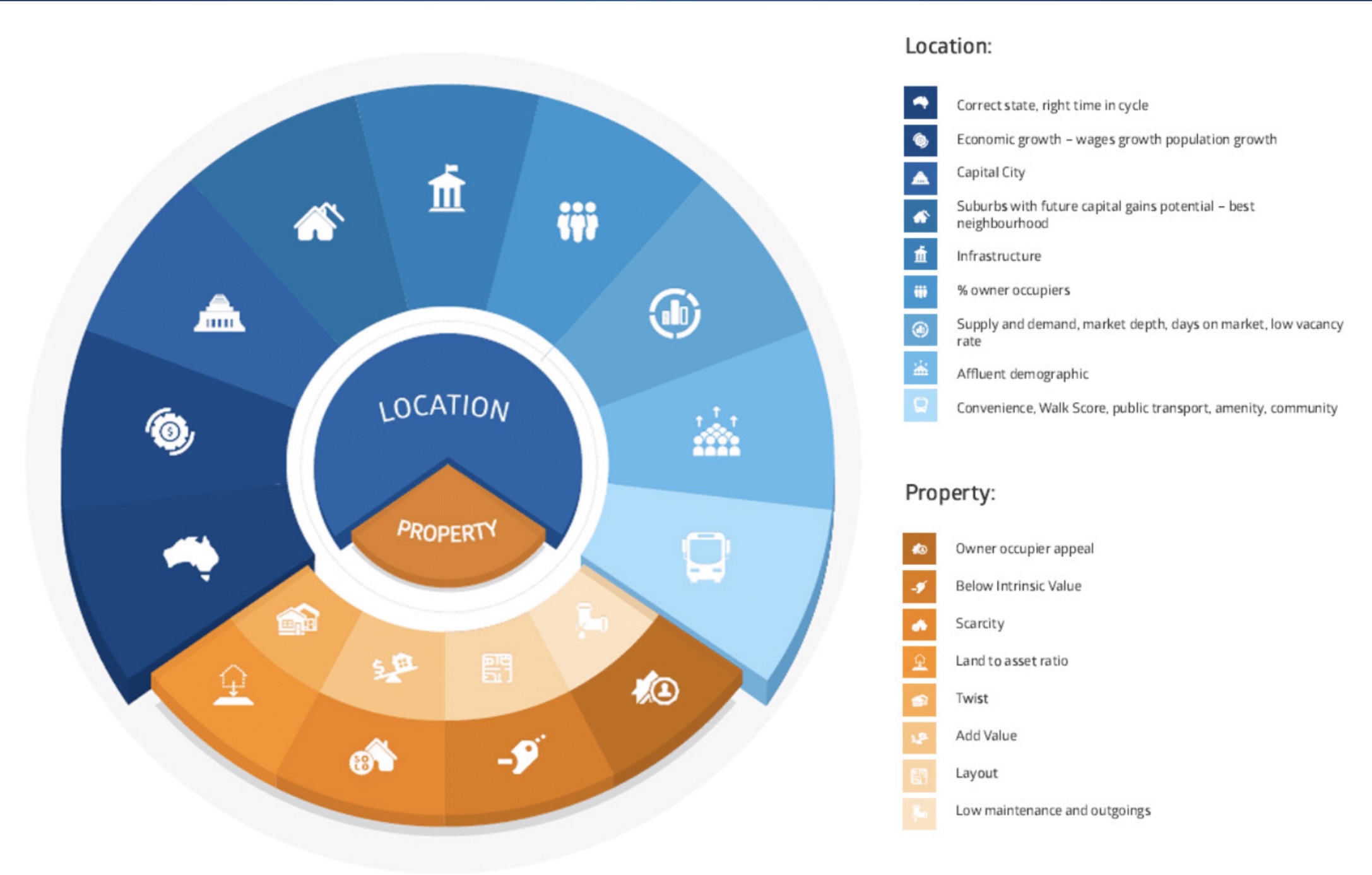
Once the location has passed those tests, I use a six-stranded approach to select the property:
- It should appeal to owner-occupiers, because they create the depth of demand that supports values over time.
- It should be bought at or below its intrinsic value, without paying a developer's marketing premium.
- It should have a meaningful land component, which can include the attributable share of land beneath a well-positioned apartment.
- It should be in an area with a proven record of above-average growth and demographics capable of supporting higher prices.
- It should have a point of scarcity or difference that future buyers will value.
- Ideally, it should offer a realistic opportunity to manufacture capital growth through improvement or redevelopment.
No property is perfect, but several independent drivers of performance give the investment a greater margin of safety.
A well-located house can be an excellent asset, although many investors can no longer afford one in an investment-grade suburb.
That's why I would rather own a family-friendly apartment, villa unit or townhouse in a desirable established neighbourhood than a larger house on the distant urban fringe with weaker owner-occupier demand.
The apartment should have functional proportions, natural light, parking where the market expects it, reasonable owners corporation costs and a position in a low-rise building with limited competing supply. Generic high-rise stock, serviced apartments and student accommodation usually carry constraints that make them unsuitable for the growth-focused investor.
Established properties generally offer better prospects than new or off-the-plan stock because the buyer can assess the building, local demand and comparable sales.
They also avoid much of the developer and marketing premium and may offer scope to add value.
New property can provide depreciation benefits and lower initial maintenance, but those advantages don't compensate for overpaying or buying a product with abundant future competition.
- Also read:This week’s Australian Property Market Update – Latest Data, State by State October 13th 2026

- Also read:Latest Property Price Forecasts. Australian Property Market Outlook 2026-2027: Navigating a Market Correction

- Also read:Brisbane Property Market Forecast [2026 & Beyond] – What The Olympics Decade Means for Investors.

- Also read:Sydney property market forecast for 2026 and 2027 | Why the short-term softness is a long-term opportunity

- Also read:Melbourne property market forecast for 2026 & 2027 | Separating the fundamentals from the sentiment

Of course, finance is part of this selection process. APRA's current settings require banks to assess borrowers at least three percentage points above the loan rate. Since February 2026, banks have also been limited to writing no more than 20 per cent of new investor loans at debt of six times income or more.
An interest-only loan can improve short-term cash flow and may be appropriate for some investors, but it is not automatically the best choice. The rate, loan term, future repayment increase and overall debt strategy need to be assessed with a finance professional.
Step 6 Weigh the advantages and disadvantages
The next step to get started in property investment in Australia is to have a clear understanding of the pros and cons of why to do it.
Understanding WHY property investing is a safe and proven method for growing your wealth can help make the best financial decisions during the property investment process.
The pros include:
- Strong historical performance: Residential property outperformed all other investment types, including shares, over the past 40 years.
- Control: Property is a great investment because you have direct control over the returns from it. One of the major benefits is that you can manage your assets rather than leaving the decisions to a large corporation or fund manager. This means you can improve your property or buy a property with a twist that can drive quick capital growth. If your property is not producing good returns, you can add value through renovations or adding furniture to make it more desirable to tenants. In other words, you can directly influence your return by taking an interest in your property and understanding and meeting the needs of your prospective tenants.
- Leverage: One of the special things about the property is that banks will lend you up to 80% of the property's value, enabling you to use other people’s money to buy larger amounts of your investment.
- Tax advantages: Investment properties offer significant tax advantages, including depreciation and the possibility of negative gearing if it is appropriate for you.
- Security: Residential real estate offers the security of bricks and mortar. This means that houses don’t “go broke” as companies or shares do. This is partly due to the size of the residential market and also the fact that just under two-thirds of the people who own properties are owner-occupiers. The residential market is the only investment market that is not dominated by investors, and this provides a built-in safety net.
- Income: The rental income you receive from your property allows you to borrow and get the benefits of leverage by helping pay the interest on your mortgage.
- Property is forgiving: Even if you bought the worst property at the worst possible time, chances are it will still go up in value over the next few years. History has proved that real estate is possibly the most forgiving asset over time. If you are prepared to hold an investment property for a number of years, it is bound to rise in value.
- You can insure for many of the risks: Not just building insurance, but smart investors take out landlords' insurance to protect their interests.
But, of course, property investments are not all rainbows and lollipops, there are some cons associated with investing in real estate, such as:
- High entry costs: With property prices constantly on the rise, it is becoming increasingly difficult to get into the market. These high entry costs keep many investors out and make it hard to get started if you don’t have some money and savings discipline behind you.
- Lack of diversification: Because of the high entry cost it is common for beginning investors to have all their eggs in one basket. This lack of diversification is a risk if the market changes suddenly or your investment doesn’t perform the way you expected. Of course, the answer to this is to own the right type of real estate, the type that doesn’t fluctuate in value significantly when the market turns. (I’ll explain this in more detail shortly).
- Ongoing and additional costs: Investment property carries with it ongoing costs like insurance costs, council rates, mortgage repayments, maintenance, renovations, etc. These expenses may be regular or may come as a surprise when you least expect them. And if you own a high-growth property, it is likely that in the early years, the rental income will not be able to cover your expenses completely. While many investors top up this negative cash flow from their savings, savvy investors set up cash flow buffers in a line of credit or offset account to cover their negative gearing.
- Tenant problems: Despite engaging the best property managers to look after your property, you can still have tenant problems or periods of rental vacancy, which, unless you have the protection of landlord insurance or cash flow buffers, can put a dent in your finances.
- Property is illiquid and lumpy: It takes time to sell and you can’t simply sell off one part of the house and convert it to cash.
- Surprises: These always seem to creep up on investors – things like changing interest rates or unexpected repairs.
Step 7 Manage the risks before they manage you
Market risk can't be eliminated, although it can be reduced through asset quality, diversification and a long investment horizon.
Buying in markets with broad employment, deep owner-occupier demand and constrained supply provides a stronger foundation than relying on a single project or industry.
Liquidity risk is inherent in property because you can't sell off just one bedroom when you need a modest amount of cash.
However, a financial buffer in an offset account gives you time to handle vacancies, repairs, higher interest costs or a temporary loss of income without being forced to sell.
Interest-rate and refinancing risk deserve special attention in 2026. Borrowing capacity has become a binding constraint for many investors, so loan structure, lender choice and future serviceability should be considered before making an offer.
There is also asset-specific risk. Building defects, combustible cladding, flood and bushfire exposure, excessive owners corporation liabilities and poor town planning can damage both cash flow and resale value. Building, pest, strata and planning checks should be completed by appropriately qualified professionals.
Legislative risk is increasing as state governments change land tax, tenancy rules, minimum rental standards and short-stay regulation. These costs and obligations vary considerably by jurisdiction and should be included in the due diligence rather than treated as an afterthought.
Climate and insurance risk now need to be assessed at property level. An apparently affordable property can become difficult to hold or finance if premiums rise sharply or comprehensive cover becomes unavailable.
Investors should consider building, landlord, income protection, life and total and permanent disability insurance according to their needs. Estate planning is also part of risk management, particularly where a spouse or family member may need to retain a geared portfolio.
Finally, review your portfolio regularly. An annual strategy, finance, insurance and performance review can identify problems before they become expensive.
Step 8 Allow for all the costs and tax rules
Many investors budget for the deposit and loan repayments, but underestimate the full cost of acquiring and holding the property.
Purchase costs can include stamp duty, conveyancing, searches, building and pest reports, loan fees and buyers' agency fees. Ongoing costs may include interest, council and water charges, land tax, insurance, property management, owners corporation levies, compliance work, maintenance and periods without rent.
Unfortunately, there is no reliable rule that these costs equal a fixed percentage of the property's value. Land tax alone varies substantially by state and ownership structure, while maintenance depends on the age and condition of the building. A property-specific cash flow forecast is far more useful than a broad rule of thumb.
For maintenance, list the expensive items such as the roof, hot-water service, heating and cooling, appliances, carpets and external paint. Estimate their remaining useful life and build a sinking fund for replacements.
What about the tax breaks? One of the biggest reasons why investment property remains popular in Australia is the whole raft of tax benefits available. And this is still the case despite changes coming from the 2026 Federal Budget.
Now, my advice is that you shouldn’t invest solely for tax benefits, but they’re a nice little bonus that makes keeping your property easier. property
Things like claiming legitimate business expenses of running your investment business as well as negative gearing (for certain properties), which allows investors to offset any shortfall between the rent that you collect from your property and the expenses that you pay for it against your other income.
However, if you sell a property at a profit, you’ll need to pay capital gains, but even this has adjustments, as you can currently benefit from a 50% discount on capital gains for a property that you’ve held for longer than 12 months. But again, this is changing after the recent Federal Budget.
A proficient property manager is another important cost. Rental laws and minimum standards have become increasingly complex, and professional management can improve tenant selection, compliance, arrears control, maintenance and rent reviews while protecting your time.
Step 9 Avoid the mistakes that stop investors progressing
The most common mistakes made by investors are remarkably consistent, even as market conditions change.
Buying emotionally is one of them. An investment should be assessed through demographics, scarcity, comparable sales, rental demand, cash flow and future owner-occupier appeal rather than décor or personal taste.
Failing to plan is another. A collection of individually reasonable properties can still form a poor portfolio if the assets duplicate the same risks, consume borrowing capacity and do not lead towards the investor's financial goals.
Some buyers rush after attending a webinar or hearing about a hotspot, while others remain paralysed by research. Good investors do enough work to understand the risk, seek independent advice and then act when the evidence supports the decision.
Speculation causes investors to focus on short-term price movements, flips and the next boom. Property is expensive to trade, and wealth creation usually requires patience, compounding and the ability to remain invested through several cycles.
Inadequate due diligence is another expensive error. Investors should understand why the vendor is selling, inspect at different times, commission the relevant building, pest and strata reports, check planning and environmental risks and assess whether the property provides a practical home for the target tenant.
Poor finance structures can be as damaging as a poor property. Cross-collateralisation, mixed-purpose loans, inadequate buffers and chasing the lowest advertised rate without considering flexibility may restrict future choices.
Finally, self-management is a false economy. An experienced manager understands the legislation, local rent, tenant screening and tribunal process, while giving the investor time to focus on strategy and the next acquisition.
Is it too late? Have I missed the boat?
The simple answer is NO, it's not too late.
And yes it would have been great to buy a property in early 2020 when most people sat on the sidelines waiting to see what would happen in the market during Covid.
Remember that there is not one “Australian property market”, and even within each state, there are multiple markets divided by geography, type of property, price point, etc.
Note: Property investment is a process – not an event.
That means to become a successful property investor, you can't just go out and buy any property. It should be part of a long-term Strategic Property Plan.
It should come as no surprise that getting a good team around you will be an important investment and not an expense and should allow you to build a property portfolio that will go a long way to replacing their income in the future.
At the same time, you must learn that property investing is not a get-rich-quick scheme and to achieve your future financial goals you will have to slowly build a substantial asset base and not chase short-term cash flow as many beginning investors do.
Here’s a wrap up of tips we’ve covered for how to invest in property:
- Formulate a plan: Understand your end goals - what you want to achieve - and then make investment decisions accordingly.
- Be cautious: You’ll find everyone is happy to give you advice. Rather than listening to well-meaning friends, it’s important to only listen to people who have achieved the financial independence you’re looking for and who’ve maintained it through a number of property cycles.
- Understand the difference: Between a salesperson and an advisor. Many salespeople are cloaked as advisors and while they suggest they’re representing you, in fact, they are representing the seller or a property developer. Only take advice from someone who is independent and unbiased rather than someone who is trying to sell you something.
- Be prepared to pay for advice: I’ve found that good advice is never expensive. In fact, it’s much cheaper than learning from your property investment mistakes.
- Not everything that glitters is gold: Often when you start out it can be tempting to see opportunities everywhere. The problem is you don’t yet have the perspective to decide what is a good investment and what is not.
Remember, the property doesn’t discriminate; it doesn’t care who owns it.
Good advice carries a cost, but poor advice usually costs much more. At Metropole, our team takes a holistic view of your position and builds a personalised Strategic Property Plan before helping you implement it through property strategy, buyers' advocacy, finance, wealth advice and property management.
That approach gives you a far better chance of building a portfolio that can grow, protect and eventually pass on your wealth.
If you get it right, you can have your share.