Key takeaways
The RBA left rates on hold in August, but its own statement makes it clear this isn't the end of the story. Inflation is still too high and isn't expected to get back to target until late 2027.
Investor lending has fallen sharply. Investor loans are down 8.6% for the June quarter and nearly 15% lower than a year ago.
Auction clearance rates have cooled right across the country compared to this time last year, even though most cities are showing the early, tentative signs of a spring lift.
The gap between owner-occupiers and investors continues to widen, and that split matters more for where prices head next than any single headline number.
For long-term investors, this is a market rewarding patience and quality over speed and sentiment.
Australia’s labour market is beginning to show clearer signs of cooling, with unemployment rising slightly, employment falling and wage growth remaining subdued.
This matters because the Reserve Bank has repeatedly highlighted the strength of the labour market and the risk of persistent wage and services inflation when explaining its cautious approach to interest rates.
The latest figures should give the RBA greater confidence that higher interest rates are slowing demand and gradually creating more spare capacity in the economy.
Of course, one month’s figures should always be treated carefully, particularly because monthly employment data can be volatile, but the broader direction is becoming harder to ignore.
At the same time, auction activity increased as the end of winter approached, although clearance rates remained subdued and significantly lower than at the same time last year.
So, what do these latest economic signals mean for interest rates, homebuyers and property investors?
That’s what Australia’s leading housing economist Dr Andrew Wilson and I discuss in this week’s Property Insiders.

The unemployment rate rises to 4.5 per cent
Watch this week's Property Insiders as Dr. Andrew Wilson explains how the seasonally adjusted unemployment rate increased to 4.5 per cent in July, according to the Australian Bureau of Statistics.
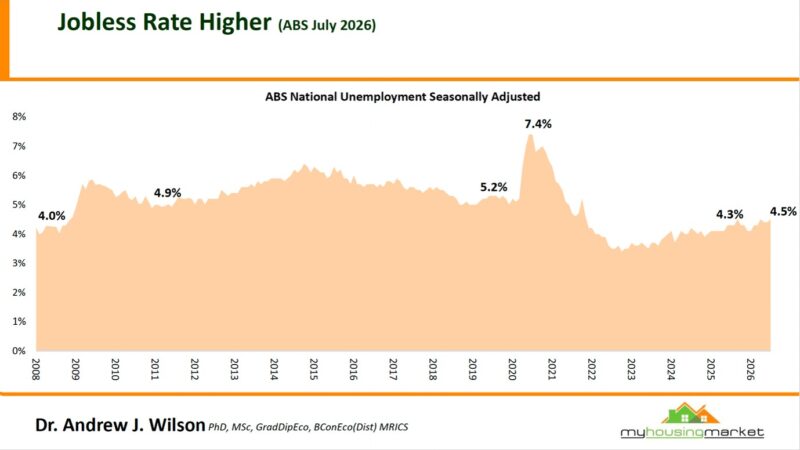
Employment fell by approximately 16,000 people over the month, while the number of unemployed Australians increased by 4,000.
The majority of the fall came from part-time employment, which declined by around 32,000, while full-time employment increased by approximately 16,000.
This distinction is important because the headline employment figure alone can make the result look weaker than it was. An increase in full-time employment generally provides a more encouraging signal than a similar increase in part-time work.
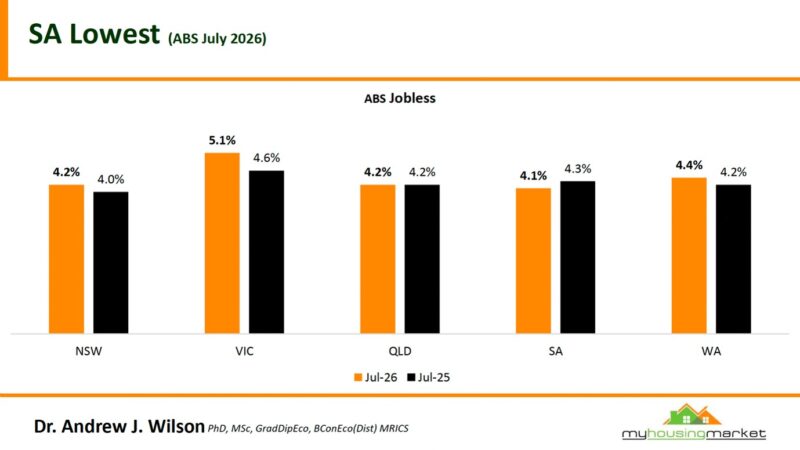
South Australia is experiencing the lowest unemployment rate amongst our capitals, while Victoria is experiencing the highest unemployment rate.
Other parts of the report also pointed towards a labour market that is gradually losing momentum.
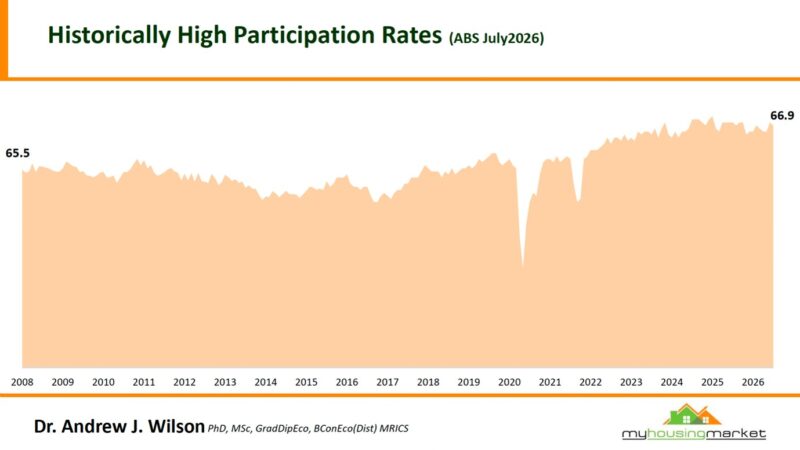
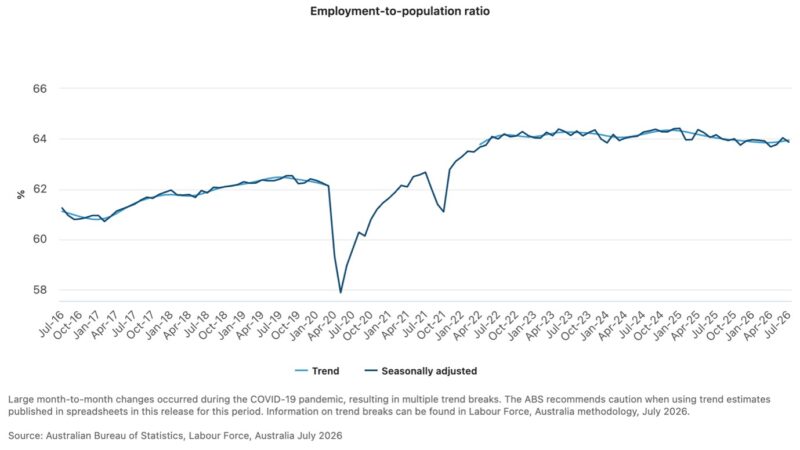
The employment-to-population ratio fell by 0.2 percentage points to 63.9 per cent, while the participation rate also declined by 0.2 percentage points to 66.9 per cent.
The underemployment rate eased slightly to 6.4 per cent, although it remains above the 5.9 per cent recorded three months earlier.
Total hours worked fell by 0.6 per cent in July, equivalent to around 12 million fewer hours across the economy.
Over the year, employment remained 1.3 per cent higher, yet total hours worked increased by only 0.2 per cent. In other words, Australian businesses may still be employing more people, but the average employee is working fewer hours.
In my mind, the weakness in hours worked may be more revealing than the small movement in the unemployment rate because employers often reduce hours before they begin cutting staff more aggressively.
The headline figure needs some perspective
While unemployment officially rose to 4.5 per cent, the underlying movement was very small.
The unemployment rate increased from 4.43 per cent to 4.46 per cent before rounding. That means the apparent 0.1 percentage point rise was largely the result of crossing a statistical rounding threshold.
There was also some uncertainty caused by changes in the ABS survey sample. You will hear Dr. Wilson explaining that the new rotation group entering the survey in July had a higher unemployment rate and a lower employment-to-population ratio than the overall sample.
This does not invalidate the figures, but it reinforces the importance of looking at the trend rather than reacting to a single month.
Trend employment growth remained reasonably solid at approximately 29,000 jobs, which NAB estimates is around the level required to keep pace with population growth if participation remains unchanged.
Australia’s labour market is cooling gradually rather than collapsing, and that is probably close to the outcome the Reserve Bank has been trying to engineer.
Wage growth remains contained
Watch this week's Property Insider chat as Dr Andrew Wilson explains how the other important piece of the puzzle was the latest Wage Price Index.
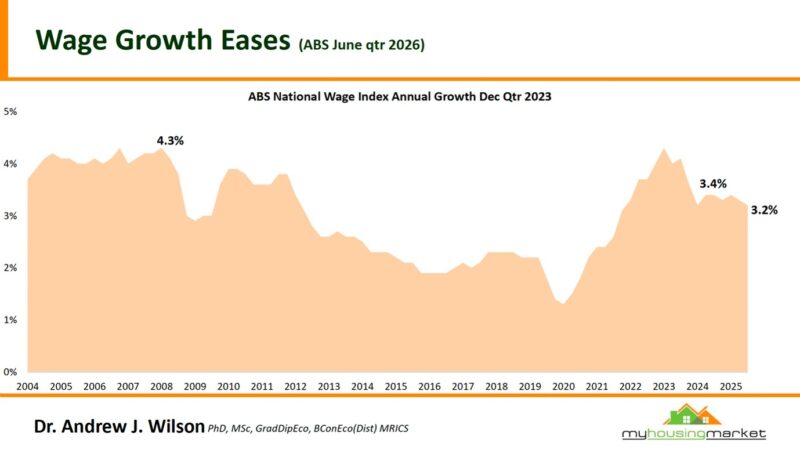
The ABS reported that wages rose by 0.8 per cent in the June quarter and 3.2 per cent over the year.
Annual wage growth is now well below the 4.3 per cent peak recorded in late 2023 and below the 3.4 per cent annual growth recorded in the June quarter of 2025.
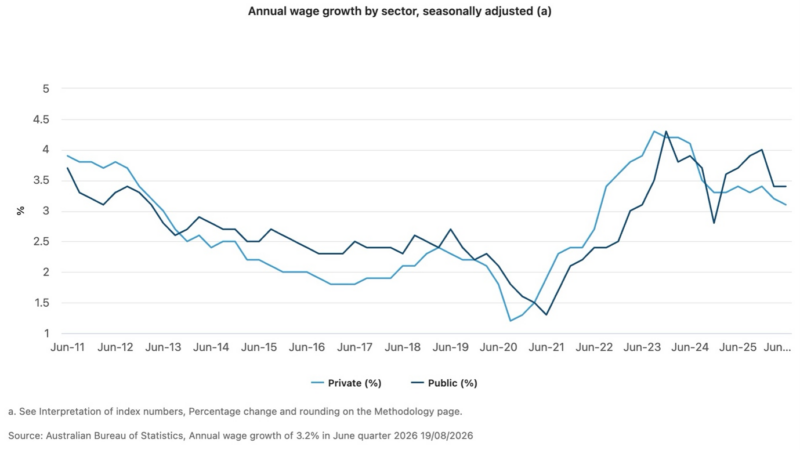
Private-sector wages grew by 3.1 per cent over the year, while public-sector wages increased by 3.4 per cent.
Public-sector wages have outpaced private-sector wages for six consecutive quarters, helped by increases for state government employees and scheduled rises under Commonwealth enterprise agreements.
The ABS also found that 79 per cent of jobs receiving a wage change over the past year recorded an increase of less than 4 per cent. That was up from 75 per cent a year earlier and was the highest proportion since June 2022.
- Also read:This week’s Australian Property Market Update – Latest Data, State by State August 25th 2026

- Also read:National Weekly Auction Report – August 22nd 2026 | Late Winter Auctions Rise – Clearance Rates Steady

- Also read:Adelaide housing market update | August 2026

- Also read:Perth housing market update | August 2026

- Also read:Brisbane housing market update | August 2026

This suggests that the larger wage increases seen during the post-pandemic labour shortage are becoming less common.
For the Reserve Bank, that is reassuring because a renewed wage-price spiral that some economists feared now appears increasingly unlikely.
Of course, households will see this differently. Softer wages make it more difficult for many Australians to recover the purchasing power lost during the recent cost-of-living surge.
What this means for the Reserve Bank
The Reserve Bank will be encouraged by these figures because they indicate that monetary policy is gaining traction.
Higher interest rates are intended to reduce borrowing, slow spending and soften demand across the economy. Over time, this should ease the pressure on labour, wages and inflation.
The latest figures point in that direction. Unemployment has increased, participation has eased, hours worked have fallen and wage growth remains contained.
This combination reduces the urgency for another interest-rate rise in the near term.
The July report should give the RBA more confidence that it was correct to look through the unusually strong employment growth recorded in June.
The bank also expects unemployment to increase gradually towards 4.75 per cent by the middle of 2027.
Westpac sees a somewhat weaker outlook, forecasting unemployment of 4.6 per cent in the September quarter and 4.8 per cent by the December quarter.
By comparison, the RBA’s August forecasts have unemployment reaching 4.5 per cent in the final quarter of 2026.
If Westpac’s forecast proves correct, the labour market would develop more spare capacity than the Reserve Bank currently expects, reducing the need for further monetary tightening and potentially bringing future rate relief closer.
However, I would be cautious about assuming that the RBA will cut interest rates anytime soon. Inflation will remain the deciding factor, and the Reserve Bank will want several months of evidence before changing course.
However, a single softer employment report will give the Board greater room to wait.
My expectation remains that the cash rate will stay unchanged for the remainder of 2026, provided inflation continues moving in the right direction.
What this means for our property markets
For property buyers and investors, the fading risk of another interest-rate rise should gradually improve confidence as interest-rate uncertainty has been one of the greatest constraints on the property market so far this year.
Many prospective buyers have delayed making decisions because they were concerned about another increase in mortgage repayments or a further reduction in borrowing capacity.
If the labour market continues to soften without deteriorating sharply, the Reserve Bank may be able to keep rates on hold while inflation gradually moderates.
That would provide buyers with greater certainty, although affordability and borrowing capacity would remain significant constraints.
Of course, the ideal outcome for property markets would be a gentle cooling in employment that removes the need for higher interest rates while avoiding widespread job losses.
On the other hand, a much sharper rise in unemployment would have very different consequences as job security is fundamental to housing demand, consumer confidence, and borrowers' ability to service their mortgages.
So far, Australia remains well short of that scenario. Unemployment remains low by historical standards, participation remains relatively high, and trend employment growth continues to keep pace with much of our population growth.
Meanwhile, our underlying housing shortage hasn’t disappeared.
Population growth, constrained dwelling construction and tight rental markets continue to provide a floor under demand, although the performance of individual property markets will remain fragmented.
In the current environment, investors should avoid making decisions based on the prospect of a quick rate cut. A quality property purchased with appropriate financial buffers should perform because of its location, scarcity and appeal to an affluent owner-occupier market, rather than because of a prediction about the next RBA meeting.
Late-winter auction activity increases
Auction markets became busier over the past week as the end of winter approached and vendors began preparing for the traditional spring selling season.
However, Dr Andrew Wilson observed that clearance rates remained generally steady and mostly subdued, while listing numbers were still well below the same weekend last year.
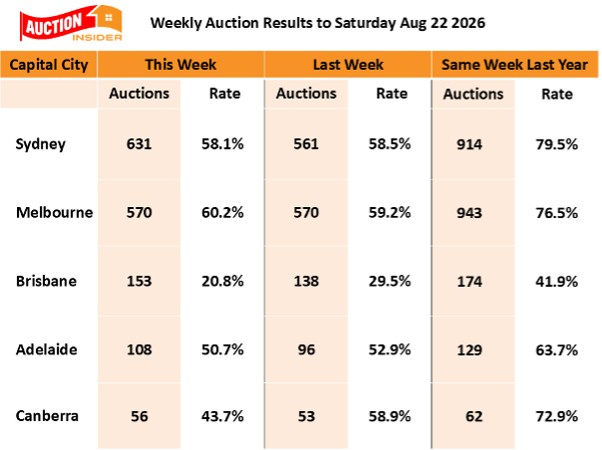
The results reveal a market with improving activity but cautious buyers.
The bottom line
The July employment report and the latest wage figures should take some pressure off the Reserve Bank.
Unemployment is drifting higher, hours worked are weakening and wage growth has settled at a level that is less likely to sustain inflation.
At the same time, the labour market retains important areas of strength. Full-time employment increased in July, trend job creation remains solid, and the rise in the unemployment rate was very small before rounding.
This should allow the RBA to remain patient while it waits for further evidence on inflation, wages and employment.
For property investors, a reduced likelihood of another near-term rate rise is encouraging, but it should not become the basis of an investment strategy.
Our property markets are likely to remain fragmented as we move into spring, with affordability, local supply, household income and property quality creating very different outcomes across cities, suburbs and individual properties.
This is the type of market where careful asset selection, a long-term strategy and sufficient financial buffers will matter much more than attempting to predict the precise timing of the next interest-rate move.