

Key takeaways
The typical income needed to rent a home without entering rental stress has surged by 51% since 2019, rising from $74,533 to $112,667 across Australia’s capitals.
Sydney remains the least affordable city, where renters need around $135,200 a year to afford a median house, while Melbourne and Hobart hover closer to $100,50.
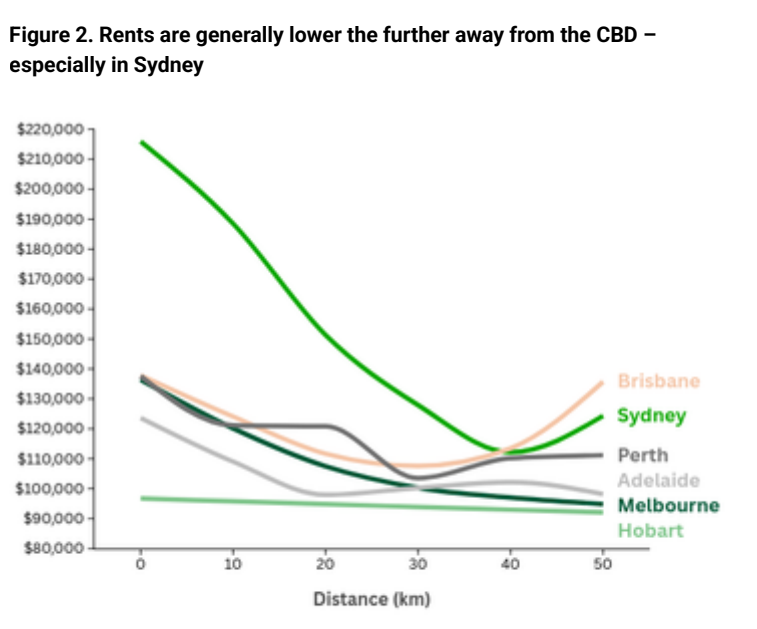
Domain notes the sharp income drop from $216,000 near the CBD to $112,000 in the outer suburbs, before rising again in lifestyle regions further out.
Melbourne stands out for having the narrowest gap between houses and units, just $900, due to strong apartment supply and premium inner-city living options.
Across all capitals, the most affordable areas tend to sit 30–40 kilometres from the CBD — far enough to escape premium rents but close enough for convenience.
However, Domain warns that affordability often deteriorates beyond that distance as lifestyle suburbs and regional hotspots command higher rents.
Vacancy rates have sat below 1.5% in every capital city for an extended period — a “critically tight” level according to Domain.
With population growth rebounding, construction lagging, and demand outstripping supply, rents are expected to remain under pressure well into 2026.
If you thought buying property was getting harder, try renting the dream lifestyle.
Across Australia, rents have skyrocketed so fast that simply living where you want is becoming a luxury for some people.
New research from Domain paints a stark picture of our rental future, one where proximity, prestige and even basic comfort come with a six-figure price tag.
According to Domain’s Renting in 2026 report, the income needed to rent comfortably in most of our capital cities has jumped an astonishing 51% since 2019, while wages have failed to keep up.
The result is a widening chasm between aspiration and affordability that’s reshaping where Australians can live, work and raise families.
How much income you really need to rent in 2026
Let’s start with the headline figures.
According to Domain, to rent a typical house without entering rental stress (defined as spending more than 30% of your pre-tax income on rent), you’d now need around $112,667 a year across the combined capitals, up from $74,533 just six years ago.
| Table 1: Required annual earnings to rent a typical price property | ||||
| City | 2019 | 2019 | 2025 | 2025 |
| Houses | Units | Houses | Units | |
| Sydney | $ 90,133 | $ 88,400 | $ 135,200 | $ 130,000 |
| Melbourne | $ 74,533 | $ 72,800 | $ 100,533 | $ 99,667 |
| Brisbane | $ 71,067 | $ 66,733 | $ 114,400 | $ 109,200 |
| Adelaide | $ 67,600 | $ 54,600 | $ 107,467 | $ 90,133 |
| Canberra | $ 98,800 | $ 82,333 | $ 121,333 | $ 100,533 |
| Perth | $ 64,133 | $ 55,467 | $ 121,333 | $ 104,000 |
| Hobart | $ 81,467 | $ 69,333 | $ 100,533 | $ 84,933 |
| Darwin | $ 81,467 | $ 65,000 | $ 124,800 | $ 100,533 |
| Combined Capitals | $74,533 | $78,000 | $112,667 | $112,667 |
| Combined Regional | $65,867 | $55,467 | $101,400 | $91,000 |
And these aren’t the incomes needed to live lavishly; they’re simply what’s required to rent the median home without financial strain.
For millions of Australians earning the average wage of $80,200, even a standard house in most capitals is now out of comfortable reach.
| Table 2: Rent as a share of average double-income earning weekly earnings (pre-tax) household | ||||
| City | 2019 | 2019 | 2025 | 2025 |
| Houses | Units | Houses | Units | |
| Sydney | 20.2% | 19.8% | 24.5% | 23.2% |
| Melbourne | 17.5% | 17.1% | 19.4% | 19.2% |
| Brisbane | 16.5% | 15.5% | 21.2% | 20.3% |
| Adelaide | 17.6% | 14.3% | 21.9% | 18.4% |
| Canberra | 19.9% | 16.6% | 20.7% | 17.1% |
| Perth | 13.9% | 12.0% | 21.8% | 19.3% |
| Hobart | 22.1% | 18.8% | 21.7% | 18.9% |
| Darwin | 16.7% | 13.3% | 20.7% | 17.2% |
Sydney: where rent meets reality
Sydney continues to set the national benchmark for rental unaffordability.
A household would need to earn a staggering $511,333 a year to rent comfortably in Vaucluse, Australia’s most expensive suburb, according to Domain’s research.
In contrast, at the other end of the spectrum, households in Willmot or Blackett on the city’s outer fringes can still find homes for which an income of around $85,000 is sufficient.
But even those “affordable” areas are far from cheap and often come with trade-offs in distance, transport access, and lifestyle.
The Domain report also highlights the “affordability gradient” in Sydney.
The income required to rent near the CBD is roughly $216,000, falling to $112,000 on the outskirts, a drop of more than $100,000 before climbing again in lifestyle-focused regions further out.
In simple terms, distance still buys affordability, but only up to a point.
Melbourne: tighter balance, but not by much
Melbourne’s rental market tells a slightly more balanced story.
The difference between house and unit rents is the smallest in the nation: just $900, thanks to strong apartment supply and a diverse mix of housing types.
But that doesn’t mean renters have it easy.
A household would need $225,333 a year to live in Toorak, while renters in Melton, roughly 40 kilometres west of the CBD, need just $69,333 to rent comfortably.
That’s still a massive threefold gap in affordability across the same city.
This narrowing gap between houses and units suggests that Melbourne’s higher-density living options have softened the blow slightly, but the broader trend remains clear: even outer-ring areas are climbing in price as demand spreads outward.
Other capitals aren’t immune
The affordability pressures extend well beyond Sydney and Melbourne.
In Brisbane, required incomes range from $190,667 in Ascot to $76,267 in Russell Island.
In Adelaide, the gap stretches from $169,000 in Malvern to $78,000 in Elizabeth South.
Meanwhile, Perth’s ritzy Dalkeith demands $242,667, compared with just $93,600 in Medina.
- Also read:Adelaide housing market update | March 2026

- Also read:Brisbane housing market update | March 2026

- Also read:Regional Property Is Booming… But Should Investors Be Careful? | Property Insiders

- Also read:Sydney housing market update | March 2026

- Also read:This week’s Australian Property Market Update – Latest Data, State by State March 17th 2026

Even Hobart, long considered one of Australia’s more affordable capitals, now requires an income north of $120,000 to rent in Battery Point, nearly double what’s needed in outer suburbs like Herdsmans Cove.
The common thread across every city? Lifestyle and location carry a premium that’s widening year after year.
The 30–40km “sweet spot”
Domain’s analysis identifies a clear “sweet spot” for renters: roughly 30 to 40 kilometres from the CBD, where rents tend to be most affordable relative to income.
But even this buffer zone has its limits.
Beyond that distance, affordability starts to erode again as coastal towns, lifestyle regions and large family suburbs command higher rents.
It’s a fascinating shift, renters are being priced out of inner suburbs, moving further out in search of value, only to find rising demand has pushed rents higher there too.
The structural shortage driving the crisis
Australia’s rental market is caught in one of the tightest supply squeezes on record.
Vacancy rates have hovered below 1.5% across all capitals for an extended period, a level Domain calls “critically tight.”
When demand outpaces supply for this long, the outcome is predictable: rents rise faster than wages, affordability erodes, and renters compete fiercely for limited stock.
We’re not just seeing a temporary imbalance; we’re living through a structural shortage that’s been years in the making.
Underbuilding during the 2010s, population growth rebounding post-pandemic, and investor retreat during recent rate rises have all compounded the problem.
What this means for renters and investors
For renters, 2026 will be another year of trade-offs.
They’ll need to balance space, location, commute times and lifestyle in ways they haven’t before.
For investors, however, the landscape looks more positive.
Persistent undersupply and surging demand mean rental yields are improving, especially for well-located, family-friendly homes.
Those holding investment-grade properties in inner and middle-ring suburbs will likely continue to enjoy rising rents and low vacancy.
But this isn’t a time for complacency.
Rising affordability pressures could eventually trigger political responses: rent controls, investor disincentives or fast-tracked housing programs, that reshape the playing field.
The bottom line
Australia enters 2026 with an increasingly divided rental market.
Domain sums it up perfectly: “Renting where you want increasingly requires a six-figure income.”
Whether you’re a renter struggling to stay close to work, or an investor positioning for long-term growth, one thing is clear: Australia’s property story is no longer just about ownership.
It’s about access, opportunity, and the growing price of lifestyle.