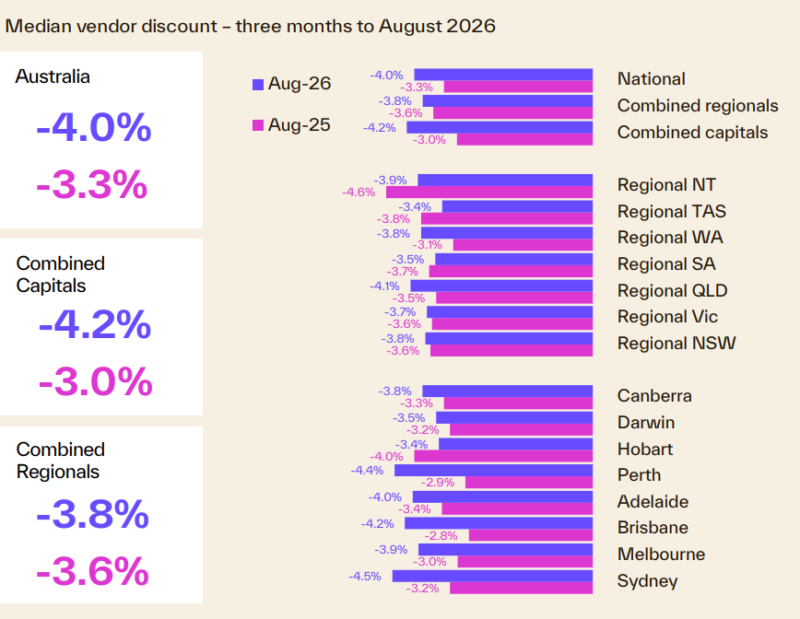

Key takeaways
Property prices continue to soften. Capital city dwelling values fell 1.2% over the past month and are 2.6% lower than a year ago.
Australia's property markets remain fragmented. Sydney and Melbourne are experiencing significant declines, while Perth, Adelaide and Darwin show greater resilience.
Spring auction activity remains subdued. Auction volumes are at their lowest spring levels since 2020, with preliminary clearance rates below 50%.
Rental markets are gradually easing. The national vacancy rate has risen to 2.0%, while gross rental yields have reached 3.85%, their highest level since 2019.
Long-term fundamentals remain important. Despite softer market conditions, the shortage of quality properties in desirable locations continues to support opportunities for strategic investors.
Australia's property markets are continuing to lose momentum, with dwelling values declining and the traditional spring selling season failing to deliver its usual lift in activity.
To help keep you up-to-date with all that's happening, below is my updated weekly analysis of data and charts as of 12th October 2026, provided by SQM Research, Cotality, and realestate.com.au.
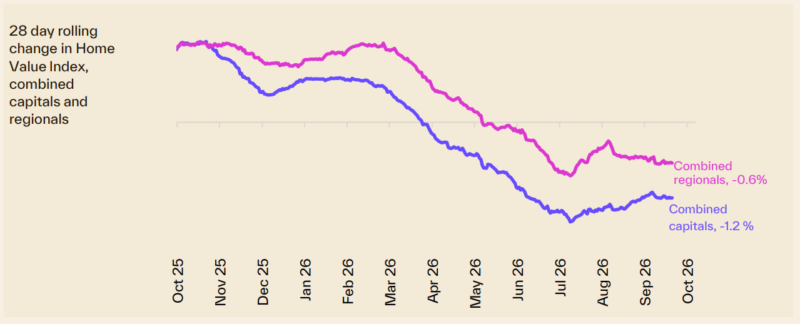
According to Cotality, capital city dwelling values have fallen 1.2% over the past month and are now 2.6% lower than a year ago.
Sydney and Melbourne remain under pressure, while Brisbane continues to record annual growth despite recent price declines.
However, our markets remain fragmented, with Perth, Adelaide and Darwin showing greater resilience and units generally outperforming houses in many locations as affordability constraints reshape demand.
Meanwhile, rental markets are showing signs of easing, with the national vacancy rate rising to 2.0% and rental growth moderating. However, gross rental yields have increased to 3.85%, their highest level since 2019.
In my view, we're moving through another phase of the property cycle, as we always do, but the underlying shortage of quality properties in desirable locations hasn't disappeared.
And while the broader market may remain subdued for some time, these conditions will create opportunities for strategic investors who focus on long-term fundamentals rather than short-term market movements.

On the auction front this week...Spring auction volumes reached their lowest level since 2020
Last week, 1,781 auctions were held, 46.9% higher than the week prior (when volumes were lower due to the long weekend in most states), but 31.2% fewer than a year ago.
For the second consecutive week, the combined capitals preliminary clearance rate held below 50%
See Cotality's full auction report below.
This week, Cotality also reports that:
- Sydney property prices declined -0.3% over the last week, also declined -1.4% over the last month, and are -7.8% lower than they were 12 months ago.
- Melbourne property prices declined -0.2% over the last week, also declined -0.7% over the last month, are -6.7% lower compared to 12 months ago.
- Brisbane property prices declined -0.4% over the last week, declined -1.4% over the last month and are 4.8% higher than they were 12 months ago.
Overall, Australian capital dwelling prices declined -1.2% over the last month and are now -2.6% lower than they were 12 months ago.
Clearly, the property cycle is moving on but our markets are very fragmented.
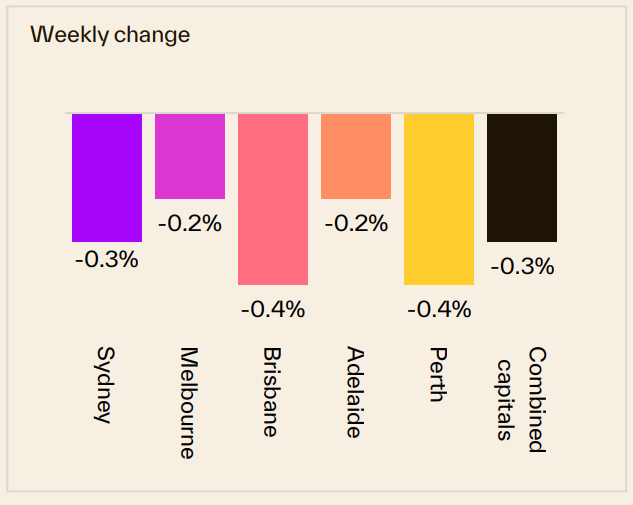
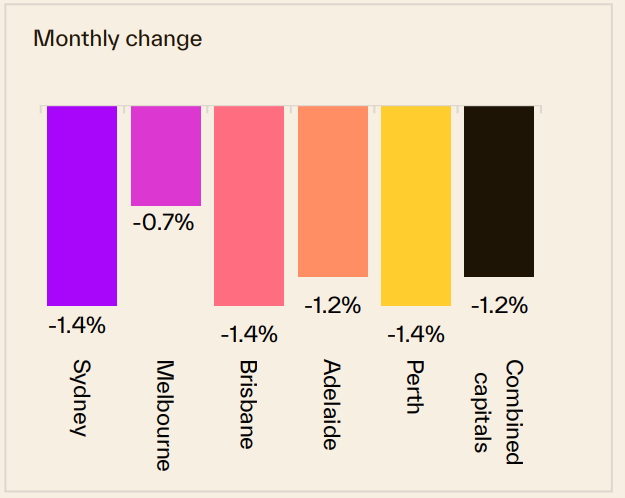
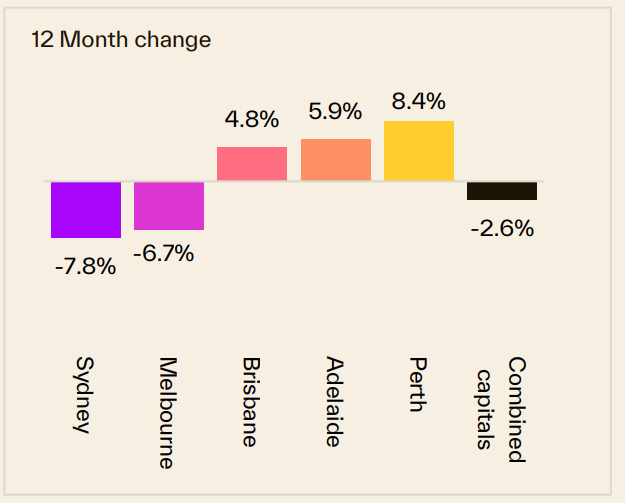
Source: Cotality October 12th 2026
Of course, these are "overall" figures - there is not one Sydney or Melbourne or Brisbane property market.
And various segments of each market are performing differently.
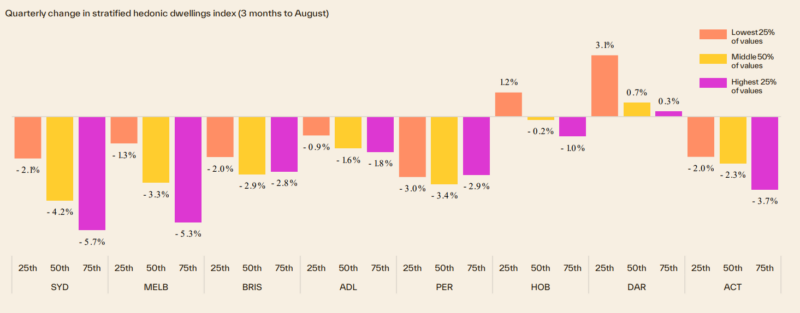
At the start of this cycle, the market's upper quartile led the upswing, but last year the lower quartile across every capital city recorded a stronger housing-value outcome than its upper-quartile counterpart. Now the more expensive properties are suffering the most.
The following chart shows how different segments of each capital city market are performing.
To help keep you up-to-date with all that's happening in property, here is my updated weekly analysis of data and charts as of 12th October 2026, provided by SQM Research, Cotality, and realestate.com.au.
Current property asking prices
Property asking prices are a useful leading indicator for housing markets - giving a good indication of what's ahead.
Here is the latest data available:
Sydney
| Property type | Price ($) | Weekly Change | Monthly Change % | Annual % change |
|---|---|---|---|---|
| All Houses | 2,060.025 | -5.566 | 0.5% | -2.4% |
| All Units | 893.774 | 2.721 | 0.1% | 1.6% |
| Combined | 1,582.867 | -2.161 | 0.4% | -1.6% |
Source: SQM Research
Melbourne
| Property type | Price ($) | Weekly Change | Monthly Change % | Annual % change |
|---|---|---|---|---|
| All Houses | 1,295.550 | 0.890 | -0.6% | -0.2% |
| All Units | 682.509 | 1.822 | 0.6% | 4.4% |
| Combined | 1,102.084 | 1.368 | -0.3% | 0.8% |
Source: SQM Research
Brisbane
| Property type | Price ($) | Weekly Change | Monthly Change % | Annual % change |
|---|---|---|---|---|
| All Houses | 1,333.519 | 2.541 | -1.3% | 2.6% |
| All Units | 819.271 | -7.172 | -1.9% | 4.3% |
| Combined | 1,202.764 | -0.065 | -1.4% | 2.8% |
Source: SQM Research
Perth
| Property type | Price ($) | Weekly Change | Monthly Change % | Annual % change |
|---|---|---|---|---|
| All Houses | 1,242.157 | -1.757 | -0.6% | 6.2% |
| All Units | 765.341 | -1.794 | -1.4% | 12.7% |
| Combined | 1,116.589 | -1.816 | -0.8% | 7.3% |
Source: SQM Research
Adelaide
| Property type | Price ($) | Weekly Change | Monthly Change % | Annual % change |
|---|---|---|---|---|
| All Houses | 1,103.815 | -1.015 | -1.2% | 3.7% |
| All Units | 632.371 | -2.471 | -0.1% | 8.0% |
| Combined | 1,018.581 | -1.337 | -1.1% | 4.1% |
Source: SQM Research
Canberra
| Property type | Price ($) | Weekly Change | Monthly Change % | Annual % change |
|---|---|---|---|---|
| All Houses | 1,227.238 | -1.626 | -0.1% | -2.8% |
| All Units | 603.952 | 0.548 | -0.4% | 3.0% |
| Combined | 988.553 | -1.139 | -0.2% | -2.0% |
Source: SQM Research
Darwin
| Property type | Price ($) | Weekly Change | Monthly Change % | Annual % change |
|---|---|---|---|---|
| All Houses | 860.262 | 15.539 | 0.9% | 10.2% |
| All Units | 510.825 | 2.925 | 5.8% | 15.8% |
| Combined | 722.868 | 10.600 | 2.2% | 11.7% |
Source: SQM Research
Hobart
| Property type | Price ($) | Weekly Change | Monthly Change % | Annual % change |
|---|---|---|---|---|
| All Houses | 933.073 | 7.345 | 1.0% | 7.8% |
| All Units | 517.726 | -5.926 | -2.2% | 5.5% |
| Combined | 869.300 | 5.287 | 0.7% | 7.5% |
Source: SQM Research
National
| Property type | Price ($) | Weekly Change | Monthly Change % | Annual % change |
|---|---|---|---|---|
| All Houses | 1,059.332 | -0.614 | -0.9% | 2.7% |
| All Units | 656.534 | -0.287 | -0.2% | 6.9% |
| Combined | 971.411 | -0.582 | -0.8% | 3.2% |
Source: SQM Research
Cap City Average
| Property type | Price ($) | Weekly Change | Monthly Change % | Annual % change |
|---|---|---|---|---|
| All Houses | 1,512.733 | 0.810 | -0.2% | -0.3% |
| All Units | 792.724 | 0.569 | 0.3% | 3.6% |
| Combined | 1,296.390 | 0.678 | -0.1% | 0.3% |
Source: SQM Research
The value of property asking prices as a leading indicator for housing markets is quite significant.
In fact it's more valuable than median prices which can be quite misleading.
Let's delve into why this is the case and how it impacts the real estate market.
- Early Market Sentiment Indicator: Asking prices often reflect the current sentiment of sellers in the real estate market.
If sellers are confident, they might set higher asking prices, anticipating strong demand.
Conversely, if sellers are uncertain or perceive a market downturn, they might lower their asking prices to attract buyers.
This makes asking prices a real-time indicator of market sentiment, often preceding changes in actual sales prices. - Predictive of Future Price Trends: Trends in asking prices can be predictive of where the actual property prices are headed.
For example, a consistent rise in asking prices over a period can signal an upcoming rise in transaction prices. - Impact of Economic Factors: Economic factors such as interest rates, employment rates, and broader economic health influence asking prices.
For instance, changes in the Reserve Bank of Australia's policies or shifts in the job market can quickly reflect in the asking prices, providing insights into how these factors are influencing the housing market. - Regional Variations: In a diverse market like Australia's, asking prices can also provide insights into regional disparities.
For instance, the property markets in Melbourne and Sydney might behave differently from those in Brisbane or Perth. Asking prices can give early indications of these regional trends. - Influence of Supply and Demand: Asking prices are also a response to the balance of supply and demand in the market.
In areas with limited supply and high demand, asking prices tend to be higher and vice versa.
However, it's important to note that while asking prices are a valuable indicator, they should not be used in isolation.
Other factors like actual sales prices, time on the market, auction clearance rates, and economic conditions also play crucial roles in understanding the property market dynamics.
READ MORE: The latest median property prices in Australia’s major cities
Last weekend's auction report
Spring auction volumes reached their lowest level since 2020
Last week, 1,781 auctions were held, 46.9% higher than the week prior (when volumes were lower due to the long weekend in most states), but 31.2% fewer than a year ago.
Challenging selling conditions have weighed on vendor activity this spring, with auction volumes over the first six weeks of the season 31.2% below the same period last year.
You would have to go back to 2020, when pandemic lockdowns were in full swing, to find a quieter start to the season.
For the second consecutive week, the combined capitals preliminary clearance rate held below 50%.
The result of 48.8% was a slight increase on 48.2% the previous week, and similar to results through mid-to-late June, when the preliminary clearance rate fell as low as 47.4%.
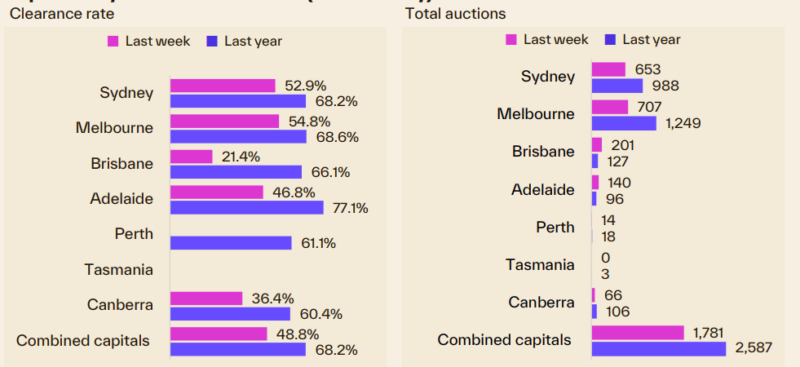
The preliminary clearance rate in Melbourne rose to 54.8% last week, up 4.2 percentage points from 50.6% the previous week.
Melbourne also held more auctions than any other capital city, with 707 homes going to auction.
- Also read:This week’s Australian Property Market Update – Latest Data, State by State October 13th 2026

- Also read:Latest Property Price Forecasts. Australian Property Market Outlook 2026-2027: Navigating a Market Correction

- Also read:Brisbane Property Market Forecast [2026 & Beyond] – What The Olympics Decade Means for Investors.
- Also read:Sydney property market forecast for 2026 and 2027 | Why the short-term softness is a long-term opportunity

- Also read:Melbourne property market forecast for 2026 & 2027 | Separating the fundamentals from the sentiment

This was a 6.2% increase on the previous week, although auction volumes remained 43.4% lower than the same week last year.
Melbourne’s auction volumes are set to fall sharply this week, down approximately 34% on last week, as the first auctions subject to Victoria’s new reserve price disclosure requirements take place.
It's too early to tell whether the new laws are influencing seller behaviour.
The timing suggests some vendors may have brought campaigns forward or delayed auction decisions as the industry adjusts to the new rules.
Following a long weekend that reduced activity the previous week, Sydney’s auction volumes increased by 118% to 653 homes.
Compared to the same period last year, auction volumes across the city declined by 33.9%.
The preliminary clearance rate decreased by 2.8 percentage points to 52.9%, marking the lowest result in ten weeks.
In Brisbane, auction volumes increased substantially, with 201 homes brought to market.
This total was 45.7% higher than the previous week, which included a long weekend, and 58.3% higher than the same week last year.
Only 21.4% of these auctions resulted in a successful sale, reducing Brisbane’s preliminary clearance rate to its lowest level since April 2020, during the initial phase of the COVID-19 pandemic.
Across Adelaide, the preliminary clearance rate rose to 46.8%, from 41.5% the previous week.
Twice as many auctions were held as the week before, 140 compared with 70, and auction volumes were 45.8% higher than a year ago.
Last week, 66 auctions were held across the ACT, 127.6% more than the week prior but 37.7% down on the same week last year.
Of these, 36.4% had reported a successful result at the time of the preliminary count, the second-lowest preliminary clearance rate this year.
This week Cotality is expecting around 1,500 auctions to be held, roughly 15% fewer than last week.
Sydney is the only market where the number of scheduled auctions is higher, up approximately 8%.
Our rental markets
Rental trends have evolved over recent months, with the vacancy rate moving higher, rental growth easing and gross rental yields lifting.
The national vacancy rate reached 2.0% in September, up from a record low of just 1.5% in February 2026.
This is the highest national vacancy rate since January 2025, but still well below the pre-COVID decade average of 3.3%.
Hobart is recording the highest vacancy rate, at 3.0%, followed by Sydney at 2.3%, Brisbane and Perth at 2.1%.
The tightest capital city rental market is Adelaide with a vacancy rate of just 1.4%.
The rise in rental vacancy comes despite a sharp pullback in investment but may be attributable to structural changes in
rental demand, where renters are progressively forming larger households in an effort to combat stretched rental affordability.
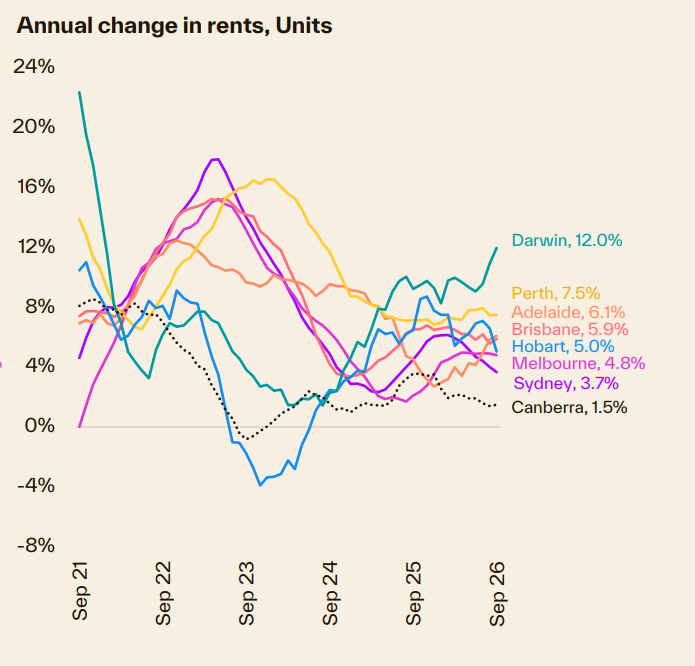
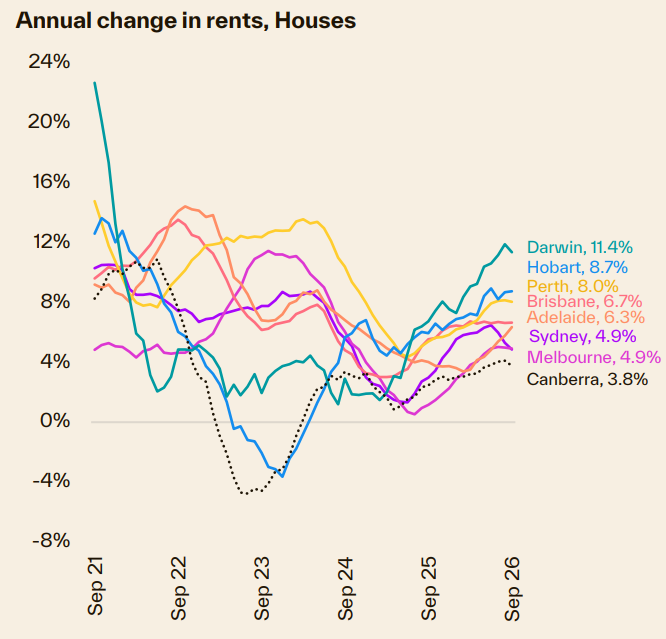
The monthly pace of rental growth eased to 0.3% in seasonally adjusted terms, the smallest monthly rise since May 2025, taking the annual change in national rents to 5.5%.
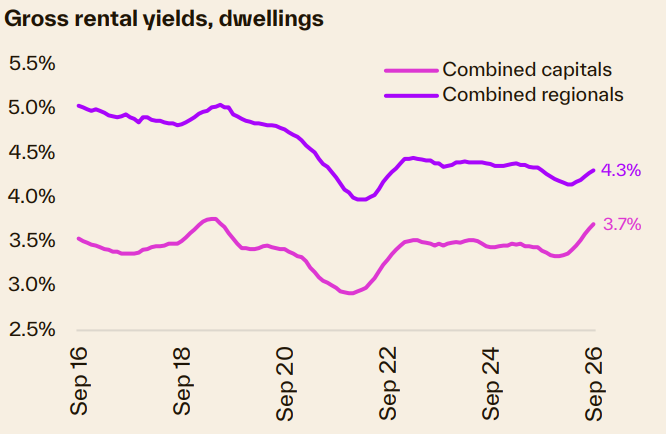
Although rental growth looks to be slowing a little, gross rental yields are continuing to repair, rising to 3.85% nationally, the highest since August 2019.
Across the capitals, gross rental yields range from just 3.4% in Sydney to 6.5% in Darwin.
However, even with yields rising, opportunities for neutral to positive cash flow remain low, given the high holding costs including interest rates but also insurances, maintenance and strata fees.
Gross yields are likely to rise further as rents continue to push higher and housing values trend lowe
Sydney
| Property Type | Rent ($) | Weekly change | Monthly change | 12 Months change |
|---|---|---|---|---|
| All Houses | $1,159.28 | 5.73 | 2.3% | 5.5% |
| All Units | $749.18 | -2.18 | -1.0% | 3.5% |
| Combined | $915.61 | 1.03 | 0.7% | 4.5% |
Source: SQM Research
Melbourne
| Property Type | Rent ($) | Weekly change | Monthly change | 12 Months change |
|---|---|---|---|---|
| All Houses | $826.30 | -2.30 | -0.1% | 7.0% |
| All Units | $594.12 | -1.11 | -1.3% | 4.2% |
| Combined | $691.97 | -1.62 | -0.7% | 5.7% |
Source: SQM Research
Brisbane
| Property Type | Rent ($) | Weekly change | Monthly change | 12 Months change |
|---|---|---|---|---|
| All Houses | $838.83 | -0.84 | -0.2% | 8.1% |
| All Units | $651.74 | 2.26 | 0.3% | 5.9% |
| Combined | $754.49 | 0.56 | 0.0% | 7.2% |
Source: SQM Research
Perth
| Property Type | Rent ($) | Weekly change | Monthly change | 12 Months change |
|---|---|---|---|---|
| All Houses | $888.10 | -2.09 | -0.4% | 6.6% |
| All Units | $664.03 | -1.02 | -0.1% | 1.9% |
| Combined | $795.82 | -1.66 | -0.3% | 5.0% |
Source: SQM Research
Adelaide
| Property Type | Rent $) | Weekly change | Monthly change | 12 Months change |
|---|---|---|---|---|
| All Houses | $697.74 | 3.26 | -0.2% | 3.7% |
| All Units | $548.12 | -0.12 | -1.9% | 6.4% |
| Combined | $647.50 | 2.12 | -0.7% | 4.5% |
Source: SQM Research
Canberra
| Property Type | Rent ($) | Weekly change | Monthly change | 12 Months change |
|---|---|---|---|---|
| All Houses | $801.64 | 3.35 | 1.1% | 4.8% |
| All Units | $593.00 | -5.00 | -1.5% | 5.1% |
| Combined | $686.22 | -1.26 | -0.2% | 4.8% |
Source: SQM Research
Darwin
| Property Type | Rent ($) | Weekly change | Monthly change | 12 Months change |
|---|---|---|---|---|
| All Houses | $847.73 | 24.27 | 2.9% | 14.0% |
| All Units | $667.13 | -2.13 | -1.5% | 13.7% |
| Combined | $735.35 | 8.71 | 0.6% | 13.9% |
Source: SQM Research
Hobart
| Property Type | Rent 9$) | Weekly change | Monthly change | 12 Months change |
|---|---|---|---|---|
| All Houses | $634.59 | 8.41 | 2.5% | 6.7% |
| All Units | $549.28 | 2.72 | -5.4% | 14.6% |
| Combined | $600.69 | 6.15 | -0.5% | 9.5% |
Source: SQM Research
National
| Property Type | Rent ($) | Weekly change | Monthly change | 12 Months change |
|---|---|---|---|---|
| All Houses | $788.00 | 1.00 | 1.6% | 8.4% |
| All Units | $608.00 | -3.00 | -1.6% | 6.3% |
| Combined | $704.76 | -0.85 | 0.3% | 7.6% |
Source: SQM Research
Cap City Average
| Property Type | Rent ($) | Weekly change | Monthly change | 12 Months change |
|---|---|---|---|---|
| All Houses | $932.00 | 1.00 | 0.8% | 6.0% |
| All Units | $673.00 | 0.00 | -1.0% | 3.9% |
| Combined | $794.57 | 0.47 | -0.1% | 5.1% |
Source: SQM Research
Here's how many properties are for sale at the moment
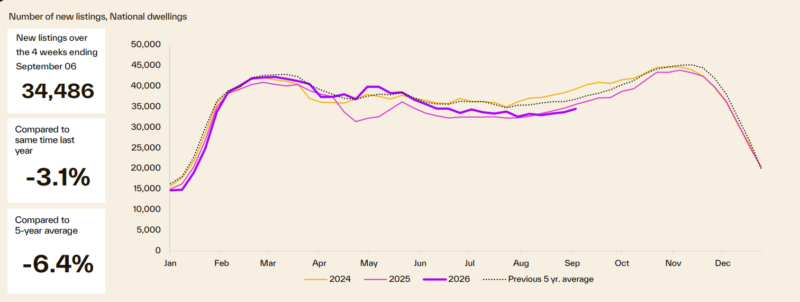
The flow of new listings is 3.1% lower nationally than at the same time last year and 6.4% below the five-year average.
New listing volumes have now fallen below the levels recorded over the past three years, reversing the trend seen earlier in the year, when listing activity was comparatively stronger, close to the five-year average and above year-ago levels.
Vendor metrics
Compared to a year ago, homes are taking slightly longer to sell.
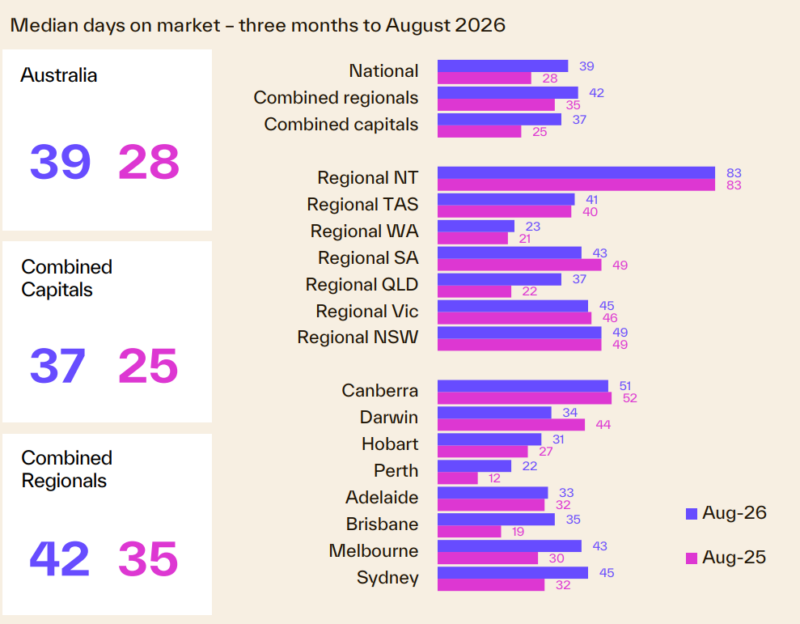
Selling conditions continue to lose momentum, with homes taking a median of 39 days to sell, compared to 28 days a year earlier.
Canberra is experiencing the longest median selling time at 51 days, while Sydney and Melbourne follow at 45 and 43 days, respectively.
Perth is fastest at 22 days, though that is up from 12 days a year ago. Adelaide, Hobart, Darwin and Brisbane range from 31 to 35 days.
The median time on market across regional areas has risen to 42 days, closely approaching the 43-day peak observed in February 2025.