

Key takeaways
Westpac’s latest forecast suggests median house prices could rise by up to $134,000 by the end of 2027.
Five of Australia’s six major capitals are expected to have a median price above $1 million, showing that the market remains resilient even with limited prospects for further rate cuts.
The three RBA rate cuts in 2025 boosted borrowing capacity by around $35,000 for the average buyer, helping fuel 2025’s strong gains.
Even though more cuts are unlikely, momentum continues due to high demand, tight supply, and strong buyer confidence.
Chronic housing undersupply, construction challenges, and high population growth, particularly in Perth and Brisbane, are keeping upward pressure on prices.
With demand far exceeding new supply, these fundamentals are doing more to lift prices than interest rate moves.
As Sally Tindall from Canstar warns, six-figure price rises will make it tougher for first home buyers trying to save a deposit.
But for strategic investors, the message is clear: focus on investment-grade properties in areas with strong demand, limited supply, and enduring owner-occupier appeal — the fundamentals that drive long-term wealth creation.
If you were hoping that house prices might finally take a breather, you’re in for a surprise.
Despite a lower chance of further rate cuts from the Reserve Bank, Australia’s housing market is still expected to rise sharply, with new data from Canstar showing that median house prices could jump by as much as $134,000 by the end of 2027.
It’s yet another reminder that property markets are driven by more than just interest rates.
Even as monetary policy stabilises, underlying demand and a shortage of quality housing continue to push prices higher and the next few years look set to deliver another round of capital growth for property owners.
The numbers tell the story
Canstar’s analysis of Westpac’s latest forecasts paints a clear picture: by late 2027, five of the six major capitals (excluding Darwin and Canberra) are expected to have a median house price above $1 million.
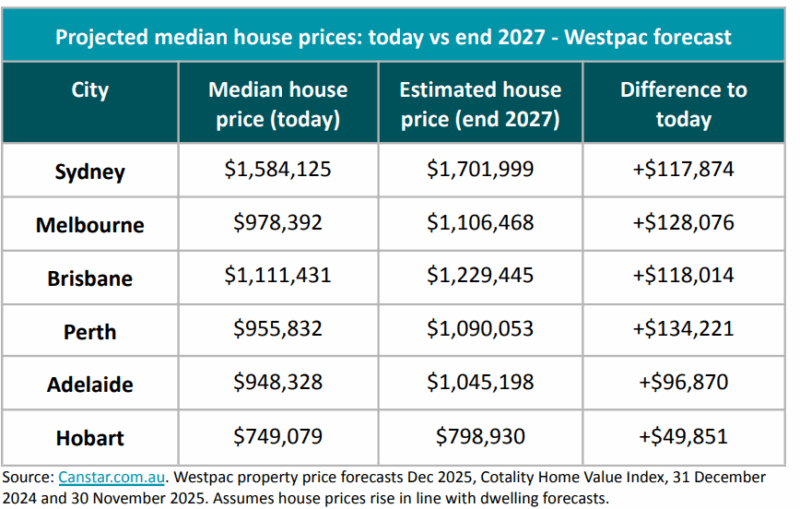
That means someone buying an average house in Perth today could see their property’s value rise by roughly $134,000 over the next two years, even with limited prospects of further rate cuts.
Among all the capitals, Perth and Brisbane are once again the standouts according to Westpac.
Westpac’s economists expect Perth to post a staggering 14% gain in 2025, followed by 8% in 2026 and 6% in 2027, the strongest performance of any capital city.
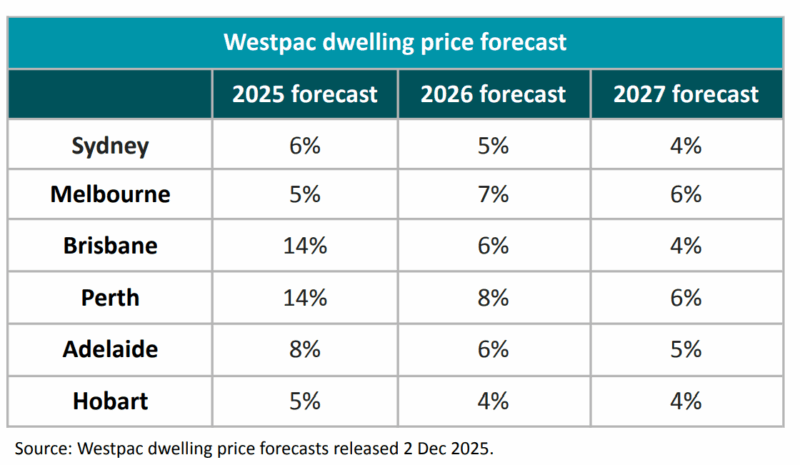
Brisbane isn’t far behind, with 14% growth expected this year and continued gains in the years ahead.
This growth story reflects the broader migration trends we’ve been tracking for years: Australians are increasingly chasing affordability, lifestyle, and job opportunities and that’s showing up in the data.
Canstar’s data insights director Sally Tindall explains:
“Westpac’s economic team might have wound back some of its property price expectations for 2026, but these forecasts still point to another two years of solid gains in markets where demand outstrips supply.”
She adds that while this is welcome news for homeowners and investors, it’s “a tough pill to swallow” for would-be first home buyers:
“A median-priced house in Perth could rise by an estimated $134,000 by the end of 2027.
That’s a tough pill to swallow for anyone trying to save for a home.
Would-be first home buyers in cities like Sydney, Melbourne, Brisbane and Perth could be staring down six-figure price rises in just over two years.”
Why the market’s still rising, even without more rate cuts
It’s tempting to think rising property prices are all about lower interest rates, but this latest data shows that’s only part of the story.
Sure, three RBA rate cuts in 2025 gave the market a boost, lifting borrowing power by around $35,000 for an average single borrower, according to Canstar.
That injection of affordability helped push prices higher this year and reignited confidence among both homebuyers and investors.
But even as the likelihood of more rate cuts diminishes, momentum is being sustained by deeper structural factors:
-
Persistent undersupply: There simply aren’t enough homes being built. Construction costs remain high, developers are cautious, and planning bottlenecks are delaying new projects.
-
Population growth: Net overseas migration remains strong, particularly in Perth, Brisbane, and Melbourne, putting further pressure on limited stock.
-
Investor activity returning: As yields improve and rents climb, more investors are re-entering the market, seeing long-term opportunity despite short-term uncertainty.
- Also read:Migration Is Falling: What Happens to Australian Property Prices Now? | Property Insiders

- Also read:This week’s Australian Property Market Update – Latest Data, State by State September 22nd 2026

- Also read:Latest Property Price Forecasts. Australian Property Market Outlook 2026-2027: Navigating a Market Correction

- Also read:National Weekly Auction Report – September 19th 2026 | Clearance Rates Ease as Auctions Surge

- Also read:Adelaide housing market update | September 2026

- Also read:Migration Is Falling: What Happens to Australian Property Prices Now? | Property Insiders
-
FOMO and scarcity: Many buyers are realising that waiting for the “perfect” time rarely works, with demand so strong, those sitting on the sidelines risk being priced out again.
This combination means the market’s current trajectory is less about cheap credit and more about a fundamental supply-demand imbalance.
What it means for investors
For seasoned investors, these numbers reinforce what we’ve seen time and again, the Australian property market doesn’t follow a straight line, but its long-term trajectory remains unmistakably upward.
Even in periods of higher rates or subdued growth, the market continues to adjust and find new equilibrium points.
The key for investors now is not to chase short-term hotspots but to focus on strategic, investment-grade properties that benefit from:
-
Strong local demand drivers – jobs, infrastructure, education, and lifestyle appeal.
-
Limited future supply – areas where zoning or geography naturally restricts new housing.
-
Owner-occupier appeal – properties that attract emotionally driven buyers who push up prices over time.
-
Affordability within growth markets – regions where the local economy can still support further price appreciation.
These fundamentals , not speculation, are what continue to separate the successful long-term investors from the rest.
The bottom line
Australia’s housing market continues to defy the doomsayers.
Despite talk of affordability pressures, higher living costs, and rate uncertainty, demand continues to outstrip supply in most capitals, and that’s keeping prices marching higher.
For first home buyers, the message is clear: the longer you wait, the harder it may get.
For investors, it’s a reminder that time in the market remains one of the most powerful wealth-building tools available.
As Sally Tindall notes, those trying to break in may need to “buy something smaller, uglier, or further away from the CBD”, but for those already holding quality assets, the coming years could once again reward patience and smart strategy.
Australia’s property market may have its ups and downs, but as history shows, it’s rarely down for long.
In fact, as we step into 2026, the opportunities will be significant – but they won’t be evenly distributed.
Smart property decisions will depend on understanding demographic shifts, supply constraints, changing buyer behaviour, and the structural forces shaping our capital city markets.
With so many mixed messages out there, it’s no wonder investors feel uncertain.
But the good news is that uncertainty creates opportunity for those who act with clarity and a proven strategy.
That’s where a tailored, evidence-based plan becomes invaluable. If you’d like to make 2026 the year you take advantage of these market conditions rather than be overwhelmed by them, now is the ideal time to speak with one of Metropole’s Wealth Strategists.
We can help you build a personalised, forward-looking strategic plan aligned with your goals, risk profile, timeframes, and financial capacity.
If you’re ready to move beyond the noise and put a proven framework around your next steps, click here to organise a complimentary Wealth Discovery Chat and position yourself to make the most of the opportunities ahead.