


Key takeaways
In challenging times, it's crucial to avoid getting caught up in short-term market fluctuations. Property investment is fundamentally about holding onto quality assets over the long haul to allow for capital growth and compounding returns.
Market conditions, media headlines, and opinions can create noise that distracts from sound investment decisions. Focus on reliable data and expert insights, steering clear of alarmist narratives.
A well-chosen, high-performing property is far more valuable than multiple underperforming ones. Investing in locations with strong capital growth potential and properties with unique attributes can offer resilience and growth even in slower markets.
Always keep a financial buffer for unforeseen expenses or interest rate changes. This safety net helps ensure you can hold onto your properties even if cash flow tightens temporarily.
Leverage the expertise of experienced professionals -buyer’s agents, mortgage brokers, and advisors - who can provide insights, help make sound decisions, and manage the complexities of the property market.
Economic and property cycles are natural, so staying committed to a solid, researched investment plan is key. Avoid hasty decisions based on fear or uncertaint
It seems that everyone was an investment genius when the property markets were booming.
But when times get tough it’s important to listen to those who have the perspective of having lived through a number of economic cycles and who take a holistic approach to wealth creation.
And clearly we are now in interesting, and what some would call "challenging" times.
I've been investing in property since the early 1970s, which means I've watched interest rates hit 17%, lived through the recession we had to have, navigated the GFC, locked down during a global pandemic, and held properties through 13 consecutive rate rises.
Right now we're in another period where investors are second-guessing themselves.
Interest rates are rising, inflation is remaining stubbornly high, we have economic and geopolitical challenges facing us, and there's plenty of noise from commentators who can't quite agree on where things are headed.
That's probably why I've been asked by both clients and the media what rules do I apply in times like this when the markets are changing in front of our eyes.
I start by explaining that I intend to remain active in the property investment markets which means I recognise that I will experience several more significant market downturns and several more property booms.
And I’ve learned not to change my strategy every time the economy or our property markets get challenged.
I invest for the long-term and don’t get thrown off by either the good all the bad phases of the property cycle, because I know they are part of the economic cycle and I recognise that while the ups and downs are short-term; the long-term trend for well-located residential real estate is up.
It’s been that way since Federation and is unlikely to change.
And because it’s easy to get caught up in the panic and drama of the moment, I’ve learned to turn down the noise and be careful who I listen to.
In particular, I’ve learned not to listen to the mainstream media, because they are for the "mainstream" - not the small group of Australians who develop financial literacy.
I know that the job of the media is not to educate us but to entertain us and entice us to click on their links with seductive clickbait headlines.
If, like me, you’re also investing for the long term, here are 12 further rules to keep in mind and help you make it through to the other side.
1. Become financially fluent
The foundation of every good investment decision is understanding how money actually works - how compounding builds wealth over time, how debt can be a tool rather than a burden, and how the tax system can work in your favour if you structure things correctly.sc
Learn from proven mentors and get a good team around you, but make sure you have a thorough knowledge base because while you can delegate or outsource many tasks, it’s critical to understand if you’re being given impartial advice or if you’re being taken advantage of by the many vested interests after your money.
Becoming financially fluent means you will invest rather than speculate.
Most investors skip this step, getting excited about property before they've developed the financial literacy to assess whether a deal is actually good for their situation, which is why so many end up buying with their emotions rather than their heads.
2. Adopt a proven investment strategy
Remember 92% of property investors never get past the first or second investment property, so don’t follow the herd; don’t follow the strategy that most property investors follow.
And buying an investment property is NOT a strategy.
While cash flow is important to keep you in the game, it’s capital growth that will get you out of the rat race, so first concentrate on building a substantial asset base over a number of property cycles, then slowly lower your loan to value ratios and eventually you’ll be able to live off your “Cash Machine.”t
It’s too hard to become rich the other way around — from savings or cash flow.
In other words… invest for the long term.
Wealth is created by building a substantial asset base and you achieve this by holding good investments for a reasonably long time, reinvesting your income, and allowing your capital gains to build up.
Of course there's much more to a successful property investment strategy than that.
You see...attaining wealth doesn’t just happen, it’s the result of a well executed plan.
Planning is bringing the future into the present so you can do something about it no
At Metropole our team helps investors by building them a personalised Strategic Property Plan
When you have a Strategic Property Plan you’re more likely to achieve the financial freedom you desire because we’ll help you:
- Define your financial goals;
- See whether your goals are realistic, especially for your timeline;
- Measure your progress towards your goals – whether your property portfolio is working for you, or if you’re working for it;
- Find ways to maximise your wealth creation through property;
- Identify risks you hadn’t thought of.
And the real benefit is you’ll be able to grow your wealth through your property portfolio faster and more safely than the average investor.
Do you have a plan for your financial future?
If so does it contain the following components:
1. An asset accumulation strategy
2. A manufacturing capital growth strategy
3. A rental growth strategy
4. An asset protection and tax minimisation strategy
5. A finance strategy including long-term debt reduction and…
6. A living off your property portfolio strategy
If not please click here and find out how Metropole's Strategic Property Planning service could help you.
3. Understand that not every property is investment grade
While virtually any property can become an investment - just put a tenant in; yet few properties are “investment grade” and will strongly outperform the averages over the long term.
Remember that while the location of your property accounts for around 80% of its performance, it’s also important to own the right property for the local demographic.
4. Be careful who you listen to
Be careful who you listen to for advice.
There are some great independent advisors out there, but the market is flooded with developers, property marketers, inexperienced Buyers Agents and Real Estate agents who don’t really have your best interests at heart.
And don't believe all the hype in the media...
It's too easy to get caught up in panic and drama.
Try switching off the nightly news before the finance segment begins and watch some bad reality television instead.
- Also read:This week’s Australian Property Market Update – Latest Data, State by State May 26th 2026

- Also read:Melbourne property market forecast for 2026 & 2027 | Why the opportunity is bigger than it looks

- Also read:Sydney property market forecast for 2026 and 2027 | Why the short-term softness is a long-term opportunity

- Also read:Latest Property Price Forecasts. Australian Property Market Outlook 2026: Where To Now After The Rate Rise & Budget Changes.

- Also read:Brisbane Property Market Forecast [2026 & Beyond] – What The Olympics Decade Means for Investors.

5. Location does the heavy lifting
Location will do 80 % of the heavy lifting for your property’s performance, and that’s why I only invest in select suburbs of our three major capital cities.
I know there will always be people telling you to invest in regional Australia, but why fight the big trends?
Most jobs, most wages growth, most population growth and most of our economy happens in Australia’s capital cities and in particular in our big 3 capital cities.
We've become a services-based economy. Higher-paying jobs are concentrated in city centres and accessible suburbs.
The people in those jobs have more disposable income, and they're prepared to pay a premium to live in locations that give them lifestyle, convenience, and access to everything they need.

Note: Think about it simply: if money was no object, where would you live?
Most people's answer to that question is what drives long-term price growth in the inner and middle rings.
6. Demographics drive the long-term story
Short-term market movements are driven by interest rates, sentiment, and supply-side factors.
But over the long term, demographics - how many people there are, where they want to live, how they're living, and what they can afford - shape markets more powerfully than any of those things.
Population growth, immigration, household formation rates, and the ageing of the baby boomer cohort are all forces that will continue reshaping property demand over the next two decades.
Investors who understand those trends and position accordingly have a structural advantage over those who are just chasing last year's growth.
7. Real estate investing is a game of finance
Cash flow management is critical to successful property investing.
And today, more than ever, having the right finance strategy is important.
This has little to do with low-interest rates, and much more to do with having the correct finance product and setting aside financial buffers, not just buying a property to buy you time to ride the ups and downs of the property cycle.
8. Markets move in cycles - learn to use that knowledge
In nearly 50 years of watching property markets, the single most consistent pattern I've observed is that markets cycle. They always have.
Good times follow bad times, and bad times follow good times, and the investors who understand this tend to buy when sentiment is weak and hold patiently through the inevitable periods of uncertainty.
The popular belief that property cycles last 7-10 years is too simplistic.
They vary in length depending on interest rates, government policy, global events, and local supply conditions.
Remember that each property boom sets us up for the next downturn, just as each downturn sets the scene for the next upswing.
But it’s important to avoid being thrown off well-thought-out long-term investment strategies by cyclical market swings.
It's very difficult to make sound financial decisions unless you know what you want to achieve. If you don't have a plan, you tend to default to what other people are doing or what the media is telling you.
That's why I recommend you allow our team at Metropole to build a Strategic Property Plan for you and your family.
Planning is bringing the future into the present so you can do something about it now! This will give you direction, results, and more certainty. Click here to learn more
Knowing where you are in the cycle won't let you time your purchases perfectly, but it will help you stay calm when headlines are alarming and stay disciplined when everyone around you is getting greedy.
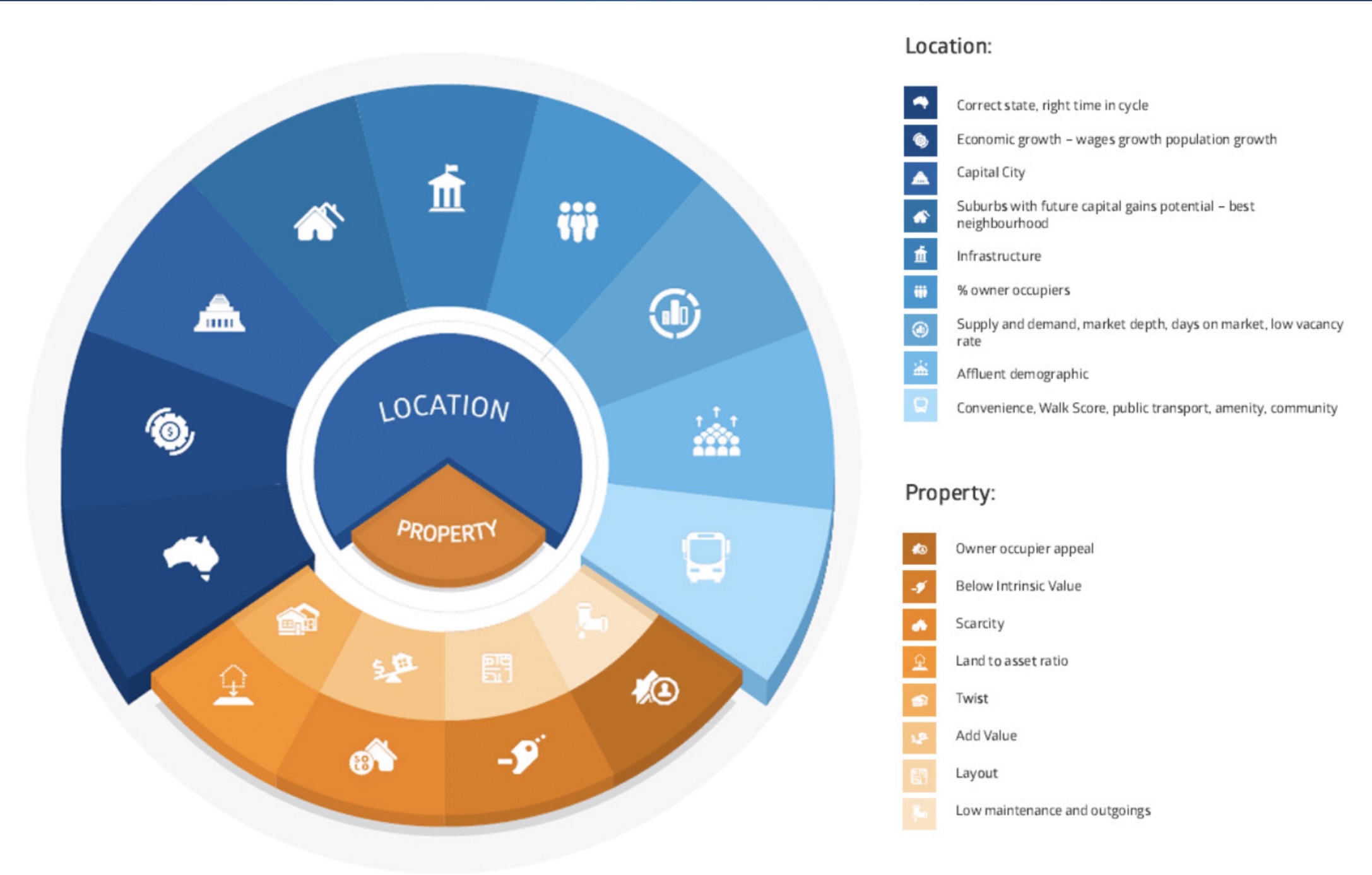
9. Follow my 6 Stranded Strategic Approach and only buy a property:
- That would appeal to owner-occupiers. Not that I suggest you sell the property, but because owner-occupiers will buy similar properties pushing up local real estate values. This will be particularly important as the cycle moves on, as the percentage of investors in the market is likely to diminish.
- Below intrinsic value — that’s why I’d avoid new and off-the-plan properties which come at a premium price.
- With a high land to asset ratio — this doesn’t necessarily mean a large block of land, but a property where the land component makes up a significant part of the asset value.
- In an area that has a long history of strong capital growth and that will continue to outperform the averages because of the demographics in the area. These suburbs tend to be areas where more owner-occupiers want to live because of lifestyle choices and where the locals can afford to and will be prepared to pay a premium to live because they have higher disposable incomes.
- With a twist — something unique, different or scarce about the property, and finally;
- Where you can manufacture capital growth through renovations or redevelopment rather than waiting for the market to do the heavy lifting
10. Stop chasing bargains
In today's market, a bargain-priced property almost always reflects something that buyers have collectively decided to discount.
And if the market doesn't want it today, there's a reasonable chance the market won't want it in ten years either.
The real money in property is made by buying the right property, not by buying cheaply.
Saving $15,000 off the purchase price is a one-off benefit. Buying a property with above-average capital growth potential generates compounding returns over every year you hold it.
Buy the best property you can afford to hold for the long term.
That framing tends to cut through a lot of noise about short-term pricing.
11. Leave room for the unexpected
Every year brings something that nobody predicted - whether that's a war on the other side of the world, a global pandemic, a rapid series of interest rate movements, a geopolitical shock, or a policy change that reshapes investor behaviour overnight.
Planning as if the future will unfold smoothly is a mistake.
Building buffers into your strategy - financial buffers, time buffers, and psychological resilience - is what separates investors who weather disruptions from those who are forced to make decisions at the worst possible time.
12. Recognise the current window of opportunity
I see the current market offering a window of opportunity for property investors with a long-term focus.
There's no doubt that there will be many headwinds for our housing markets as the cycle moves on. However, the underlying fundamentals are still strong.
The shortage of housing is real. Construction costs remain high, and will only get higher. Skilled labour is scarce, and population growth continues to outpace new supply. Those factors will underpin strong demand in well-located markets for years ahead.
I've never been a market-timer, and I'm not suggesting you try to be one either.
But when the fundamentals are this clear and quality properties in the right locations are still available at reasonable prices, the case for acting thoughtfully and decisively is strong.
The investors who built significant wealth in previous cycles weren't the ones who waited for certainty. They were the ones who understood the fundamentals well enough to move when others were still waiting to see what would happen next