Key takeaways
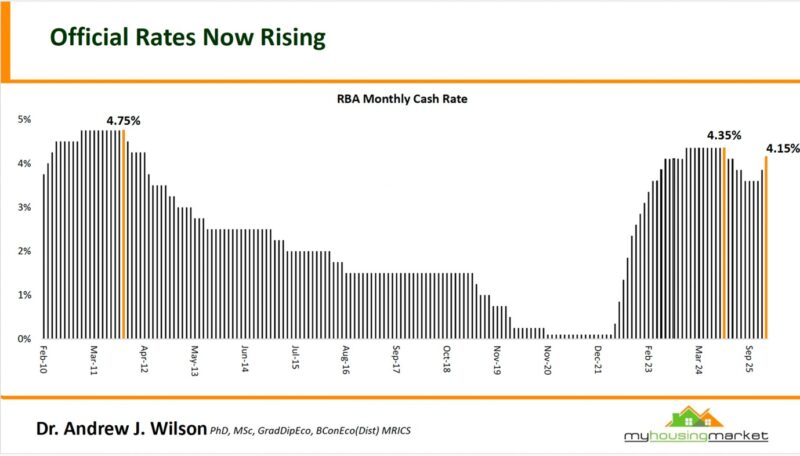
Rates are rising again due to stubborn inflation. The RBA lifted the cash rate to 4.15% as inflation pressures, especially fuel costs, remain persistent.
A strong labour market is cushioning the impact. Low unemployment and record workforce participation are keeping the economy resilient despite higher rates.
Property markets are softening but not collapsing. Auction clearance rates have dipped slightly, reflecting reduced confidence, not a fundamental downturn.
Interest rate cycles are normal and temporary. Smart investors understand rates move in cycles and plan for volatility rather than react emotionally.
Underlying property fundamentals remain solid. Strong population growth, housing shortages, and employment stability continue to support long-term property values.
Interest rates are back on the move… and if you’re a property investor, this changes the conversation again.
Just when many were expecting a more stable rate environment in 2026, the Reserve Bank delivered another increase, taking the cash rate up to 4.15% and signalling that inflation remains stubbornly persistent.
But here’s the twist… despite higher rates, Australia’s labour market remains remarkably resilient, and that’s creating a very different dynamic for our housing markets than many expected.
So what does all this mean for property prices, buyer confidence, and the market's next move?
In this week’s Property Insider Dr. Andrew Wilson and I unpack the real story behind the latest rate rise, what’s happening with jobs and wages, and how auction markets are responding on the ground.

The RBA raises rates again and here's why
Watch this week's Property Insider video as Dr. Andrew Wilson suggests that the RBA's decision to raise rates in March wasn't a surprise to anyone paying attention.
Inflation, which had fallen sharply from its 2022 peak, picked back up materially in the second half of 2025.
And the situation has been compounded by the conflict in the Middle East, which has driven fuel prices sharply higher - a development that, if sustained, will flow through to almost everything Australians buy.
The RBA board was blunt about it - there is now a material risk that inflation will remain above its 2–3% target band for longer than previously anticipated, and it's not prepared to stand by and let that happen.
What's given the Bank the confidence to act is the extraordinary strength of the labour market.
When unemployment is low and the economy is generating jobs, the RBA has room to tighten without triggering widespread economic pain. And right now, that's exactly the situation it's in.
The cash rate chart above tells an interesting story.
We went from near-zero during the pandemic, then through the aggressive tightening cycle that peaked at 4.35%, then down through the 2025 cuts, and now we're heading back up again.
It's a reminder that rates are always cyclical, and that smart investors plan for that reality rather than being surprised by it. Current interest rates are still below where they were this time last year.
Employment growth strong, but unemployment rises to 4.3%
Watch this week’s Property Insider chat as Dr Wilson explains that despite all the rate rise anxiety, Australia's jobs market is in genuinely good shape.
The unemployment rate rose in February to 4.3% despite strong employment growth, up 49,000.
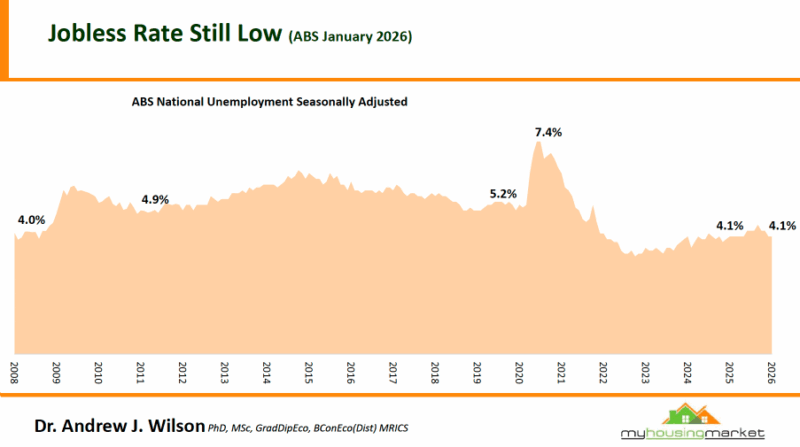
To put that in context, we were sitting at 7.4% unemployment during the depths of COVID in 2020. Clearly, the picture we have today is completely different.
While new jobs grew by another 49,000 in February, though it's worth noting that the number of unemployed also rose by 35,000 over the month - a signal that more people are entering the workforce and looking for work, which explains the uptick in the jobless rate despite solid job creation.
- Also read:Latest Property Price Forecasts Revealed. Australian Property Market Outlook 2026: Where To Now After The Rate Rise.

- Also read:March Home Prices Still Rising | Latest stats from Dr. Andrew Wilson

- Also read:National Weekly Auction Report – March 28th 2026 | Auction Clearance Rates Still Fading Over Super Week of Listings

- Also read:RBA raises interest rates again. Here’s what this means for property. | Property Insiders

- Also read:This week’s Australian Property Market Update – Latest Data, State by State March 24th 2026

What's particularly notable is the participation rate, which has risen to a record high of 66.9%.
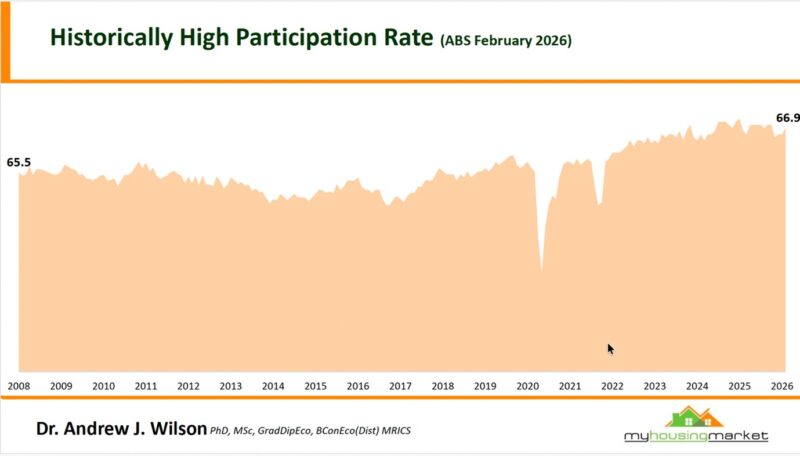
This means more Australians are in or actively seeking work than at any point in recorded history - a remarkable achievement that reflects genuine confidence in the economy.
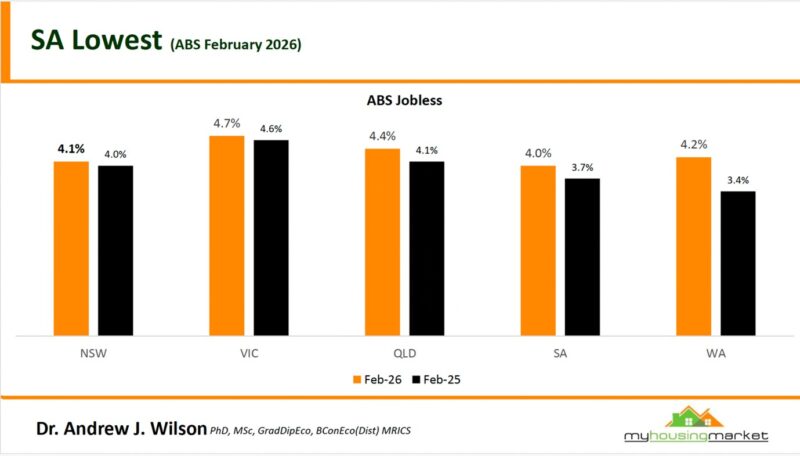
Looking across the states, South Australia recorded the lowest unemployment rate at 4.0%, while Victoria came in at 4.7% - slightly above the national average, but still a far cry from the doom and gloom commentary you sometimes see about Melbourne's economy.
The bottom line is that a strong labour market is the bedrock of a healthy property market.
People with secure jobs buy homes, pay their mortgages, and create demand. That fundamental dynamic hasn't changed.
Auction markets down again following the latest RBA rate increase
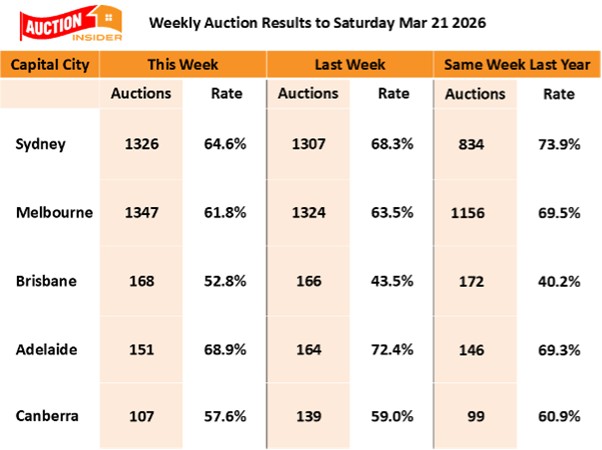
Watch this week's Property Insider chat as Dr.. Andrew Wilson explains that capital city auction clearance rates were lower again over the past week following the decision by the RBA to raise interest rates in March.
The national weekend auction market reported an average clearance rate of 61.1% over the past week, lower than the 61.3% reported the previous week and now also below the 62.9% reported for the same week last year.
Auction listings will continue to rise over the coming weeks, leading to the Easter break, with market confidence tested by this year’s official interest rate increases.
What this all means for property investors
Here's the thing I keep coming back to: rate cycles are temporary. They always have been, and this one will be no different.
Yes, two rate rises in two months is uncomfortable for borrowers. Yes, auction clearance rates are softer than they were six months ago.
And yes, the uncertainty around fuel prices and Middle East conflict adds another layer of complexity that nobody asked for.
But when I zoom out and look at the bigger picture—a near-record-low unemployment rate, historically high workforce participation, ongoing structural housing undersupply in our major capitals, and population growth that isn't slowing down anytime soon - the fundamentals for quality property investment remain sound.
In my experience, the investors who do best over the long run are not the ones who time the market perfectly.
They're the ones who stay in the market, hold quality assets in the right locations, and don't panic when conditions get temporarily uncomfortable.
If anything, a period of softer sentiment creates a window for serious buyers to acquire investment-grade properties with less competition at the auction than they'd face in a hot market.
That's not spin - that's just how property cycles work. The noise is loud right now. But the signal hasn't changed.