

Key takeaways
Baby boomers are holding onto their homes longer. This is reducing the normal turnover of established housing.
Downsizing is harder than it should be. High transaction costs (stamp duty) and a lack of suitable local housing are major barriers.
More boomer-owned homes will enter the market over time. The biggest impact is likely to occur through the 2030s and 2040s.
The effect will vary by location. Strong city markets may see redevelopment, while some ageing regional areas could face weaker demand.
The wealth transfer will widen inequality. Families that already own property are likely to gain the greatest advantage.
Australia’s housing shortage is usually blamed on population growth, sluggish construction, planning delays, labour shortages and the rising cost of building new homes.
All of these factors matter, but another powerful force is sitting quietly in the background.
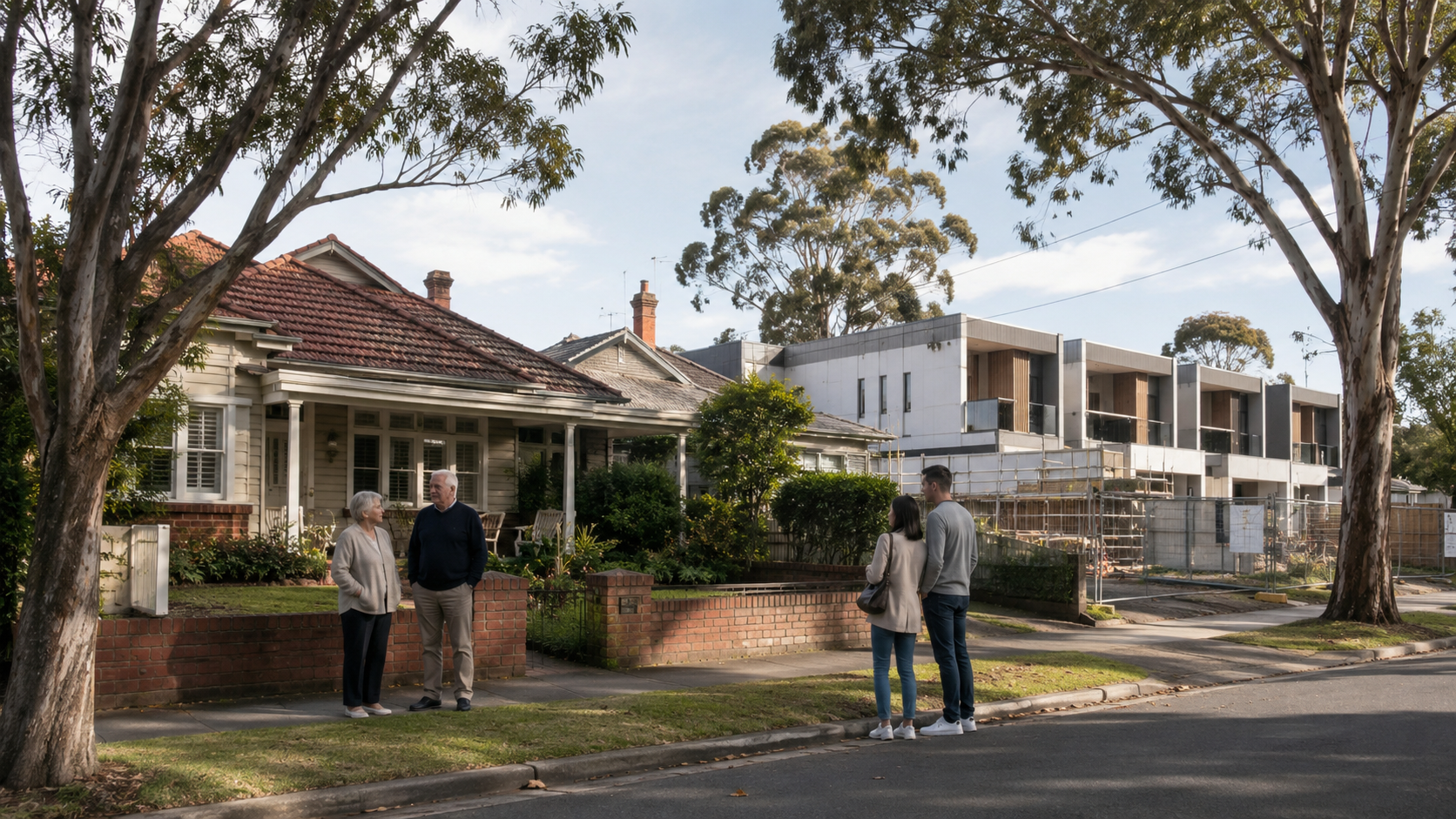
Australia has around 4.5 million baby boomers, aged between 62 and 80, and many remain in the family homes they bought decades ago. These are often large houses on substantial blocks in established suburbs that were once considered the outskirts of our cities.
Today, those suburbs are well connected, highly desirable and increasingly valuable, yet the homes within them are turning over much more slowly than they did for previous generations.
This has created something of a demographic traffic jam. Properties that might once have returned to the market through downsizing or deceased estates remain tightly held at a time when Australia urgently needs more housing.
According to analysis highlighted by demographer Bernard Salt, there may be around 1.3 million more homes occupied by older Australians today than would have been the case if they behaved like equivalent retiree cohorts in 2008.
That is roughly the same number of homes the federal government hoped to build under its national housing target.
In other words, our housing challenge is not only about how many dwellings we construct - it is also about how efficiently we use the homes we already have, how long people remain in them and what happens when Australia’s largest generation eventually begins releasing those properties back into the market.

For weekly insights, subscribe to the Demographics Decoded podcast, where we will continue to explore these trends and their implications in greater detail.
Subscribe now on your favourite Podcast player:
The generation that reshaped Australia
Baby boomers have influenced almost every stage of Australia’s development.
As children, their numbers required more kindergartens and schools.
As young adults, they created demand for universities, jobs, roads and new suburbs.
When they formed families, our cities expanded to accommodate them.
Their demographic impact has often been compared to pushing a tennis ball through a garden hose. Wherever this unusually large generation moved, institutions, infrastructure and markets had to adjust.
And housing was no exception.
When many baby boomers bought their first homes, land on the urban fringe was relatively inexpensive.
They just drove a little farther from the city, purchased a quarter-acre block and built a modest family home.
Then the next family travelled slightly farther and did the same.
Over time, the city expanded around those properties. Suburbs that were once peripheral became part of the middle ring and, in some cases, are now relatively close to the city.
As Simon Kuestenmacher explains, many boomers purchased cheap land without anticipating how valuable it would become.
“They didn’t expect this thing to be worth that much money, but it did,” he says.
While the houses themselves may now be dated, the land beneath them has become enormously valuable.
A basic dwelling built 40 or 50 years ago may lack the open-plan living, extra bathrooms and home offices buyers now expect, but its location and block size can make it a substantial asset.

Note: This combination of timing, land ownership and long-term capital growth created an extraordinary store of wealth for one generation.
Now, as baby boomers move through their seventies and eighties, that housing stock will gradually begin changing hands.
Why Boomers are staying put
It is tempting to suggest older Australians are selfishly occupying homes that younger families need, but that explanation is unfair and far too simplistic.
Most baby boomers are behaving rationally.
Their family home may be close to friends, children, grandchildren, doctors, shops and community groups. They have spent decades building their lives in these neighbourhoods, so leaving the property can mean leaving much more than an oversized house.
There are significant financial barriers as well. Stamp duty, moving expenses, selling costs and concerns about pension entitlements can make downsizing expensive and complicated.
Then there is the shortage of suitable alternatives.
Many older Australians would consider moving to a well-designed, low-maintenance home in the same neighbourhood. They may want two or three bedrooms, single-level living, accessible bathrooms, good security and enough space for children or grandchildren to stay.
Unfortunately, this type of accommodation remains scarce in many established suburbs.
We have built high-rise apartments near major centres and detached homes on distant urban fringes, but far too little of the housing that sits between these extremes. Duplexes, terraces, townhouses and villa units remain the missing middle of Australian housing.
Simon argues that we have almost made downsizing deliberately difficult.
Note: Older homeowners may be willing to move, but they do not necessarily want to relocate ten or twenty kilometres away and rebuild their social network.
In many cases, they want a suitable property within a kilometre or two of their current home, and that option simply does not exist.
There is some irony here - many established communities resisted medium-density development for years because they feared it would change the character of their neighbourhoods.
Now those same neighbourhoods lack the smaller, accessible dwellings their ageing residents need.
No one should be forced from their home
This discussion must not become an argument for pushing older Australians out of properties they legally own.
As Simon puts it..
“You buy a thing, it’s yours. That’s the end of it.”
People should remain free to live in their homes for as long as they choose. The policy question is how governments can remove the barriers that discourage those who already want to move.
One possibility would be a stamp duty concession for older homeowners purchasing their final home, similar to the concessions offered to first-home buyers.
Reducing transaction costs would allow more people to relocate without losing a substantial portion of their savings.
A broader reform would involve gradually replacing stamp duty with a fairer land tax system.
Stamp duty discourages transactions and makes it costly for households to move into homes better suited to their circumstances. It penalises people for changing jobs, forming families, downsizing or relocating closer to support services.
Any reform would need to occur slowly and with existing arrangements protected, but the current system clearly works against more efficient use of Australia’s housing stock.
Planning reform is equally important.
Note: Governments should encourage age-appropriate, medium-density housing in established suburbs close to transport, shops and health services.
This would give older households genuine choices while gradually allowing larger homes to pass to younger families.
The aim should be to create attractive alternatives rather than pressure people to move.
The great release of housing stock
The present situation will not last forever.
Baby boomers are living longer and remaining healthier than previous generations, but every property will eventually change hands.
Some owners will downsize, some will move into aged care, some homes will be inherited, and others will be sold through deceased estates.
- Also read:This week’s Australian Property Market Update – Latest Data, State by State September 22nd 2026

- Also read:Latest Property Price Forecasts. Australian Property Market Outlook 2026-2027: Navigating a Market Correction

- Also read:Brisbane Property Market Forecast [2026 & Beyond] – What The Olympics Decade Means for Investors.
- Also read:Sydney property market forecast for 2026 and 2027 | Why the short-term softness is a long-term opportunity
- Also read:Melbourne property market forecast for 2026 & 2027 | Separating the fundamentals from the sentiment
Simon describes this as the first major demographic event in almost a century that could place downward pressure on property prices rather than continually pushing them higher.
“Death releases property,” he says, acknowledging that this may sound uncomfortably clinical.
From a housing-market perspective, however, the passing of such a large generation will release more established homes than usual.
This process will gather momentum through the 2030s and 2040s, with peak deaths among baby boomer women expected around 2041.
Women are particularly important to this calculation because they tend to outlive their partners and are often the final occupants of the family home.
Even so, Australians should not expect a sudden flood of properties to hit the market.
This transition will unfold over decades rather than months. Homes will be released gradually, and the effect will vary according to location, land size, dwelling quality and local demand.
In expensive inner and middle suburbs, many older homes will remain beyond the reach of average first-home buyers. Some will be purchased by established families with substantial equity, while others will appeal to developers.
A dated house on a large block may be demolished and replaced with two or three townhouses. A property previously occupied by one or two older people could eventually accommodate several households.
Over time, this may become one of the most practical ways Australia increases the population capacity of its established suburbs.
A demographic game of musical chairs
The release of baby boomer homes will also redistribute people across our cities.
The buyers of these properties may not be today’s twenty-year-olds.
Many will be millennials who are now entering their forties and will be in their fifties or sixties when the turnover accelerates. Having built equity in homes farther from the city, they may use that wealth to move closer to established centres.
Generation Z households may then move into the outer-suburban homes millennials leave behind.
Simon describes the coming shift as a large-scale game of musical chairs, with households moving through different parts of the housing system as properties become available.
The effects will not be evenly distributed -regional areas with older populations may experience a much larger increase in available homes relative to local demand. Parts of rural Tasmania and other ageing communities, for example, could see substantial numbers of properties released without enough younger residents willing to buy them.
Prices in these locations may come under pressure.
The large capital cities face a different situation. They may not have the highest proportion of baby boomers, but the homes involved are often located on valuable land in tightly held suburbs.
Note: As a result, the greatest impact may be redevelopment rather than a widespread collapse in values.
A large block in a sought-after Melbourne suburb near transport, employment and amenities will behave very differently from a property in a shrinking regional town with limited economic opportunities.
The wealth transfer will widen the divide
The transition will involve more than housing supply - it will also produce the largest intergenerational transfer of wealth Australia has experienced.
Trillions of dollars in property, superannuation, shares and other assets are expected to pass from baby boomers to their children over the coming decades.
However, this wealth will not be shared evenly.
Many baby boomers own valuable homes and have already helped their children through the Bank of Mum and Dad. Their children are more likely to own property themselves and will eventually inherit additional wealth.
Other boomers never purchased a home, meaning they have no property to transfer. Their children are more likely to remain outside the housing market and receive little or no inheritance.
Simon warns this will deepen the divide between asset owners and non-asset owners.
“It’s the millennials who own homes that actually inherit homes and inherit property wealth,” he explains.
This creates a compounding advantage for families that already possess assets and a growing disadvantage for those who do not.
It also reinforces an uncomfortable financial reality. Home ownership remains one of the strongest protections against poverty in retirement because a household that owns its home outright has far lower ongoing housing costs than a renter.
For younger Australians, the objective does not necessarily need to be purchasing the perfect family home immediately. It may involve buying an affordable first property, investing strategically, building equity and improving their position over time.

Tip: The important step is gaining exposure to productive assets rather than waiting indefinitely for conditions to become easier.
Will Boomergeddon solve the housing shortage?
The eventual release of millions of baby boomer properties will improve the supply of established housing, but it will not solve Australia’s shortage by itself.
Population growth will continue, household sizes may decline further, and new migrants will add demand for housing in major employment centres.
Developers will also adjust their activity as more established properties become available. If the resale market becomes more competitive, fewer new homes may be built, allowing supply and demand to move back toward equilibrium.
Note: Australia is therefore unlikely to find itself with a large, permanent oversupply created solely by demographic change.
More likely, the silver surge will reshape the type, location and ownership of housing while easing some pressure in particular markets.
It may also accelerate the transformation of middle-ring suburbs. Large blocks containing dated detached homes will increasingly be redeveloped into townhouses, terraces and smaller apartment projects.
This will allow more people to live near established infrastructure while creating the low-maintenance homes older Australians already want.
Handled properly, this could improve housing choice across several generations.
What this means for property investors
For strategic property investors, the coming transition reinforces the importance of following long-term demographic trends rather than reacting to short-term headlines.
Demand will remain strong for well-located, low-maintenance homes that appeal to downsizers, professional couples and smaller households.
Established suburbs with ageing populations, large blocks and limited housing supply may also offer redevelopment opportunities as older properties gradually change hands.
However, investors should not assume every region with a large baby boomer population will benefit.
Some older regional markets may eventually have more sellers than buyers, particularly where younger people continue moving away and local economies are weak. Cheap property alone will not compensate for limited demand.
Location, employment growth, infrastructure, household incomes, scarcity and owner-occupier appeal will remain critical.
Tip: The strongest opportunities are likely to occur where several trends overlap: older homeowners are releasing underutilised land, younger households want to move into the area, planning rules support sensible density and the local economy remains strong.
These are the markets where one ageing household can eventually make room for several new families without sacrificing the amenity that made the suburb desirable in the first place.
The next chapter of Australia’s housing story
The baby boomers have shaped Australia throughout every stage of their lives, and their final demographic influence may be just as significant.
Their retirement will affect the workforce. Their longevity will increase demand for health and aged-care services. Their eventual passing will release homes, unlock land, transfer enormous wealth and reshape communities.
Australia has time to prepare.
We can build better downsizing options, reform inefficient taxes, allow thoughtful medium-density development and ensure established suburbs evolve in ways that preserve their character while accommodating more people.
We should also recognise that the housing shortage is about more than construction targets. It involves the way existing homes are distributed, the financial barriers that discourage people from moving and the changing needs of Australians throughout their lives.
The coming silver surge will create challenges, particularly around inequality and regional demand, but it will also give Australia an opportunity to use its housing stock more intelligently.
Demographics does not determine the future on its own, but it provides a clear view of the forces shaping it.
Investors, policymakers and homeowners who understand those changes early will be better placed to make informed decisions and take advantage of the opportunities that emerge as Australia’s largest generation moves through the next stage of its demographic journey.