


Key takeaways
National house prices are falling, but the downturn remains uneven. Sydney and Melbourne are weaker, while Perth, Darwin, Adelaide and Brisbane remain higher than a year ago.
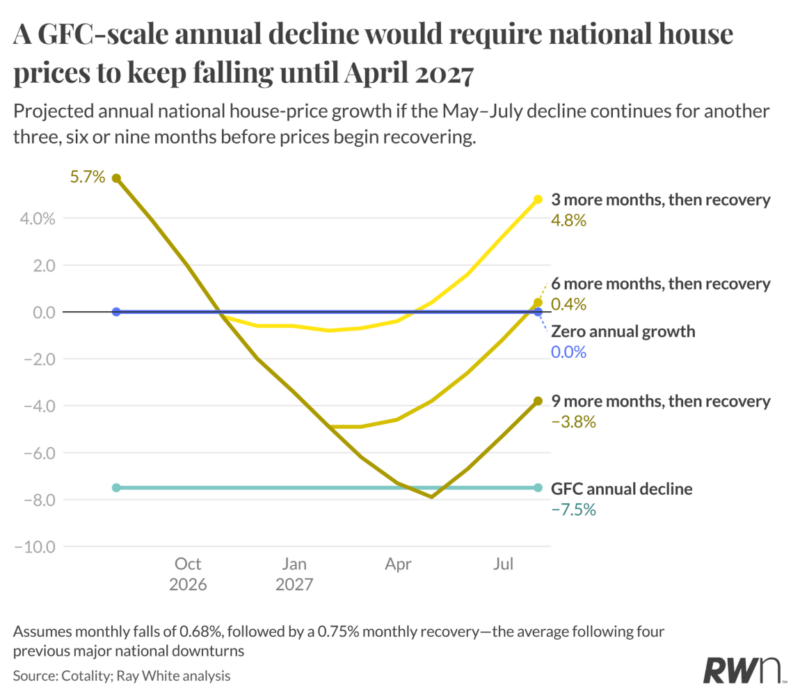
To get to the level of a GFC-sized downturn would require many more months of falling prices. Nerida Conisbee’s analysis suggests current declines would need to continue until around April 2027.
Low activity is driving much of the weakness. Buyers are cautious, but widespread distressed selling has yet to emerge.
Improving rental yields and high replacement costs should support established property values. Both factors could eventually encourage investors back into the market.
Australia’s housing shortage remains a powerful long-term support. For strategic investors, softer markets may create opportunities to buy quality properties at better prices.
Australia’s housing market has clearly entered a downturn, and prices are likely to fall further in some markets.
Higher interest rates have reduced borrowing capacity, confidence has weakened and the Federal Budget has changed the investment equation for established residential property.
Sydney and Melbourne are already recording meaningful declines, transaction volumes have fallen sharply and buyers are becoming more cautious.
However, there is a big difference between a housing correction and a housing crash.
When you look at interest rates, investor yields, construction costs and Australia’s chronic housing shortage, there are good reasons to believe this downturn will ultimately be relatively contained.

The downturn is real, but uneven
The latest Cotality Home Value Index shows national house values fell 0.8% in July and 2.0% over the three months to July, although they remain 5.7% higher than a year ago.
Sydney and Melbourne house prices are down 3.4% over the past year, while Canberra is down 0.5%. Yet Perth remains 10.2% higher, Darwin 13.1%, Adelaide 6.4% and Brisbane 6.3%.
Clearly, this shows what I've always been saying- there is no single Australian property market. Some cities are correcting as affordability and borrowing constraints bite, while others continue to benefit from population growth, relative affordability and limited supply.
Ray White Chief Economist Nerida Conisbee recently examined how long the current downturn would need to continue before it became significantly more serious.
Since May, national house prices have been falling at an average rate of around 0.68% a month. Conisbee estimates that if this continued for another three months before prices began recovering, annual growth would briefly turn negative and bottom at around 0.8% below the previous year.
If the weakness continued for another six months, the annual fall could reach around 4.9%.
Taking a step further, it would take roughly another nine months of declines, through to April 2027, for the annual fall to approach 7.9% and become comparable with the Global Financial Crisis.
As Conisbee points out, this is not a forecast. It simply shows how prolonged the downturn would need to become before we saw falls of that scale.
Source: Ray White
This is largely a confidence downturn
One of the most important features of the current cycle is that buyers have stepped back rather than sellers being forced out.
Ray White’s open-home attendance has fallen to just 2.2 people per property, while Cotality estimates sales volumes across the combined capital cities are almost 30% lower than a year ago.

Note: That suggests a market with very little activity rather than widespread distressed selling.
Conisbee describes the adjustment as the first of three phases, with uncertainty around interest rates and the Budget keeping buyers on the sidelines.
The second phase should begin when another rate rise becomes increasingly unlikely, because the market may only need greater certainty about the peak to bring some buyers back.
The third phase will begin when the Reserve Bank eventually starts cutting rates, although some markets are likely to recover before the first cut actually arrives.
Of course, the recent uptick in inflation has led many commentators to suggest there could be another rate rise in the next couple of months.
- Also read:Melbourne housing market update | October 2026

- Also read:National Vacancy Rate Rises to 1.4% | SQM Research

- Also read:Australian housing market update | October 2026

- Also read:This week’s Australian Property Market Update – Latest Data, State by State October 13th 2026

- Also read:Latest Property Price Forecasts. Australian Property Market Outlook 2026-2027: Navigating a Market Correction

Investor yields will adjust
The Budget has also changed the economics of property investment, particularly after removing negative gearing benefits for established homes.
Investor lending fell quickly after the changes because, without the same tax treatment, investors require stronger rental yields to make the numbers work.
That adjustment can happen through lower prices, higher rents or a combination of both.
We are already seeing this process in Sydney and Melbourne as softer prices and higher rents gradually improve yields.
Over time, established property will begin to look more attractive again, particularly in a market where population growth remains strong and rental supply is constrained.
Replacement costs will support values
Another factor likely to limit the depth of the downturn is the rising cost of building new homes. Construction costs are now around 51% higher than they were at the end of 2019 and have risen another 5.9% over the past year.
Established property prices can fall while construction costs rise, but that gap can't widen indefinitely. If existing homes become materially cheaper than replacing them, new projects become increasingly difficult to justify, and buyers are redirected towards established housing.
That dynamic is already affecting construction. Private new-house completions fell 0.6% in the March quarter, while commencements fell 3.5%.
Around 879,000 dwellings were completed over the five years to March 2026, averaging about 176,000 a year. Yet the Government’s housing target requires around 240,000 completions annually.
The National Housing Supply and Affordability Council expects about 980,000 homes to be delivered over the Accord period, leaving Australia roughly 220,000 homes short of the 1.2 million target.
That persistent undersupply will continue to support established housing values over the medium and long term.
Why this is different from the GFC
The Global Financial Crisis was driven by a global credit shock and severe stress across the financial system.
Today’s market is very different. Buyers are cautious, borrowing capacity has fallen, and policy changes have altered the investment landscape, but no equivalent shock is forcing large numbers of owners to sell.
Sydney and Melbourne are likely to record further falls, while growth elsewhere should continue to slow. National prices may also briefly move into annual decline.
However, for national house prices to experience a GFC-sized correction, Conisbee’s analysis suggests the current weakness would need to continue until around April next year.
Greater interest-rate certainty, improving rental yields, high replacement costs and ongoing undersupply are all likely to intervene before then.
The bottom line
There will be more negative property headlines over the coming months, and some markets will fall further before this cycle is over.
For strategic investors, however, the more important question is what the market will look like several years from now.
Australia will continue to add people and households while our construction sector struggles to build enough new homes. Replacement costs remain high, rents remain under pressure and, eventually, the interest-rate cycle will turn. At the same time, softer prices and improving yields will gradually make quality established property more attractive again.
That does not mean every property will perform equally. The next phase of the cycle will continue to favour investment-grade assets in locations with strong demand, scarcity and the right demographics.
For investors with strong finances, a long-term perspective and the patience to act selectively, this downturn may ultimately create some of the better buying opportunities of the next property cycle.