


Key takeaways
National home prices have fallen for the third month running, declining by 0.3% in June. Despite the monthly drop, they remain 5.8% higher compared to a year ago.
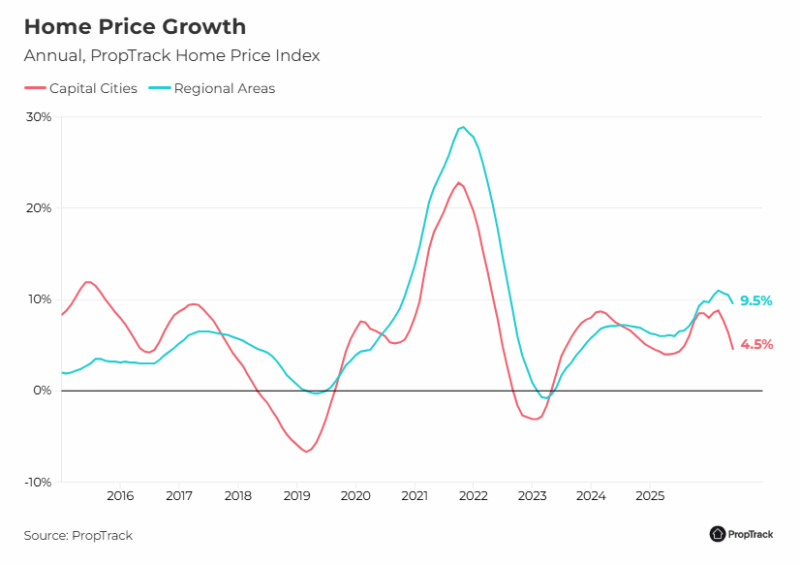
Capital cities drove the decline, dipping by 0.4% over the month. Regional areas, in contrast, continued to outperform, holding steady at a record high in June and were up 9.5% year-on-year.
Sydney (-0.5%) and Perth (-0.5%) saw the strongest declines in home prices over June, followed by Melbourne (-0.4%) and Canberra (-0.4%). Compared to a year ago, Melbourne is the only capital city where the median home price is lower.
Darwin (+0.2%) was the only capital city to see home prices rise in June and is the second strongest performer year-on-year behind Perth.
Australian home prices fell in June, as all but one capital city recorded a decline, according to the latest PropTrack Home Price Index.
Despite dropping a further 0.3% during the month, prices remain 5.8% higher than a year ago.
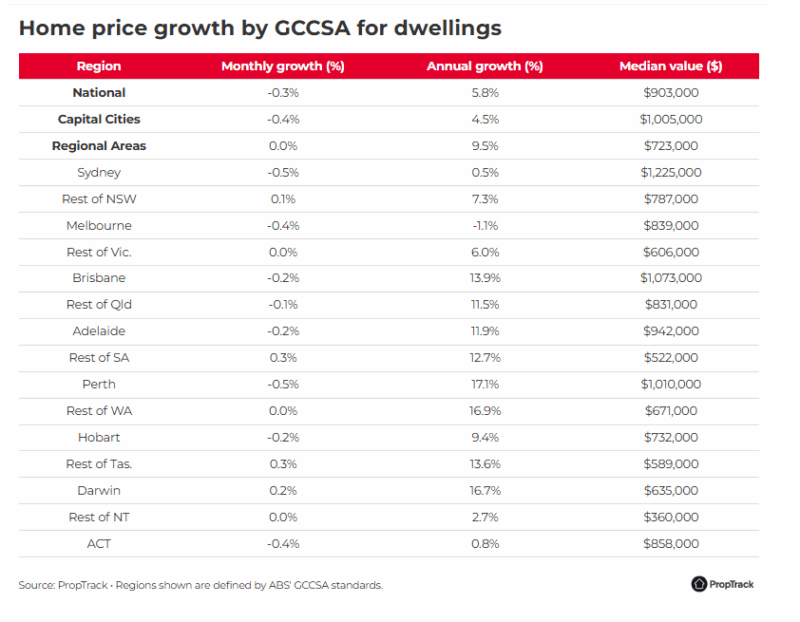
According to Proptrack's data, the median price of a home reached $903,000 in June following a 0.3% fall over the month.
Anne Flaherty, Senior Economist at PropTrack said:
"While prices were lower over June, most homeowners are still sitting on significant gains, with the median price of a home 5.8%, or $71,900, higher compared to a year ago.
Weighing on home prices have been the cumulative impact of three interest rate rises, which have reduced borrowing capacities for buyers.
Changes to housing taxation following the 2026 Federal Budget also appear to be impacting the market.
These changes are expected to reduce investor demand, which could contribute to an overall reduction in buyer demand."
Australia’s capital cities and regional areas have experienced a divergence in home price growth
Data from the report shows that Australia’s capital cities and regional areas have experienced a divergence in home price growth over the past 12 months, as well as the past five years.
Source: Proptrack
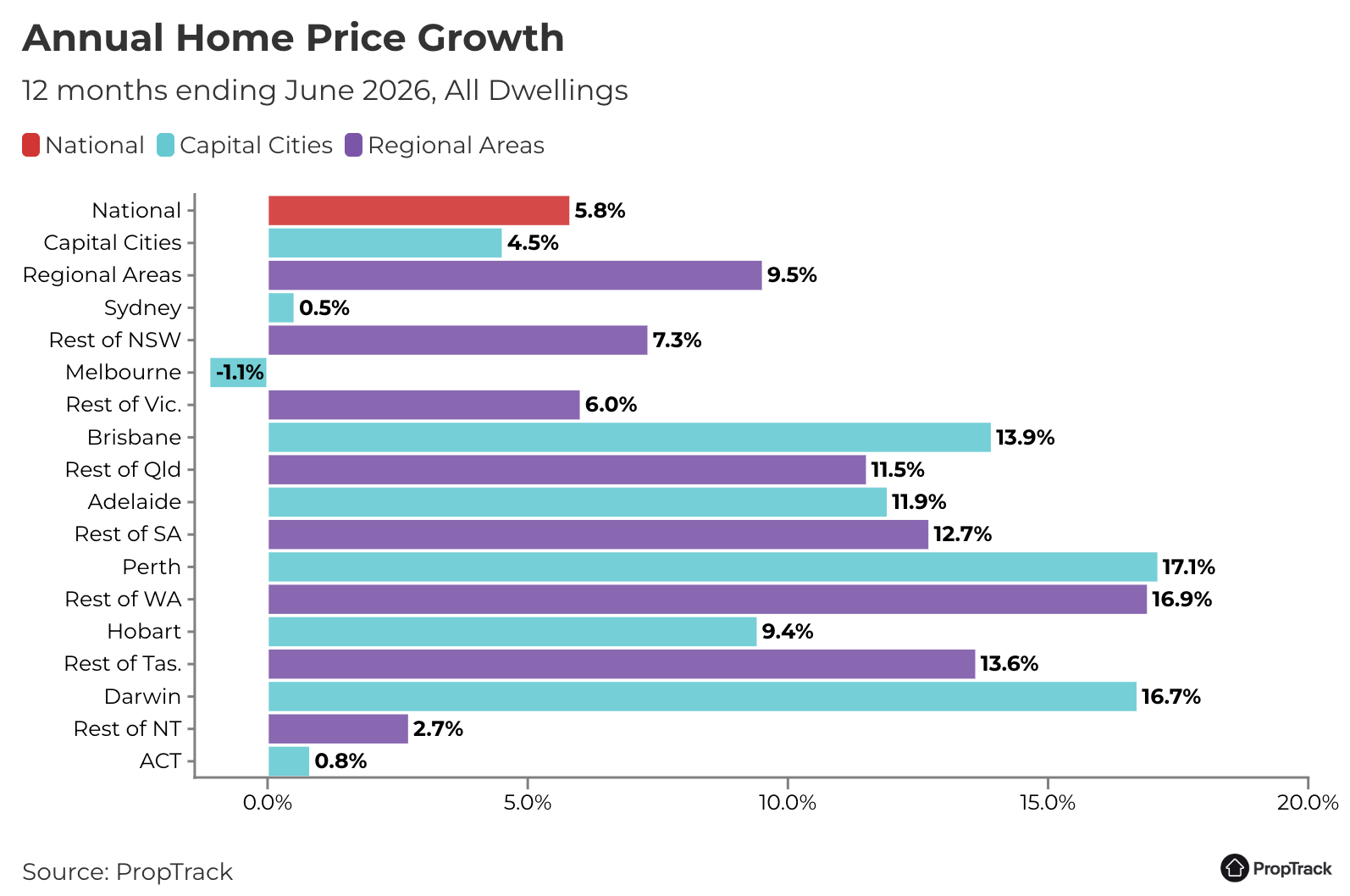
Comparing year-on-year, Perth has been the strongest performing capital city, with prices up 17.1%, followed by Darwin with growth of 16.7%.
Brisbane and Adelaide have also been high performers, up 13.9% and 11.9%, respectively.
On the other end of the spectrum are Sydney and Canberra, where prices have only risen by 0.5% and 0.8%, respectively, over the past 12 months.
Melbourne has been the weakest performing capital city, and the only market to see home prices fall over the past year, down 1.1%.
- Also read:Melbourne housing market update | October 2026

- Also read:National Vacancy Rate Rises to 1.4% | SQM Research

- Also read:Australian housing market update | October 2026

- Also read:This week’s Australian Property Market Update – Latest Data, State by State October 13th 2026

- Also read:Latest Property Price Forecasts. Australian Property Market Outlook 2026-2027: Navigating a Market Correction

In contrast to the capital cities, the report highlights that most rest of state markets saw home prices hold at record highs in June.
Regional Western Australia has been the strongest performers over the past year, with growth of 16.9%, followed by regional Tasmania (13.6%), regional South Australia (12.7%), and regional Queensland (11.5%).
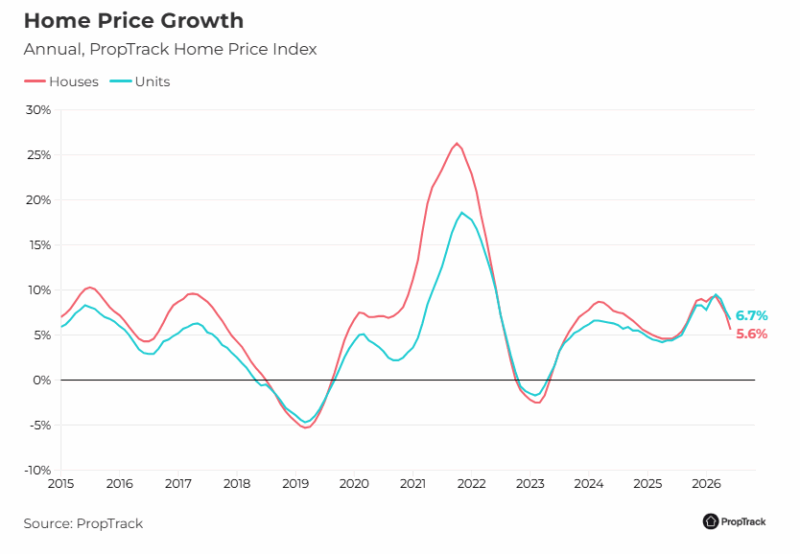
Houses saw larger declines than units over June and have also underperformed over the past year
PropTrack's data show that compared to 12 months ago, the median price of houses is up 5.6% to $1,001,000, while units have climbed 6.7% to $735,000.
Ms Flaherty explains:
"Driving the outperformance of units over the past year is likely to be affordability constraints.
Despite recent declines, home prices remain close to record highs and houses have become out of reach for a growing share of buyers, driving more to the unit market.
Given the higher average mortgage size for houses, this property type is also typically more sensitive to interest rate rises."
Outlook
According Flaherty, while home values were down in most capital cities over June, prices remain higher in every capital city and regional area, except Melbourne, compared to a year ago.
She further notes:
"Several factors will impact the extent to which home prices move over the second half of 2026.
While there is still the potential for another interest rate rise before the end of 2026, expectations of additional hikes have moderated. Once it becomes clear interest rates have peaked, this is likely to see confidence improve among buyers.
The extent to which housing taxation changes announced in the May Federal Budget impact the market also remain to be seen.
While these changes are expected to contribute to softer home prices over the short term, over a longer term horizon, the fundamentals of Australia’s housing market remain the same.
That is, most capital cities and regional areas remain undersupplied relative to population growth, which will limit the extent to which home prices can fall."