

Key takeaways
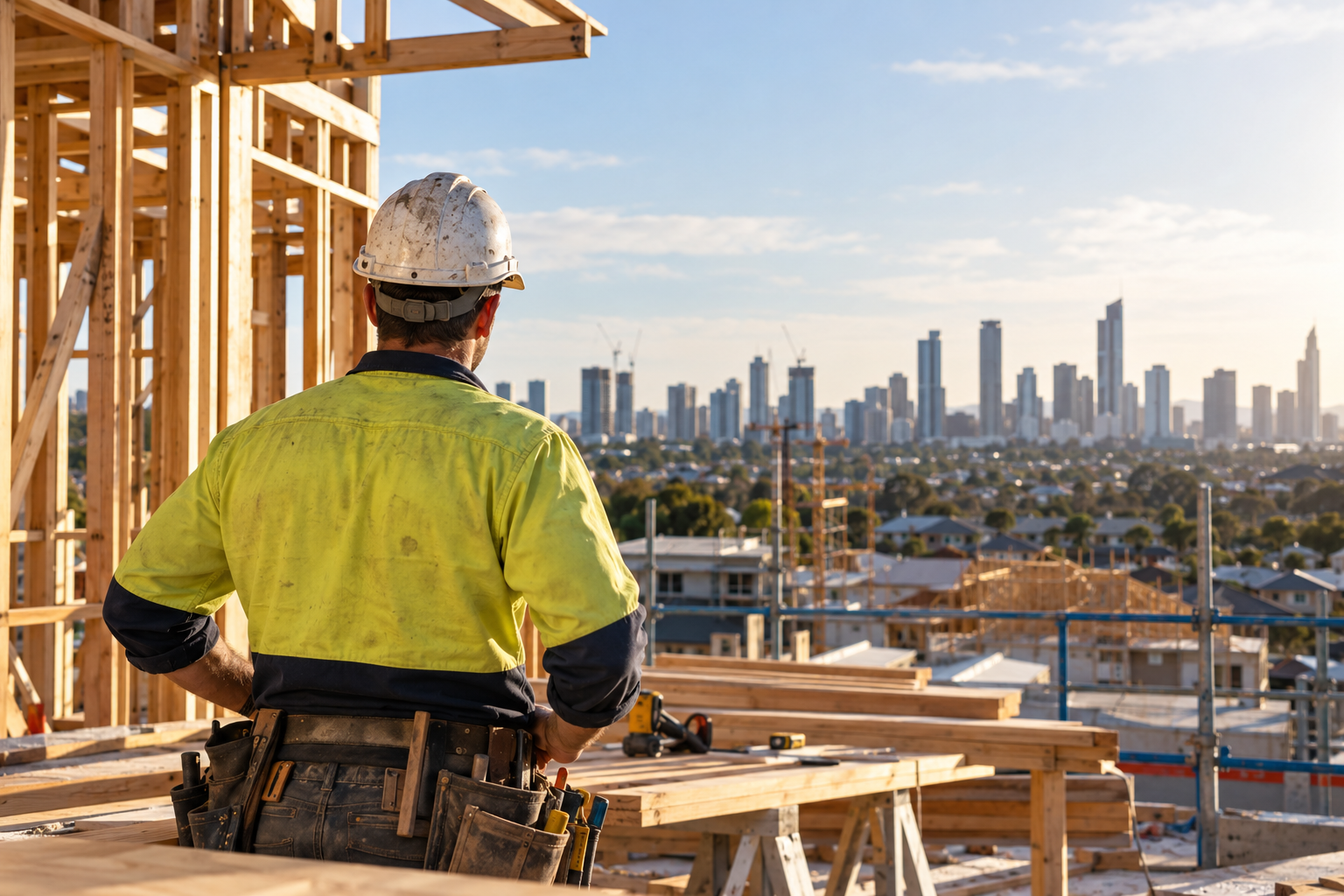
Australia doesn't have enough skilled construction workers. The shortage is limiting our ability to build the homes and infrastructure we need.
Higher unemployment won't automatically solve the problem. Construction requires skilled and qualified workers who take years to train.
Housing targets don't guarantee new homes. Labour shortages, rising costs and longer construction times can make approved projects unviable.
Housing undersupply is likely to persist. Australia's growing population will continue adding demand while new supply struggles to keep pace.
This supports the long-term fundamentals of quality property. Well-located, investment-grade housing should continue benefiting from constrained supply and strong underlying demand.
Australia has spent the last few years talking about its housing shortage as though the solution were relatively straightforward: release more land, speed up planning approvals, encourage higher density and build more homes.
And, of course, we need to do all of those things.
But there is another constraint that doesn't receive nearly enough attention, and it could prove just as important as planning rules, finance or the availability of land.
We simply don't have enough skilled people to build everything Australia wants to build.
That might sound strange at a time when unemployment is rising. Australia's unemployment rate reached 4.6% in August, yet the construction sector is reportedly already around 141,000 workers short.
Without changes to training, migration and productivity, workforce modelling suggests that shortage could become substantially larger over the coming decade.
This is one of the great contradictions facing our economy.
We can have more Australians looking for work while simultaneously suffering an acute shortage of the skilled workers required to build the homes, roads, hospitals and infrastructure our growing population needs.
And that's a problem that won't be solved simply by announcing bigger housing targets.
We don't just need more workers, we need the right workers
At first glance, you might reasonably assume rising unemployment should ease labour shortages.
If more Australians are looking for jobs, surely builders should have a larger pool of workers available. Unfortunately, construction doesn't work that way.
You can't take someone who has lost a job in retail, hospitality or an office and immediately turn them into a qualified electrician, plumber, carpenter or experienced machine operator.
Construction requires specific skills, qualifications, licences and experience, and developing those skills takes time.
The training pipeline is one of the industry's major bottlenecks, with apprenticeship commencements failing to keep pace with demand and businesses carrying much of the cost of wages, supervision and lost productivity involved in training the next generation of workers.
At the same time, residential builders aren't competing only with other residential builders for labour. They're competing with major infrastructure projects, hospitals, schools, roads, rail and renewable energy projects for many of the same tradespeople.
So we're asking essentially the same pool of skilled workers to build substantially more housing while simultaneously delivering the infrastructure required to support Australia's growing population.
This creates a capacity problem that can't be fixed overnight.
Housing targets don't build houses
This is where the labour shortage becomes particularly important for our housing markets.
Governments can announce ambitious targets, councils can approve developments and land can be rezoned, but an approved dwelling isn't the same thing as a completed dwelling.
A development may have planning approval, finance and willing buyers and still be delayed because the builder can't secure the subcontractors required to complete the project.
Australian Property Review highlights three consequences already flowing from the labour shortage: longer construction timelines, higher costs as scarce tradespeople command higher rates, and marginal developments being shelved when escalating costs make them financially unviable.
And each of those problems feeds into the next.

Note: Longer construction periods increase financing and holding costs. Higher labour costs push up the price developers need to achieve to make a project viable. Higher completed prices reduce the pool of buyers who can afford the product, which can make banks less willing to finance projects.
Eventually some developments simply don't stack up financially.
- Also read:Melbourne housing market update | October 2026

- Also read:Australian housing market update | October 2026

- Also read:Latest Property Price Forecasts. Australian Property Market Outlook 2026-2027: Navigating a Market Correction

- Also read:Brisbane Property Market Forecast [2026 & Beyond] – What The Olympics Decade Means for Investors.
- Also read:Melbourne property market forecast for 2026 & 2027 | Separating the fundamentals from the sentiment
This is why I've repeatedly argued there is an enormous difference between theoretical housing supply and deliverable housing supply.
Governments can rezone land and councils can approve apartment towers, but unless developers can finance them, builders can construct them and purchasers can afford the finished product, those approvals won't become homes.
What this means for property markets
This also has important implications for anyone expecting a huge wave of new housing supply to solve Australia's affordability problems anytime soon.
Australia can and should build more homes, and governments should continue removing unnecessary barriers that prevent viable projects from proceeding. But increasing supply on the scale required is going to be harder, slower and more expensive than many commentators assume.
Our population continues to require additional housing while changing demographics and smaller households add further pressure to the number of dwellings needed. Meanwhile, builders face elevated construction costs, financing constraints, planning delays and shortages of skilled labour.
That's a difficult combination to overcome quickly.
For property investors, it reinforces the importance of looking beyond headline housing targets and asking a more useful question: how much housing can realistically be delivered in the locations where people actually want to live?
That's a very different number.
It also helps explain why simply releasing more land isn't necessarily the answer. A block of land on the outskirts of a city doesn't provide much housing if there aren't enough builders and tradespeople to construct homes on it, or if the cost of construction means buyers can't afford the finished product.
We need to rebuild the construction pipeline
There is no single solution, but there are several sensible places to start.
Australia needs to make construction careers more attractive to young people, increase apprenticeship commencements and, importantly, improve completion rates.
We also need to make it easier for smaller building businesses to train apprentices because those businesses currently carry much of the financial and supervisory burden.
There is also considerable scope to improve recognition of overseas qualifications and prior learning = experienced migrants can face months of delays and substantial costs before their existing skills are formally recognised, leaving potentially productive workers on the sidelines while the industry desperately needs them.
I'd add another consideration to the discussion...
Governments need to become better at coordinating infrastructure spending with residential construction cycles. Of course Australia needs new roads, rail, schools and hospitals as our population grows, but enormous public infrastructure programs inevitably compete with residential construction for engineers, project managers, tradespeople, equipment and materials.
Better sequencing won't solve the shortage, but it could reduce some of the pressure.
The bottom line
Australia's housing shortage has been decades in the making, and it won't disappear quickly.
The encouraging news is that these problems are solvable. We can train more tradespeople, improve apprenticeship pathways, recognise overseas qualifications more efficiently, embrace modern construction methods and create better incentives for building businesses to expand their workforce.
But all of this takes time.
That means the structural undersupply of housing is likely to remain an important feature of Australia's property markets for years rather than months.
For investors, that doesn't mean every property will perform well. Location, scarcity, affordability, demographics and the quality of the individual asset will continue to determine long-term performance, which is why I've always believed investors should focus on investment-grade properties rather than simply buying into a broad housing shortage story.
Australia will eventually build more homes because we have little choice.
Until we develop the workforce capable of delivering them at the scale required, however, housing supply will struggle to keep pace with demand. And that continuing imbalance is one of the reasons I remain confident about the long-term fundamentals of well-located residential property in Australia's major capital cities.