
Key takeaways
Australia remains one of the world's most desirable places to live.
Melbourne, Sydney and Adelaide all ranked among the world's top 10 most liveable cities, reflecting their strong healthcare, education, infrastructure and quality of life.
People are attracted to cities with strong economies, good amenities and stable communities, supporting ongoing demand for well-located housing.
High liveability also attracts more residents, putting pressure on housing affordability, transport and infrastructure.
Faster planning approvals, better infrastructure and well-designed medium-density housing are essential to accommodate future population growth.
The most successful investors buy quality properties in locations where people want to live, recognising that strong cities continue to create wealth over time.
We Australians are very good at finding fault with the cities in which we live.
We complain about congestion, expensive housing, crowded trains, planning delays and infrastructure that often seems to arrive years after it is needed.
Sure, many of those concerns are justified, but every so often an international comparison allows us to step back from the daily frustrations and see our cities through a wider lens.
The latest Global Liveability Index does exactly that.
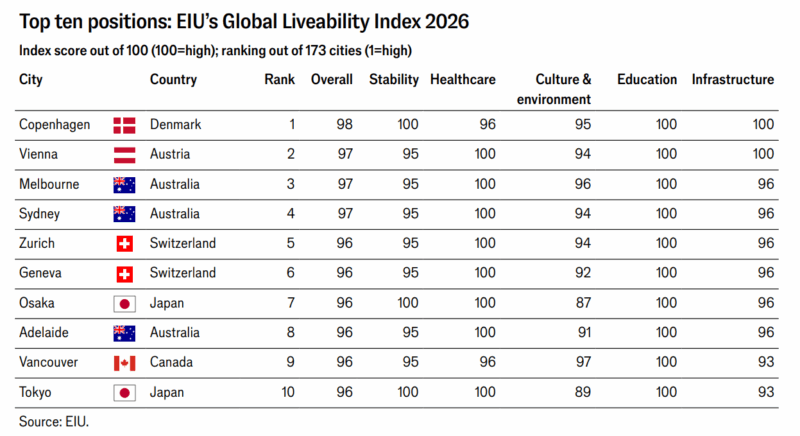
Melbourne, Sydney and Adelaide have all been ranked among the world’s 10 most liveable cities in the Economist Intelligence Unit’s 2026 index.
Melbourne rose to third place behind Copenhagen and Vienna, Sydney climbed to fourth and Adelaide moved into eighth position.
The ranking assessed 173 cities across five broad areas: stability, healthcare, culture and environment, education and infrastructure.
In other words, this was not a popularity contest based on tourism or beautiful skylines.
It measured how well cities actually function for the people who live in them. That makes Australia’s result particularly impressive.
For a relatively small country, having three cities in the global top 10 reflects decades of investment in healthcare, education, transport, public spaces, cultural institutions and stable communities.
What makes these cities so liveable?
Melbourne and Sydney each received an overall score of 97 out of 100.
Both achieved full marks for healthcare and education, along with strong results for stability and infrastructure.
Melbourne’s narrow advantage came from culture and environment, while Adelaide’s smaller scale, accessibility and proximity to beaches, food and wine regions helped secure its place among the world’s best.
Each city offers a different type of liveability.
Melbourne is known for its culture, sporting calendar, restaurants and distinctive inner suburbs.
Sydney combines a major global economy with beaches, harbour access and natural beauty.
Adelaide offers many of the advantages of a capital city with less congestion and a more manageable pace.
What they share is more important than what separates them.
All three offer strong institutions, good education, reliable healthcare and a level of political and social stability that many parts of the world cannot take for granted.
Liveability creates housing demand
For property investors, these rankings are more than a source of civic pride because liveability is closely connected to long-term housing demand.
People are drawn to cities that offer employment, education, healthcare, safety, culture and lifestyle.
As those cities attract workers, families, students and businesses, demand grows for housing, rental accommodation, services and infrastructure.
Of course, this does not mean every property in Melbourne, Sydney or Adelaide will make a good investment.
- Also read:Melbourne housing market update | October 2026

- Also read:National Vacancy Rate Rises to 1.4% | SQM Research

- Also read:Australian housing market update | October 2026

- Also read:This week’s Australian Property Market Update – Latest Data, State by State October 13th 2026

- Also read:Latest Property Price Forecasts. Australian Property Market Outlook 2026-2027: Navigating a Market Correction

Within every city there are suburbs with weak growth prospects, oversupplied apartment markets and properties that appeal to a narrow pool of buyers.
However, investing in a city where people genuinely want to live provides a valuable long-term advantage.
Quality cities attract employers, employers attract workers and universities attract students, many of whom remain after graduation and form households of their own.
Over time, those forces support well-located property, particularly in established suburbs where land is scarce and new supply is limited.
The affordability problem
There is an uncomfortable relationship between liveability and affordability because the most desirable cities usually attract the strongest demand.
When many people want to live in a city and housing supply fails to keep pace, prices and rents rise.
Australia has made this problem worse through slow planning approvals, restrictive zoning, high construction costs, infrastructure bottlenecks and taxes that increase the cost of delivering new homes.
Governments have responded with buyer grants and other demand-side incentives, but these policies often increase purchasing power without adding enough housing.
The result is more competition for the same limited supply.
The liveability rankings should therefore be seen as both an endorsement and a warning.
They confirm that Melbourne, Sydney and Adelaide remain highly desirable, but they also show why pressure on housing and infrastructure is unlikely to disappear.
What governments need to do
Australia’s challenge is to manage growth more intelligently. Established suburbs will need more well-designed medium-density housing close to transport, employment and existing services.
Planning approvals must become faster and more predictable, while infrastructure investment should be directed towards the areas where population growth is occurring.
This does not require covering every suburb with high-rise towers.
Townhouses, terraces, duplexes and smaller apartment buildings can increase supply while preserving much of the character and amenity that make established areas attractive.
Poorly planned density can reduce liveability, but thoughtful development can support better transport, stronger local businesses and more vibrant communities.
The bottom line
The 2026 Global Liveability Index is a timely reminder that Australia’s major cities continue to perform exceptionally well on the measures that shape everyday life.
Melbourne, Sydney and Adelaide face real challenges, particularly around housing affordability, congestion and infrastructure.
Yet they begin from a position of considerable strength, supported by stable institutions, strong economies and lifestyles that continue to attract people from around the world.
For property investors, the lesson is clear.
Long-term wealth is generally created by owning scarce assets in places where people with choices want to live.
Market cycles, interest rates and government policies will change, but the underlying appeal of prosperous, highly liveable cities tends to endure.
With better planning, more housing in the right locations and continued investment in infrastructure, Australia’s leading cities can remain among the world’s most liveable while becoming more productive, accessible and resilient.