

Key takeaways
Put your equity to work. Using existing home equity can help investors enter the property market sooner rather than spending years saving a deposit.
Always maintain a financial buffer. A substantial buffer helps cover holding costs, interest rate rises and unexpected expenses while your investment grows.
Focus on growth before debt reduction. Capitalising interest can help manage cash flow in the early years, provided the risks are carefully managed and there is a clear debt repayment strategy.
Time and compounding build wealth. In this example, Peter and Kate's equity grows to approximately $2.1 million in 10 years and $5.9 million in 20 years, assuming 7% annual capital growth.
Strategy comes before property selection. Successful investing requires the right property, disciplined borrowing, strong cash flow management and a long-term plan.
Do you have equity sitting idle in your home?
Most Australian homeowners are sitting on a fortune they never touch, not because they choose to, but they are not sure what to do with it or how they could use it.
We've likely all been told and likely the very same thing: pay down your mortgage, avoid debt, and save before you invest.
It sounds sensible but while you save, the market moves on, and the deposit you were chasing keeps getting further away, while the equity in your home sleeps.
It is my mission to educate and to run through a real-world style example, showing how one family could turn the equity in their home, into a multi-million-dollar property portfolio,
Here's how it works, step by step, with the numbers.

Meet Peter and Kate
Peter and Kate are a married couple in their mid-40s with two kids, about 20 years out from retirement.
On paper, they're doing everything right.
| Their situation | Details |
| Incomes | Peter earns $150,000 a year, Kate earns $62,000 |
| Their home | Bought 7 years ago for $600,000 with a 20% deposit, now worth $1,000,000 |
| Their mortgage | Paid down to $400,000 |
| Their equity | $600,000 |
| Structure | Buying in their own names for simplicity and maximum borrowing capacity |
Their home has performed very well and given them a golden opportunity to set themselves up for retirement.
The problem is that Peter and Kate are nervous, whilst they understand the need to invest, they worry about their existing debt and don't like the idea of taking on more.
They also love their annual family holiday or two and don't want investing to affect or eat into their lifestyle.
Longer term, the priority is to set their kids up, which is something I think every parent carries a burden for in the current environment.
In short, they want to have their cake and eat it to and that can be possible.
If that sounds like you, keep reading.
Why saving can't keep up
Saving for an investment property sounds responsible, but in reality, you will find that the goalposts keep shifting.
If Peter and Kate put aside $20,000 a year, it would take them about almost 10 years to build the $200,000 needed for a $750,000 property purchase.
By then, at 7% annual growth, that same property would cost around $1.38 million and they would need about $370,000 up front.
They'd be back to where they started, chasing a market that never waits.
Let’s consider and compare what would happen if they went down the path of using the existing equity in their home.
Peter and Kate already have about $400,000 of usable equity in their home, enough to buy that $750,000 property today.
Over those same ten years it took them to save for a deposit, the investment property itself would grow by roughly $630,000.
That's the difference between time saving and time in the market, one works against you, while the other works for you.
Unlocking the equity
Lenders will generally let you borrow up to 80% of your home's value without lenders mortgage insurance.
On a $1 million home, that's $800,000.
Take away the $400,000 Peter and Kate still owe, and they have $400,000 of usable equity.
This is where a big mental shift and having a well thought out strategy comes in.
It goes against everything we're told about paying down debt but used with knowledge and discipline, equity is a tool.
Here's how I'd set it up:
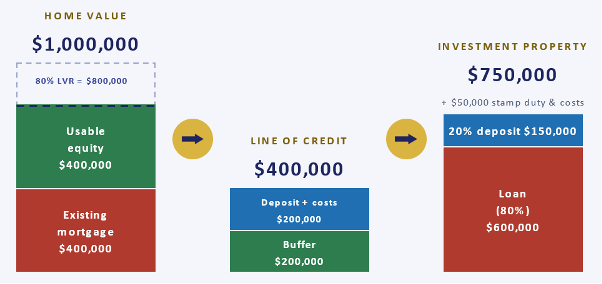
The best part is that Peter and Kate have not used a single dollar of their income or savings and they didn't have to wait nine or ten years to enter the market.
Every dollar came from the equity in their home, and they still have $200,000 sitting in reserve, as a buffer.
The buffer and capitalising interest
The buffer is what answers Peter and Kate's biggest fear: out-of-pocket costs.
Like most investment properties, theirs doesn't fully pay for itself in the early years.
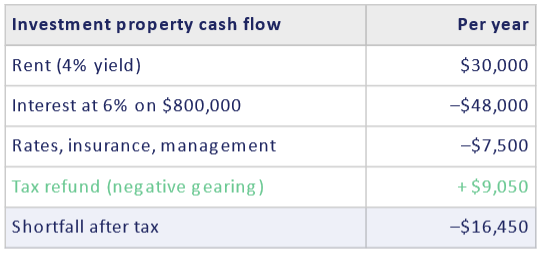
The shortfall after tax is around $16,450 per year or $320 a week.
Normally, that cost would come out of the family budget, and something would have to give, like the annual holiday.
Instead, Peter and Kate choose to let the interest capitalise.
The shortfall is drawn from the line of credit and added to the balance, so they're effectively borrowing to cover the holding costs.
Each year at Tax time, their refunds go back into the line of credit too.
I know that's a foreign idea to many people and it can be difficult to grasp. it certainly was for me when I started investing.
I had two heavily negatively geared properties and struggled to hold them and was very close to selling one.
Once I understood equity and capitalising interest, I could not only get through that period but add more properties to my portfolio.
- Also read:Brisbane housing market update | November 2026

- Also read:Everything you need to know about the state of Australia’s property markets in 20 charts – November 2026

- Also read:Melbourne housing market update | November 2026

- Also read:Sydney housing market update | November 2026

- Also read:Vacancies fall, rents stall and rates hit an 18-year high: what Australia’s latest property data is telling us | Property Insiders

In this case, over 10 years, the line of credit grows from $200,000 to about $360,000, which is about $40,000 under its $400,000 limit.
On the other hand, over the same period, the investment property grows by around $725,000.
In other words, roughly $160,000 of capitalised holding costs bought them a $725,000 gain.
In my mind, that's a big advantage, and it creates the opportunity to do it all again, should they choose to.
Ten years later: $2.1 million in equity
After 10 years at 7% annual growth, Peter and Kate's net position has almost quadrupled, from $550,000 to about $2.1 million.
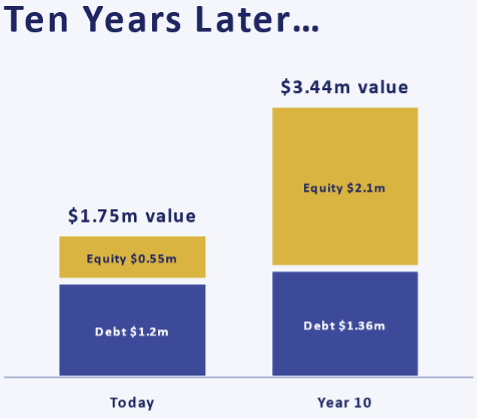
Yes, their debt went up a little but look at what it bought them.
In the first year alone, the two properties added roughly $120,000 in value, almost as much as Peter's salary and that growth continues to compound every year after.
Warren Buffett is often quoted as saying that if you don't find a way to make money while you sleep, you'll work until you die.
That is exactly what Peter and Kate had achieved, without a dollar down or second job in sight.
Peter and Kate kept working and stopped worrying, they put things on cruise control, knowing they had a 10-year runway to ride out whatever came: a boom, a downturn, a shock nobody saw coming.
Piece of mind and an incredible outcome.
Twenty years later: $5.9 million
By year 20, Peter and Kate's portfolio is worth about $6.77 million, with debt down to around $870,000.
That's roughly $5.9 million of net equity from buying just one investment property.
The first 10 years did more than grow the properties, it bought time to allow wages and rents to ramp up and inflation time to eat away at the debt.
That is what makes the next phase possible.
At year 10, they switch their loans from interest-only to principal and interest and the focus moves from growth to consolidating and paying down debt.
There is the trade-off, and it's important to be upfront about it, with Principal and interest repayments across their loans come to about $118,500 a year.
After rent and tax refunds, that's roughly $1,450 a week from their incomes but by then, their incomes have had 10 years to grow, and the gap diminishes as rents rise.
This isn't about flipping, buying and selling, or trying to time the market.
Put simply: buy a good property, set up your buffer, understand what you need to get through the holding period, and put it on cruise control.
It can sound easy, but it takes a monumental mindset shift, and that's exactly what we help our clients understand.
When it works, and when it doesn't
Of course, there are risks associated with every strategy.
This strategy is only as good as the buffer, the property and the person behind it.
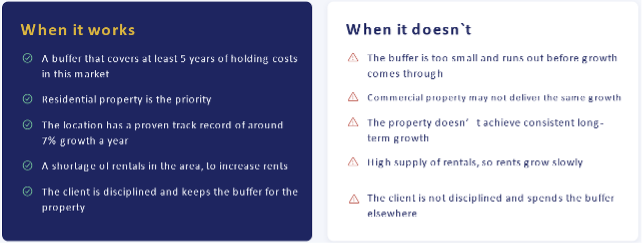
Why the buffer matters now. I wouldn't do this with only a two or three year buffer in this market, because many areas won't grow over the next year or two.
A shorter buffer can see you through a job loss or a stint on one income while you start a family, as long as you replace your income.
Why rental shortages matter. In tight markets, rents have risen around 6% in the past year, with talk of increases closer to 10%.
Rising rents close the shortfall faster, so you can switch to principal and interest sooner and live more comfortably.
Where I wouldn't buy. Often, it's where investors are being encouraged to buy right now: high-rise complexes and massive house-and-land estates where up to 70% of owners are investors.
These locations and types of properties will always have owners competing for tenants, rather than the other way around.
Why discipline matters most. The line of credit is purely for your property business.
The moment it funds your lifestyle, holidays, cars etc the strategy stops working.
Five key takeaways
Here are the key points:
- Equity beats saving. If you can use your equity, consider doing it now. Spend four or five years saving and you'll likely spend them chasing the market.
- Always keep a buffer. A $200,000 line of credit can cover around $16,000 to $25,000 a year of holding costs for seven to 10 years, depending on your tax position. That buys you the time to benefit.
- Grow first, repay later. Capitalise interest while your assets and rents grow. Once you reach that equilibrium point, switch to principal and interest and consolidate.
- Time does the heavy lifting. Peter and Kate's $550,000 of equity became about $2.1 million in 10 years and $5.9 million in 20, without touching their savings to buy.
- Strategy before property. Understand your serviceability, plan for rate rises and flat markets, and know your numbers before you buy anything.
That end result gives Peter and Kate far more choices: a legacy to pass on to their kids, and the means to live comfortably in retirement.
What could your home's equity do for you?
Do you have equity sitting idle in your home?
You may be nervous about buying in this market, and that's okay.
It may not be the right time for you to buy, but it could be a good time to take a step back and consider your options.
The investors who get their ducks in a row now will be in a much stronger position to take action when the market picks up again.
Visit metropole.com.au to talk with one of our property strategists about your options and run the numbers for your own situation.