

Key takeaways
Short-term property noise can distract investors from the bigger picture.
Population growth, housing demand and rising household wealth remain important long-term drivers of propery values.
Australia’s housing shortage continues to support property values. Strong population growth and constrained new supply should underpin demand over time.
Quality locations remain critical for long-term capital growth. Look for established suburbs with high incomes, transport, schools, walkability and enduring owner-occupier demand.
Capital growth can create significantly more wealth than chasing higher rental yields. Growing equity also gives investors greater flexibility to build their portfolios.
Demographics and the coming intergenerational wealth transfer will reshape housing demand. Millennials and Baby Boomers are increasingly competing for similar properties in well-located suburbs.
Are you overwhelmed by interest rates, falling confidence, gloomy headlines and a new prediction every week?
Right now, the property noise is deafening, and it's easy to freeze.
My message is simple: there is light on the horizon.
The short term will remain uncertain, but the long term is still very much on our side.
If you understand what really drives property prices and the demographic shifts shaping the next cycle, you can position yourself now rather than panic and watch from the sidelines.
This is now my third or fourth property cycle as an investor.
Each one has shared the same traits: a boom, some kind of bust or slowdown, and, over time, strong growth for quality property.
I can't tell you what happens next week or even in the next two or three years, but I can show you why the long-term case is still strong, and what to do about it.

Only two things drive prices in the long run
Finance, interest rates and consumer sentiment are short-term noise. They come and go week to week and month to month.
Over the long run, prices respond to two forces, and you need both:
- Household formation. People keep moving to Australia and, whatever our politics, some level of immigration will continue. How people live matters too. Household sizes have been shrinking, although the housing crisis is pushing more people under one roof. Either way, a growing population needs somewhere to live.
- Underlying wealth. An area also needs the capacity to pay more for property over time. Without that, growth simply can't flow.
Japan has experienced strong economic growth but low population growth, and its property market has largely gone nowhere.
Cairo, on the other hand, has huge population growth but lacks the underlying wealth to produce strong rates of property price growth.
Australia is fortunate to have both, and that should remain the case for the foreseeable future.
A new cycle is already forming
A new cycle is already forming
We're near the bottom of another cycle, and the ingredients for the next upswing are starting to line up.
- Strong population growth. Immigration remains high, and around 80% of new arrivals settle in Sydney, Melbourne and Brisbane.
- A chronic supply shortage. Building costs keep rising while completions fall. Strong demand meeting constrained supply will continue to put pressure on prices.
- Rates will eventually ease. Maybe not this year, but as we move through this cycle, rates will come down and buyer confidence will return.
- A rental crisis. Rents keep climbing, and I expect that pressure to continue.
- First home buyer support. Governments on all sides are working to help people into the market, and that has strong popular backing.
A tale of two Australias
Most homeowners are sitting on substantial equity, while renters watch prices pull further away.
We're at a real juncture in our society, with those two groups moving further apart.
My strong advice is: don't stand by and watch it happen. Work out a way to get in.
This is not a bubble.
Some areas may be a little overpriced, but the market as a whole is not in a bubble.
Australian residential real estate is worth around $11.7 trillion, against roughly $2.4 trillion of mortgage debt. That's about a 20% loan-to-value ratio across the market.
If that figure were closer to 60% or 70%, I'd be worried.
A large share of purchases are also being made with no mortgage at all; by some measures close to 30% of sales last year.
People holding that kind of buying power will do particularly well in the coming cycle.
The bank of mum and dad is opening up
We're now seeing parents release equity to help their children, funding home upgrades, new investment purchases and gifted deposits.
That's a big reason prices kept rising even as rates went up.
Most buyers aren't borrowing 95%. That's mainly first home buyers without family help. Most others are drawing on wealth they or their families already hold.
Australia's people boom
Australia's population is close to 28 million people, and we're adding a new Australian roughly every minute.
Around 12 million more people are expected by 2050. That means far more cars on the road, so locations with good public transport and walkability will matter more than ever.
Keep an eye on Melbourne. It has underperformed for the past decade, yet it's on track to reach around 9 million people by the 2050s and overtake Sydney as our largest city.
That means it will need well over a million new homes and a similar number of new jobs. Melbourne could be the sleeper of the next cycle.
"Prices can't go any higher"
I've heard this argument for three or four decades and yes, maybe one day it will be true.
But even if the market doubles just once more, and it takes 15 years instead of 10, you'll be significantly better off for owning property.
An $8 million family home in 30 years may sound unbelievable, but 30 years ago, a $2 million home would have sounded just as unbelievable.
In reality, that $8 million is only about $3.8 million in today's money, once you allow for 2.5% annual inflation and adjust for wages growth.
The catch is this: you must buy in "investment-grade" suburbs.
What worked five years ago won't necessarily work in this new stage of the cycle.
Look for areas where the top 20% of income earners live, and where their incomes are growing fastest.
The next two or three years may bring low or no growth in some locations, but higher-income households can rebuild their savings faster, keep buying, and keep supporting prices in the suburbs they choose.
What makes a good neighbourhood
This is where many investors go wrong. They try to reinvent the wheel, chasing yield or some clever angle.
In my view, location does about 80% of the heavy lifting for capital growth, and the things that matter are well known:
- Public transport, including trains and buses.
- School zones. Families routinely pay $50,000 to $60,000 more to secure a great school catchment.
- Walkability to parks, shops and cafes.
- Low crime, which matters especially to families.
- Well-kept streets with history, charm and character.
- Long-term, multi-generational demand.
I'm not buying in a suburb that has only existed for five years. I want locations that have attracted owners for 50 or 60 years, across generations.
Capital growth beats cash flow
Let’s take a $750,000 property, which is within reach for many investors.
Suppose you chase an extra 1% yield, roughly $10,000 a year more in rent, but give up growth to get it.
Compare that with a property in a stronger location growing 2% a year faster.
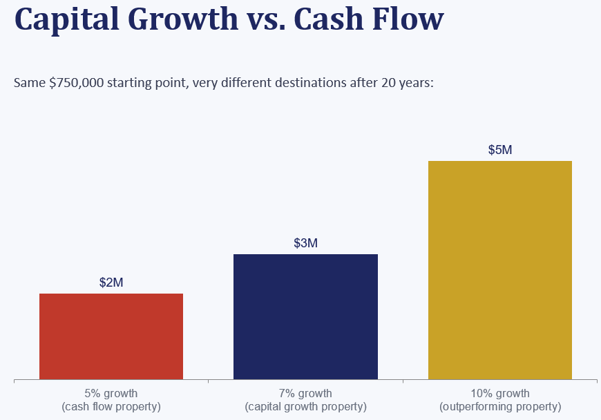
| Annual growth | Value after 20 years |
| 5% | about $2.0 million |
| 7% | about $2.9 million |
| 10% | closer to $5mil |
That 2% gap is worth around $900,000 in 20 years' time, so an extra $10,000 or even $20,000 a year in rent doesn't come close.
Some areas have delivered even more, with growth near 10% in parts of the market over the last five years, although that may not be realistic at this stage of the cycle.
Why growth wins:
- Equity builds the next deposit. Saving the first deposit is the hardest part. After that, a growing property lets its equity fund your next purchase.
- Good debt needs gains. Borrowing at 5% is fine only if your property grows faster than that.
- Better liquidity. Right now, quality homes in owner-occupier areas are still selling. Properties further out, where buyers are mostly investors, are struggling to find a market.
- Choices. Equity lets you refinance, buy again or simply sit comfortably. Flat rent gives you none of that.
Chasing cash flow can feel tempting when rates are high and household finances are under strain.
At any stage of the cycle, though, the right property is the one that gets you into your next property the fastest, and equity will be the key.
Don't Underestimate Demographics
Demographics are destiny, so understand which generations you're buying for and, therefore, who your target market is.
Millennials and baby boomers together make up more than half the buying population, and they increasingly want the same thing.
Millennials are moving out of CBD high-rises into middle-ring suburbs.
They can't afford a house there, and will prioritise convenience, so they're choosing a villa or townhouse with a spare room for a child and a small courtyard.
At the other end, baby boomers are selling their large family homes and rightsizing.
They too want a villa or townhouse nearby, with a courtyard for the dog and a spare room for hobbies or the grandkids.
These two large groups will be competing for the same type of property in the same kinds of locations.
That's a powerful source of demand.
The next big shift: the great wealth transfer
Every major property boom in our history has followed a big structural shift:
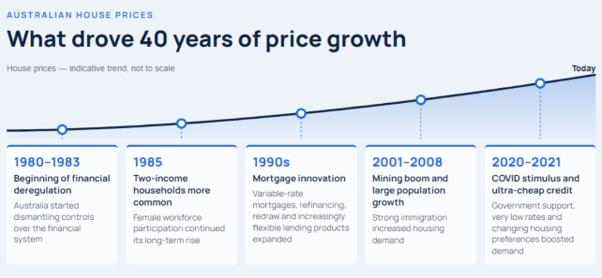
There won't be another true boom until the next structural shift arrives.
I believe that shift will be the biggest transfer of wealth in our history, with estimates running to $5 trillion or more.
As baby boomers reach retirement and beyond, they'll hand over the wealth they've accumulated, reshaping our property markets, our economy and our society.
It has already started, and many parents aren't waiting for an inheritance. They're giving with a warm hand now, helping children and grandchildren buy property.
I expect this to build over the next decade or so, with activity peaking around 2041. That flow of equity and capital will push into our markets and deliver some significant structural shifts.
As it begins to build momentum, now is the time to prepare for it.
- Also read:Latest Property Price Forecasts. Australian Property Market Outlook 2026-2027: Navigating a Market Correction

- Also read:Home Prices Down Again Over September – But Not as Much | Latest Property Market Stats

- Also read:Unemployment rises, student numbers fall and Melbourne still leads the auction market | Property Insiders

- Also read:This week’s Australian Property Market Update – Latest Data, State by State September 29th 2026

- Also read:National Weekly Auction Report – September 26th 2026 | Mixed Auction Results Over AFL Grand Final Week

The bottom line
Demographics are destiny, so position yourself now.
While recent headlines may be gloomy, population growth and rising wealth will keep supporting long-term price growth, and a major structural shift is on its way.
Capital growth compounds into substantial amounts over time. Cash flow can be beneficial, but it mostly helps in the short term, while growing equity gives you more options.
There will always be a reason not to invest. There always has been. Yet markets and cycles move on, rewarding investors who own the right assets and stay the course.
If you're sitting on equity and unsure how to use it, talk to a professional who can help you set up a plan and take the next step on your property journey.