

Key takeaways
Housing affordability barely changed despite softer property prices. Higher interest rates largely wiped out the benefit of lower prices and smaller loans.
Mortgage repayments are taking a bigger bite out of household incomes. The average monthly repayment reached $6,018, up 12.4% over the year.
Affordability varies significantly across Australia. New South Wales remains the least affordable state for home buyers, while the ACT is the most affordable jurisdiction.
First-home buyers are still active despite higher borrowing costs. Their loan commitments rose 11% over the June quarter.
Increasing housing supply remains critical to improving affordability. Australia needs better planning, infrastructure, construction capacity and investment settings to deliver more homes.
For years, the housing affordability debate has focused heavily on property prices, with the assumption that if home values fall, homes automatically become more affordable.
But the latest figures from the Real Estate Institute of Australia remind us that affordability is much more complicated than the price on the contract.
Australian house prices softened over the June quarter and the average amount borrowed by owner-occupiers also fell, yet housing affordability barely improved because higher interest rates swallowed almost all of the benefit.
According to REIA's latest Housing Affordability Report, the proportion of median family income required to meet average home loan repayments edged up to 50.9 per cent, meaning the typical borrowing household is now spending just over half its income servicing its mortgage.
And I think there's an important lesson here for home buyers, property investors and policymakers alike.
Falling prices don't necessarily mean better affordability
During the June quarter, Australia's weighted average median house price declined 1.2 per cent to $1,135,560, while the average owner-occupier loan fell 0.6 per cent to $730,719.
Normally, you would expect those two movements to improve affordability.
However, the cash rate increased by 25 basis points in May to 4.35 per cent, and the quarterly average standard variable mortgage rate subsequently rose to 8.8 per cent.
As a result, the average monthly loan repayment climbed to $6,018, up 1.5 per cent over the quarter and a substantial 12.4 per cent over the year.
In other words, buyers may be borrowing a little less and paying a little less for their homes, but the cost of servicing that debt has risen.
This is why I have long argued that affordability shouldn't be viewed simply through the prism of property prices.
The ability to buy a home depends on a combination of household income, borrowing capacity, interest rates, property prices and, increasingly, the enormous cost of saving a deposit while paying rent and meeting rising living expenses.
The national figures hide very different markets
As always, there isn't one Australian property market.
Affordability actually improved during the quarter in New South Wales and Victoria and remained unchanged in Tasmania, while deteriorating in every other state and territory.
Western Australia recorded the largest quarterly deterioration, with mortgage repayments rising to 47.5 per cent of median family income.
New South Wales remains Australia's least affordable jurisdiction for home buyers, where average mortgage repayments consume an extraordinary 57.7 per cent of median family income.
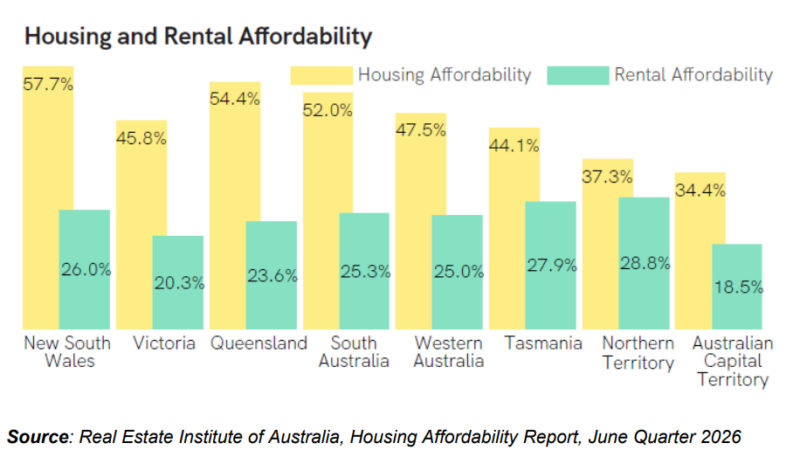
At the other end of the spectrum, the ACT requires 34.4 per cent, helped by its comparatively high household incomes.
- Also read:Sydney housing market update | September 2026

- Also read:The Housing Number That Makes No Sense Right Now | Property Insiders

- Also read:Melbourne housing market update | September 2026

- Also read:This week’s Australian Property Market Update – Latest Data, State by State September 15th 2026

- Also read:Australian housing market update | September 2026

These differences also reinforce why broad national headlines can be misleading for property investors.
Local economic strength, household incomes, supply constraints, population growth and the composition of housing stock all influence how individual markets respond to changing interest rates.
Renters aren't escaping the affordability squeeze either
National rental affordability remained steady, according to the REIA, with median rent requiring 23.9 per cent of median family income, although there were again significant differences between jurisdictions.
The Northern Territory experienced the greatest deterioration, with rents consuming 28.8 per cent of median family income, while the ACT remained Australia's most affordable rental jurisdiction at 18.5 per cent.
Interestingly, first-home buyer activity increased during the quarter.
There were 30,129 new first-home buyer loan commitments, an 11 per cent increase from the March quarter, and first-home buyers accounted for 36.3 per cent of owner-occupier commitments.
Their average loan fell slightly to $610,063, although it remained 10 per cent higher than a year earlier. That suggests considerable pent-up demand for home ownership remains despite the financial hurdles buyers face.
We can't fix affordability by attacking demand alone
These figures highlight why there is no simple solution to Australia's housing affordability problem.
Lower property prices may help buyers, but much of that benefit disappears when interest rates rise, and borrowing capacity falls.
And policies that boost first-home buyer purchasing power can simply push more money into the market, pushing up prices, unless housing supply increases alongside demand.
REIA argues that improving affordability requires coordinated action on planning, infrastructure, construction capacity, taxation and investment, with a sustained focus on increasing housing supply.
That's where I believe the real solution lies. Australia needs more homes where people want to live, supported by a healthy construction sector and private investors willing to provide rental accommodation.
Policies that discourage investment risk reducing rental supply at precisely the time we need more of it.
For property investors, the message is equally clear.
Rather than waiting for interest rates, government policy or property prices to create the perfect conditions, concentrate on what you can control: maintain appropriate financial buffers and own investment-grade properties in locations with strong underlying demand and constrained supply.
Property markets and interest rates will continue to move through their cycles, but Australia's need for well-located housing isn't going away.