

Key takeaways
Australia faces an annual apartment shortfall of between 13,000 and 21,000 dwellings with the Gold Coast is the only major market forecast to meet demand.
Planning approvals alone won't solve the housing shortage. Projects also need viable costs, finance, builders and enough presales to proceed.
The recent SMSF lending changes could weaken the apartment pipeline as investor presales remain critical to securing development finance.
Build to Rent will play a larger role in the future, especially in Melbourne. However, it cannot replace a healthy Build to Sell market.
Well-located, scarce apartments should benefit from continued undersupply. Investors still need to avoid generic stock with little owner-occupier appeal.
Australia’s housing debate has become dominated by ambitious targets, planning announcements and promises to unlock more land.
However, the latest evidence suggests we may be focusing too much attention on the number of homes being approved and far too little on the number that can actually be built.
Of course, that distinction matters because an apartment project can have planning approval, attractive architectural drawings and plenty of apparent demand, but unless the development is financially viable, supported by sufficient presales, adequately funded and able to secure a capable builder, it will remain little more than a proposal.
Charter Keck Cramer’s latest State of the Market H1 2026 report highlights just how serious this gap between aspiration and delivery has become.
CKC research suggests Australia is facing an annual apartment shortfall of between 13,000 and 21,000 dwellings across Sydney, Melbourne, Brisbane, Perth, Adelaide and Canberra, with the Gold Coast the only major market forecast to deliver enough apartments to meet underlying demand.
This serious undersupply clearly shows that Australia’s apartment market is being reshaped by construction costs, financing constraints, government policy and the growing role of institutional rental housing, while our population continues to expand and demand for well-located homes remains strong.
The numbers reveal a widening supply gap
Sydney is facing the largest projected shortage, with Charter Keck Cramer forecasting underlying apartment demand of between 16,300 and 19,500 dwellings a year.
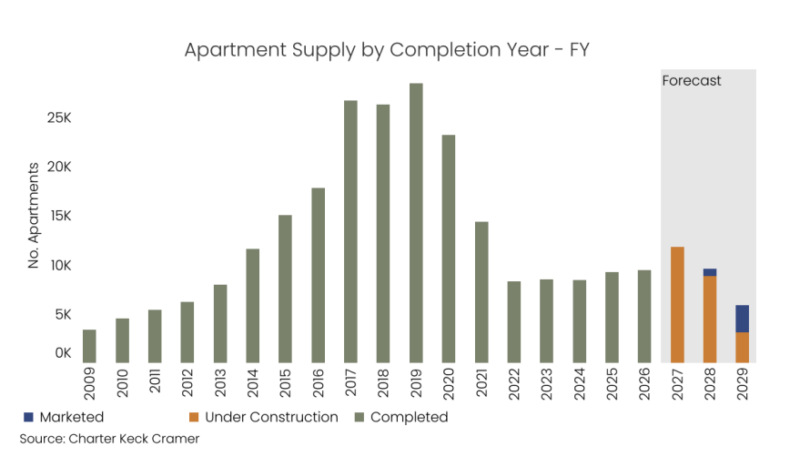
This is compared with expected annual supply of about 10,200 apartments over the next three years. That leaves a yearly gap of between 6,100 and 9,300 homes.
Melbourne is expected to require between 12,400 and 14,800 apartments annually, while forecast supply sits at approximately 9,000.
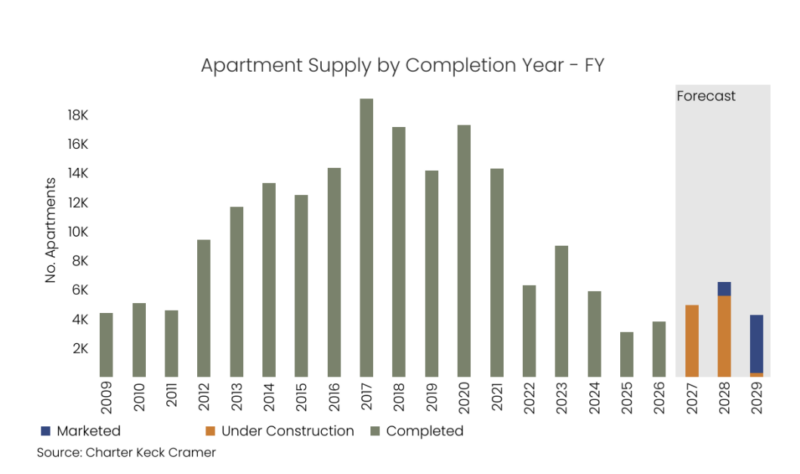
Brisbane is also projected to fall short, as are Perth, Adelaide and Canberra.
Perth’s situation is particularly revealing because its forecast apartment supply is expected to meet only around half of underlying annual demand, despite the city recording some of the strongest population growth in the country.
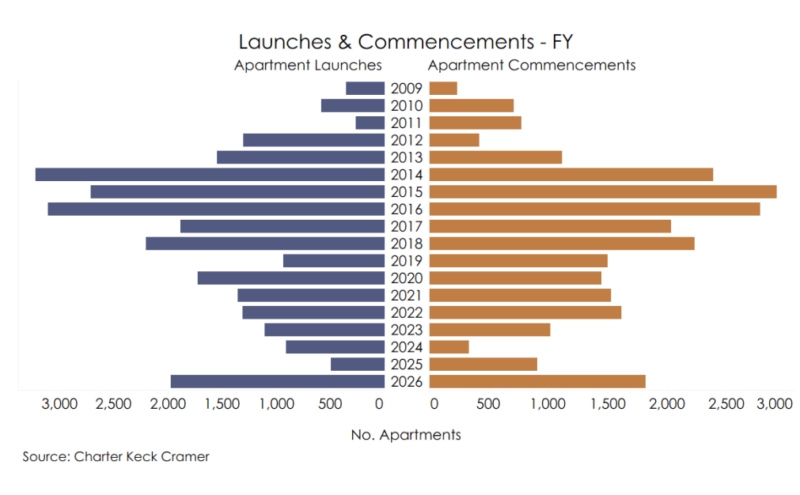
Clearly Australia does not have one housing market, and these supply shortages will not be evenly distributed.
Some cities will experience much deeper deficits than others, while conditions can vary considerably between suburbs, price points and apartment types.
The Gold Coast is the exception in Charter Keck Cramer’s national analysis, with forecast supply of around 3,000 apartments a year compared with estimated annual demand of between 2,300 and 2,800.
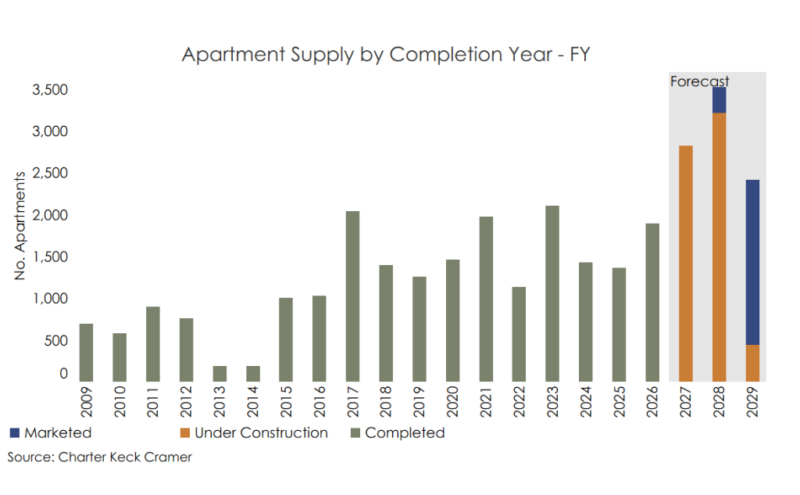
However, even there, the report warns that delivery remains dependent on the capacity of Queensland’s already stretched construction sector.

Note: In other words, a healthy-looking pipeline doesn't guarantee that every proposed apartment will reach completion.
Planning approvals are only the beginning
Governments often point to rezoning decisions and rising approval numbers as evidence that the housing supply problem is being addressed.
While these reforms are necessary, the CKC report makes clear that they are only one part of a much more complicated development process.
As Richard Temlett, National Executive Director of Research at Charter Keck Cramer, explained:
“The data makes clear that closing Australia’s housing gap isn’t only a question of planning approvals - it’s about the settings that determine whether approved projects can actually get built.”
It is well-documented that the economics of apartment development have become increasingly difficult. Building costs have risen sharply, borrowing has become more expensive, buyers have less capacity and developers must still achieve enough presales to satisfy lenders before construction can begin.
Charter Keck Cramer argues that land values, construction costs or achievable selling prices must adjust before many stalled markets can become viable again.
However, there is a limit to how much buyers can pay, particularly after higher interest rates have reduced borrowing capacity.
Land prices may eventually respond, but that process can be slow because owners are often reluctant to accept lower values.
That leaves construction costs as one of the most important variables, and the report calls for better productivity, greater use of modern methods of construction and more innovation across the building sector.
It also points to the “tax wedge” created by government taxes and charges, which adds to the cost of delivering new housing.
Until these issues are addressed, Australia may continue approving projects that developers can't afford to build, and buyers cannot afford to purchase.
Why investor presales still matter
The report also raises concerns about the Federal Budget’s changes to self-managed super fund lending, warning that the policy could unintentionally weaken future apartment supply.
Presales from investors have traditionally played a critical role in apartment development as they provide developers with early sales commitments and help demonstrate to lenders that there is sufficient demand for a project to proceed.
Without enough presales, finance may not be available, and construction may never begin.
- Also read:Migration Is Falling: What Happens to Australian Property Prices Now? | Property Insiders

- Also read:This week’s Australian Property Market Update – Latest Data, State by State September 22nd 2026

- Also read:Latest Property Price Forecasts. Australian Property Market Outlook 2026-2027: Navigating a Market Correction

- Also read:National Weekly Auction Report – September 19th 2026 | Clearance Rates Ease as Auctions Surge

- Also read:Adelaide housing market update | September 2026

Charter Keck Cramer estimates that SMSF investors account for around 20 to 30 per cent of off-the-plan buyers in parts of the Melbourne and Brisbane apartment markets.
Removing a significant proportion of that buyer pool could therefore affect more than individual investment decisions.
It could reduce the number of projects able to secure funding.
As Temlett noted,
“Investor presales have long been the mechanism that gets new supply out of the ground, and policy needs to account for that role rather than treat all buyers the same.”
This is a good example of why property policy must be based on a clear understanding of how new housing is financed and delivered.
Measures designed to discourage one form of investment can have consequences throughout the supply chain, particularly when the market is already struggling to produce enough new dwellings.
Build to Rent is becoming a permanent part of the market
While traditional Build to Sell apartment projects face growing headwinds, Build to Rent is expanding and is likely to become an increasingly important source of new housing.
Australia now has around 19,000 completed Build to Rent apartments, and Charter Keck Cramer expects the sector to deliver more than half of Melbourne’s new apartment completions in FY2027.
Melbourne already has thousands of Build to Rent apartments under construction, while additional projects are progressing in Sydney and Brisbane.
This represents a structural change in the way apartment housing is owned and supplied - instead of selling individual dwellings to owner-occupiers and private investors, Build to Rent developments are generally retained by a single institutional owner and professionally managed as long-term rental accommodation.
There is a valid role for this model, particularly in a country experiencing chronic rental shortages a well-designed and professionally operated developments can broaden housing choice and provide a more secure rental experience.
However, Build to Rent can't carry the entire housing market. As Temlett acknowledged, it is...
“a genuine part of the solution and institutional confidence in the sector remains strong, but it can’t close the gap on its own.”
Australia still needs a functioning Build to Sell market that allows owner-occupiers and private investors to purchase apartments, because institutional rental housing alone will not satisfy the full range of housing needs.
What this means for property investors
For investors, the report reinforces the importance of scarcity, location and replacement cost when choosing an investment-grade property.

Tip: If fewer new apartments are delivered while population growth continues, well-located established properties should benefit from stronger demand.
At the same time, rising construction and development costs make it increasingly expensive to create competing stock, supporting the long-term value of quality apartments in supply-constrained locations.
That doesn't mean every apartment will perform well - investors still need to avoid generic high-rise stock with little scarcity, poor owner-occupier appeal or excessive future competition.
The strongest prospects will remain in established suburbs with employment access, transport, amenities and a limited supply of comparable properties.
The growing shortfall also suggests rental markets will remain tight in many cities.
New supply is unlikely to arrive quickly enough to offset population growth, which should continue placing upward pressure on rents, although affordability will ultimately constrain how rapidly they can increase.
Where we go from here
Australia’s apartment shortage won't be solved by one level of government or a single policy change.
Planning reform is necessary, but so are viable development economics, reliable construction capacity, appropriate finance, sensible tax settings and policies that encourage capital to support new supply.
The encouraging part is that these problems are capable of being addressed.
Australia has the capital, expertise and underlying demand needed to build more homes.
Build to Rent is growing, major lenders are showing renewed interest in apartment finance and governments are beginning to recognise that approvals alone will not meet their housing targets.
For property investors, the broader message remains positive - Australia’s population will continue to grow, people will continue to seek homes close to jobs and amenities, and the supply of well-located housing will remain constrained.
The next property cycle will reward investors who understand that scarcity alone is not enough.
The real opportunity lies in owning the type of property that people with choices will want to buy and rent, in locations where new supply is difficult, expensive and slow to deliver.