


Key takeaways
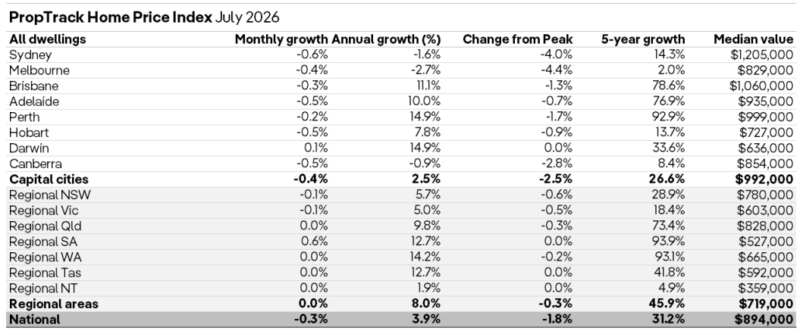
National home prices fell by 0.3% in July and are now sitting 1.8% lower compared to the peak level seen in March 2026
Despite the fall, prices remain higher in most markets compared to a year ago and are up 3.9% nationally
Sydney (-0.6%) saw the largest drop in prices over July, followed Adelaide (-0.5%), Hobart (-0.5%), Canberra (-0.5%), and Melbourne (-0.4%)
Darwin (+0.1%) was the only capital city to see prices rise, hitting a new peak in July, though growth has moderated
Regional areas continued to outperform their capital city counterparts in July, holding steady in most markets over the month
Perth and Darwin have been the strongest performers over the past 12 months, each up 14.9%
Australian home prices fell for the fourth straight month in July, with capital cities driving the decline, according to the latest Home Price Index from PropTrack.
Data shows that the median price of an Australian home fell by 0.3% in July to reach $894,000. Houses were down 0.4% to $989,000, while units were down 0.2% to $730,000.
Capital cities were the primary driver of price falls nationally, with every market except Darwin seeing prices move lower over the month.
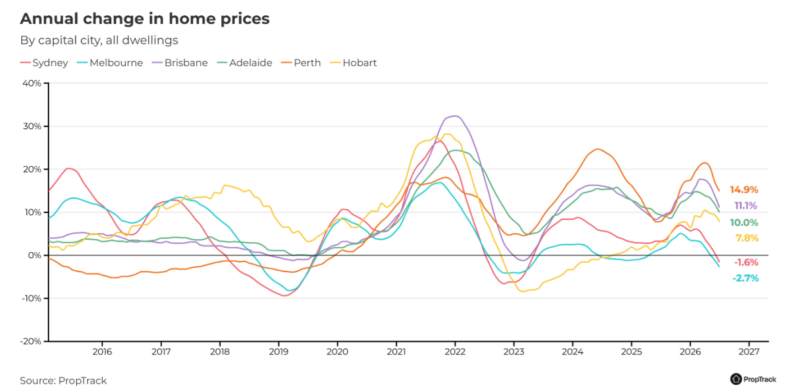
The combined capital cities saw prices down 0.4% in July, with prices down 2.5% since the peak of the market in March of this year.
Anne Flaherty, PropTrack's Senior Economist at PropTrack said:
"High interest rates continue to weigh on prices by constraining borrowing capacities which could be exacerbated if we see another interest rate rise this year.
Cost of living pressures are also stretching buyers’ budgets, with inflation still above target levels.
Budget tax changes are also likely impacting overall buyer demand, and ongoing price falls could be driving some buyers to delay purchasing until prices stabilise."
Home prices in Australia’s regional areas continued to show greater resilience
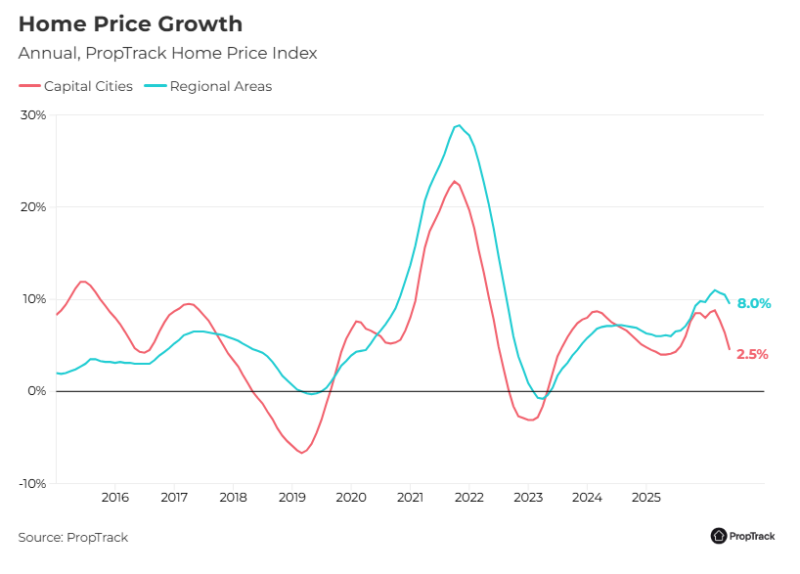
PropTrack's data show that home prices in Australia’s regional areas continued to show greater resilience than the capital cities, with the combined regional areas seeing prices hold steady over the month.
Prices in the regions were just 0.3% below their peak levels in July, with regional markets in South Australia, Tasmania, and Northern Territory still at record highs.
Regional South Australia was the strongest performer over July, with prices jumping 0.6%.
Overall, regional home prices remain 8% higher compared to a year ago.
Ms Flaherty further explained:
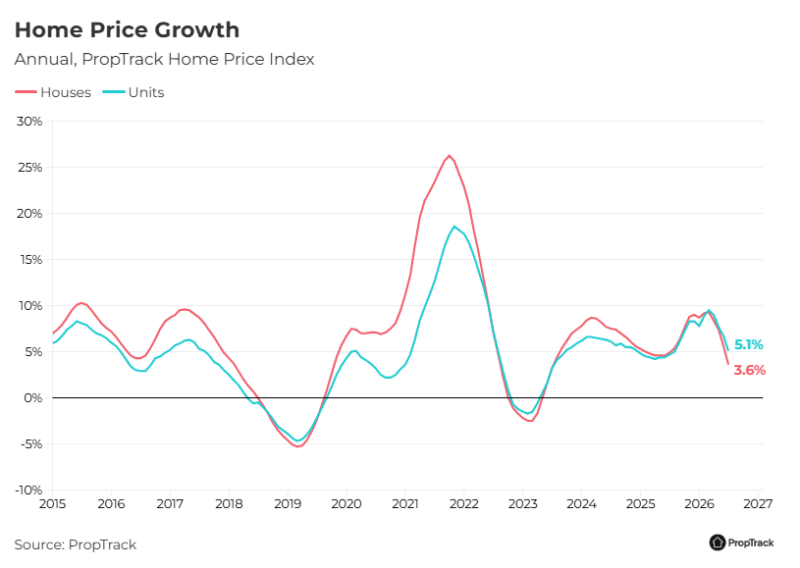
"While houses have historically outpaced units for price growth, this trend has reversed over the past year, with houses seeing 3.6% growth nationally compared to 5.1% for units.
Affordability may be a contributor here, with a growing share of buyers priced out of purchasing houses, particularly in the more expensive established inner and middle ring suburbs.
- Also read:Melbourne housing market update | September 2026
- Also read:This week’s Australian Property Market Update – Latest Data, State by State September 15th 2026
- Also read:Australian housing market update | September 2026
- Also read:Latest Property Price Forecasts. Australian Property Market Outlook 2026-2027: Navigating a Market Correction
- Also read:Everything you need to know about the state of Australia’s property markets in 20 charts – September 2026
The high average price point of new unit developments could also be contributing to the rise, with the majority of new unit stock priced above established stock."




Houses vs units
According to PropTrack, while houses have historically outpaced units for price growth, this trend has reversed over the past year, with houses seeing 3.6% growth nationally compared to 5.1% for units.
Affordability may be a contributor here, with a growing share of buyers priced out of purchasing houses, particularly in the more expensive established inner and middle ring suburbs.
The high average price point of new unit developments could also be contributing to the rise, with the majority of new unit stock priced above established stock.
Outlook
Ms Flaherty notes that home prices likely have further to fall in 2026, though the magnitude of further declines will be determined by whether interest rates are lifted as well as the number of homes listed for sale.
Additionally, she said that the the full impact of the budget on investor demand is still unclear, in particular, how much this is likely to reduce overall buyer demand.
She further commented:
"Despite current headwinds, the fundamentals underpinning home price growth over the long term remain unchanged.
Most capital cities and regional markets continue to face a shortage of housing relative to population growth which will limit the extent to which home prices can fall over the long term."
What this means for property investors
With our housing markets still finding their feet heading into Spring, there will likely be periods over the coming months where buyer competition eases in certain locations.
For strategic, long-term investors with their finances in order, that's often when the best opportunities present themselves, well before the broader market senses the recovery and the crowd returns, which is not likely to occur until inflation comes under control and interest rates start falling.
If you'd like help building a property strategy that can weather these conditions and take advantage of the opportunities they create, get in touch with our team at Metropole. We help our clients build, protect and pass on intergenerational wealth through strategic property advice, and we'd be happy to talk through how these latest figures might affect your own portfolio plans.
At Metropole, our wealth strategists take the time to understand where you are today, where you want to be, and whether your property, finance and wealth strategies are working together.
If you’d like greater clarity and a personalised roadmap for safely growing, protecting and eventually passing on your wealth, click here now and book a complimentary Wealth Discovery Chat with a Metropole Wealth Strategist.