

Key takeaways
Since 2000, overall housing costs have increased by an average of 4 per cent a year, compared with CPI inflation of 3 per cent.
Ashley Owen’s analysis shows electricity and gas prices have more than quadrupled, while state property taxes have risen by around 250 per cent.
Federal policies have added demand through population growth, grants, guarantees and tax settings without ensuring sufficient housing supply.
State governments have increased taxes and construction costs while failing to release enough serviced land or deliver efficient planning systems.
Local councils have restricted density, delayed approvals and imposed costly infrastructure and compliance requirements.
Investors and homeowners absorb many of these costs initially, but over time a large proportion flows through to tenants in higher rents.
Australia’s housing affordability crisis is the predictable result of decades of policies that increased demand, restricted supply and raised the cost of providing homes.
Australians are regularly told that inflation is running at a certain annual rate, yet many households look at their mortgage payments, rent, electricity bills, council rates, and insurance premiums and wonder whose cost of living the official figures really measure.
Their experience feels very different because the headline Consumer Price Index is an average across a broad basket of goods and services. It tells us something useful about price movements across the economy, but it doesn’t necessarily describe the inflation experienced by an individual household.
This is particularly true when it comes to housing.
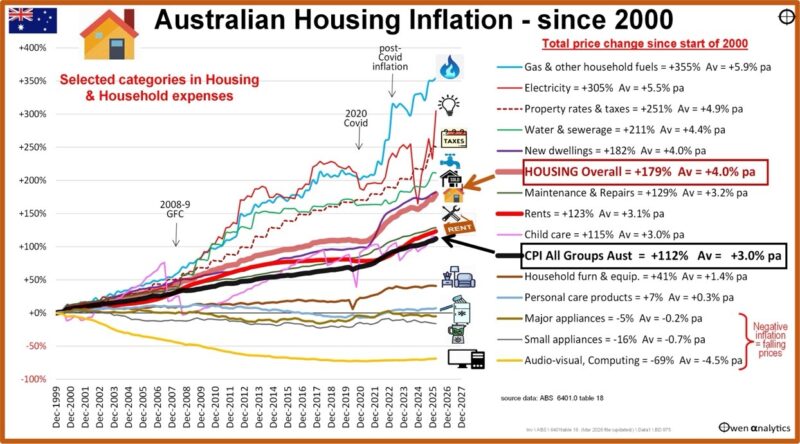
Recent analysis by Ashley Owen of Owen Analytics shows that overall housing cost inflation has averaged 4 per cent a year since 2000, compared with average CPI inflation of 3 per cent.
That one percentage point gap may sound modest, but compounding turns it into a substantial difference over 25 years. Something rising by 3 per cent annually roughly doubles over that period, while something increasing by 4 per cent rises by around 167 per cent.
And, of course, some housing expenses have risen much faster than the overall housing average.
Source: Owen Analytics
In my mind, the bigger concern is that many of the fastest-rising costs are either controlled by governments or heavily influenced by government policies.
Housing inflation is much broader than house prices
Before going further, it is important to explain what we mean by housing inflation.
The price of established homes is generally excluded from the CPI because purchasing a property is treated as acquiring an asset rather than consuming a good or service. Similarly, mortgage principal repayments are not included in the headline CPI.
The housing component of CPI includes expenses such as rents and the cost of constructing new owner-occupied dwellings, utilities and some other housing-related charges.
This means official housing inflation and property price growth are different measures, even though they affect one another.
A first-home buyer may face an enormous increase in the deposit needed to purchase a property even when headline CPI appears relatively contained.
An existing homeowner may see little change in the value of the services they consume, yet experience a sharp increase in mortgage repayments when interest rates rise.
A renter may experience another form of housing inflation altogether through rising rents, electricity costs and other household expenses.
In other words, there is no single housing crisis because different households are being squeezed in different ways. However, the same policy failures underpin much of these pressures.
The compounding cost of government-controlled services
Ashley Owen’s chart shows that electricity and gas prices have recorded the highest inflation among the major housing components, rising by more than 5 per cent per year on average since 2000. Over that period, electricity and gas prices have more than quadrupled, while the overall CPI basket has roughly doubled.
This is an extraordinary outcome for a country blessed with vast reserves of coal, gas and renewable energy resources.
Australia is one of the world’s largest energy exporters, yet households and businesses continue to face high and volatile domestic energy costs.
This cannot be blamed entirely on overseas wars or temporary supply disruptions because the underlying trend began long before recent geopolitical conflicts.
Energy policy is divided between federal and state governments, creating a complex mix of regulation, infrastructure investment, environmental policy, subsidies and market intervention.
Every layer can point to another part of the system when prices rise, but households still receive the bill.
As Ashley Owen puts it, “The real problem is rapidly rising costs of utilities.”
State governments have become increasingly dependent on property
State governments are among the biggest financial beneficiaries of rising property values. They collect stamp duty when properties change hands, land tax from investors and certain other property owners, payroll tax from businesses engaged in development and construction, and a range of levies and infrastructure contributions.
According to Owen’s analysis, state property taxes have increased by around 250 per cent since 2000, equivalent to average inflation of approximately 4.9 per cent a year.
Governments often describe these charges as taxes on investors or developers, as if the cost stops with the person or company writing the cheque. It doesn’t!
A developer incorporates taxes, levies and approval costs into the price required to make a project financially viable. A builder passes higher compliance and employment costs on to clients where the market allows.
And an investor must eventually recover rising ownership costs through rent or accept a lower return.
When a development project no longer stacks up financially, it may not proceed at all. This further restricts supply and adds upward pressure on the price of existing homes and rents.
Victoria provides a useful warning of what happens when governments treat property owners as an endlessly available source of revenue.
Higher land taxes, expanding rental regulation and additional compliance costs have discouraged some investors, even as the state desperately needs more rental accommodation.
Tenants may not receive the tax assessment, but they are ultimately exposed to the consequences in the form of reduced rental supply and rising rents.
Federal governments keep adding demand
The Commonwealth doesn’t control local zoning or most residential planning, but it has enormous influence over the demand side of the housing equation.
The federal government sets migration policy, influences the availability and cost of credit, funds housing programs and introduces grants, guarantees and concessions intended to help buyers enter the market.
Australia needs migration, particularly skilled migration, to support economic growth and offset an ageing population. However, population policy must be connected to housing and infrastructure capacity.
For many years, governments have allowed the population to grow much faster than the housing stock without requiring a credible plan to accommodate the additional demand.
At the same time, successive federal governments have introduced first-home buyer incentives that increase purchasing power without increasing the number of homes available.
Deposit guarantees, grants, shared-equity arrangements and expanded borrowing capacity can help selected buyers compete more effectively, but they also increase the amount of money chasing a limited supply of property. This tends to bring forward demand and push prices higher, leaving the next group of buyers facing an even larger affordability hurdle.
I believe there is a place for targeted assistance, especially for lower-income households, but demand subsidies cannot substitute for housing supply. Unfortunately, they are politically attractive because the benefits are immediate and visible, whereas the price effects emerge gradually across the market.
As I see it, the RBA also deserves a share of responsibility, although it operates independently of the government.
Ultra-low interest rates and extraordinary monetary support during the pandemic significantly increased borrowing capacity and fuelled the surge in property prices. When rates were subsequently raised rapidly, many borrowers faced substantially higher mortgage repayments.
Monetary policy didn’t create Australia’s housing shortage, but it amplified both the upswing in prices and the later pressure on household budgets.
State planning systems restrict supply
State governments control the broader planning framework, building regulations, public infrastructure and the release of land.
For decades, governments have announced ambitious housing targets while keeping planning systems that make those targets difficult to achieve.
The National Housing Supply and Affordability Council has described Australia’s housing crisis as one that has been decades in the making. It has highlighted deteriorating affordability, weak new housing supply, labour shortages, rising material costs and reduced project feasibility.
Meanwhile, the Productivity Commission has found that productivity in housing construction has declined over the past 30 years.
Builders are dealing with increasingly complex building codes, planning rules, environmental requirements, workplace arrangements and approval processes. Many individual regulations have reasonable objectives, but governments rarely consider their combined impact on costs, productivity and supply.
Each new requirement may add only a small amount to the cost of a dwelling, but when layered together, they can add tens of thousands of dollars, extend delivery times and make marginal projects unviable.
The people who eventually pay are homebuyers and tenants.
- Also read:Latest Property Price Forecasts. Australian Property Market Outlook 2026-2027: Navigating a Market Correction

- Also read:Brisbane Property Market Forecast [2026 & Beyond] – What The Olympics Decade Means for Investors.
- Also read:Melbourne property market forecast for 2026 & 2027 | Separating the fundamentals from the sentiment
- Also read:Sydney property market forecast for 2026 and 2027 | Why the short-term softness is a long-term opportunity
- Also read:This week’s Australian Property Market Update – Latest Data, State by State August 25th 2026

Local councils have helped preserve scarcity
Local councils are often overlooked in the national housing debate, yet they wield significant power over what can be built, where it can be built and how long approval takes.
Councils influence zoning, density, heritage overlays, parking requirements, building heights and neighbourhood character rules. They also impose application fees, infrastructure contributions and other costs.
There are legitimate reasons to protect valued streetscapes, provide infrastructure and prevent inappropriate development. However, some councils have effectively responded to housing demand by preserving existing neighbourhoods while shifting the responsibility for new supply elsewhere.
This is particularly damaging in well-located suburbs near employment, public transport, schools and established amenities.
Of course, Australia does not need high-rise towers on every suburban street, but we do need more of the missing middle, including townhouses, villa units, duplexes and well-designed boutique apartment developments.
Allowing appropriate medium-density housing in established suburbs would make better use of existing infrastructure and offer more choices for downsizers, young families and renters.
Too often, local planning systems give existing homeowners a strong voice in opposing change, while future residents, who would benefit from additional housing, have no representation.
That creates an understandable political bias towards scarcity.
Construction costs are also policy costs
Owen’s analysis shows that new dwelling construction costs have risen by about 4 per cent a year since 2000, again exceeding overall CPI.
Some of this reflects unavoidable increases in labour, materials and energy costs. The pandemic disrupted supply chains, many builders failed, skilled tradespeople became scarce and financing costs rose sharply.
Yet government policy is embedded throughout the construction process. Taxes apply to land acquisition, employment, materials, and completed property transactions. Building standards continue to expand. Approvals can take years, and delays add financing and holding costs before construction begins.
Infrastructure charges are also increasingly loaded onto new developments, even though the roads, schools, public transport and community facilities being funded will serve the wider population for decades.
This means today’s homebuyers are often expected to fund infrastructure that previous generations received through broader government revenue.
Governments then express surprise when newly constructed homes cost more than established properties and projects struggle to achieve enough presales to obtain finance.
Renters may be carrying the heaviest burden
Interestingly, Ashley Owen’s long-term data shows that rents increased by an average of 3.1 per cent a year from 2000 to March 2026, only slightly above average CPI inflation.
That doesn’t mean renters have had an easy time.
Rents have risen much more rapidly in recent years because population growth has exceeded the supply of new rental properties in many locations. Vacancy rates remain tight, while the cost of holding and supplying rental accommodation has increased.
Renters also tend to spend a larger share of their income on housing, electricity, gas and food, which have experienced relatively high inflation. Higher-income households generally have more discretionary spending on goods such as technology, appliances and furniture, many of which have become cheaper in real terms.
Consequently, two households facing the same headline CPI rate can experience markedly different changes in their living standards.
Rental regulations that increase security and improve minimum standards may deliver worthwhile protections, but governments must acknowledge their costs.
If new rules make rental property substantially more expensive or risky to provide, some owners will leave the market and fewer investors will replace them. The remaining rental stock then becomes more expensive.
Governments cannot regulate away the cost of providing housing.
Investors did not create the shortage
Property investors are often blamed for Australia’s housing affordability problem because they compete with owner-occupiers and receive tax deductions for legitimate investment expenses.
While this explanation may be politically convenient, it ignores the role investors play in supplying most of Australia’s rental accommodation.
The typical investor owns one or two properties and faces the same higher borrowing costs, council rates, insurance premiums, maintenance expenses and state taxes as other property owners.
Many investors have experienced years in which their expenses increased much faster than the rent they received.
Landlords don’t have unlimited power to set rents. Rents are ultimately determined by the balance between the number of tenants seeking accommodation and the number of available properties.
When vacancy rates are high, landlords must compete for tenants. When vacancy rates fall towards 1 per cent, as they have lately, tenants are forced to compete for homes.
The sustainable way to moderate rents is to create more rental accommodation relative to demand.
Penalising the people who provide that accommodation may be emotionally satisfying to some voters, but it is unlikely to improve affordability.
We have built a system that rewards announcements rather than homes
Australia’s housing debate is full of targets, funds, incentives and announcements, yet the number that matters is the number of suitable homes completed in the locations where people want to live.
Governments announce assistance for first-home buyers while introducing taxes and regulations that increase the cost of supplying homes.
They promise ambitious construction targets while maintaining approval systems that delay projects and reduce feasibility.
They encourage institutional investment in rental housing while making conditions increasingly difficult for the small investors who currently provide most rental accommodation.
They support strong population growth without ensuring that states and councils have the infrastructure, planning capacity and incentives required to accommodate it.
These policies may be managed by different departments and different levels of government, but households experience their combined effect in a single weekly rent payment or monthly mortgage repayment.
What governments should do now
There will be no single policy that makes Australian housing affordable again, and any politician promising a quick fix should be treated with caution.
However, governments could stop making the problem worse.
Federal housing assistance should be more tightly targeted and linked to genuine additional supply. Population policy should also take account of housing availability and infrastructure capacity, rather than being considered in isolation.
State governments should reduce their reliance on inefficient property taxes, simplify planning systems and establish firm approval timeframes. They also need to release serviced land more effectively and permit appropriate medium-density development in established suburbs.
Local councils should be rewarded for accommodating additional housing and held accountable when approval delays or restrictive zoning prevent the achievement of agreed targets.
All three levels of government should subject proposed housing regulations, taxes and building standards to a transparent, cumulative cost assessment. The public deserves to know how much each policy adds to the final price of a home or to the weekly rent required to make an investment viable.
Governments should also recognise that private investors remain essential to the rental market. Stable, predictable rules will attract long-term investment far more effectively than a cycle of incentives followed by punitive taxes and regulations.
The bottom line
Australia’s housing affordability crisis did not arrive suddenly, and it can’t be blamed on one group of buyers, property investors or a single period of high migration.
It is the cumulative result of decades of government decisions that stimulated demand, restricted supply and increased the cost of constructing, owning and providing housing.
Ashley Owen’s chart makes the consequences clear. Since 2000, housing costs have risen faster than the general inflation rate, while several government influenced costs have risen fastest of all.
For property investors, the lesson is that government policy has become an increasingly important factor in risk assessment. Tax settings, planning rules, energy policy and rental regulation can materially affect returns and future supply.
For homeowners and renters, the lesson is more sobering. Housing costs are unlikely to become meaningfully more affordable while governments continue to treat housing as a source of tax revenue, political announcements and tightly controlled scarcity.
Australia can build more homes and provide more affordable housing choices, but that will require all three levels of government to accept responsibility for the costs and restrictions they have created.