
Key takeaways
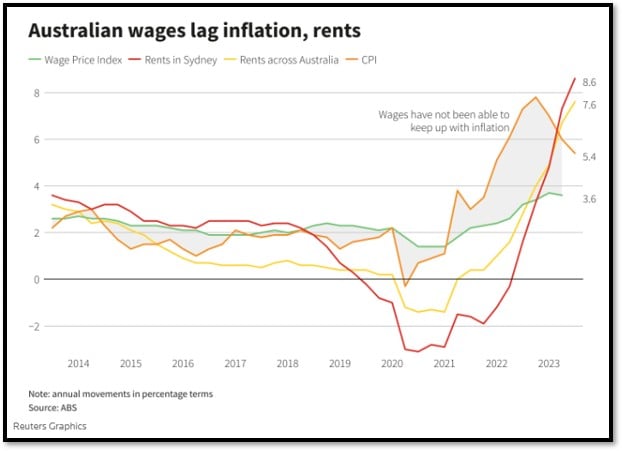
Australia's rental crisis is getting worse, not better. Rents are rising faster than both inflation and wages, putting increasing pressure on household budgets.
Rental supply is shrinking as demand keeps growing. Fewer investment properties and strong population growth are creating a widening gap between available homes and renters.
Policy changes risk making the housing shortage even worse. Tax reforms and fewer new housing projects could further reduce the supply of rental properties.
Higher living costs are adding to financial pressure. Rising energy, utility and housing costs are increasing the risk of stagflation and squeezing household finances.
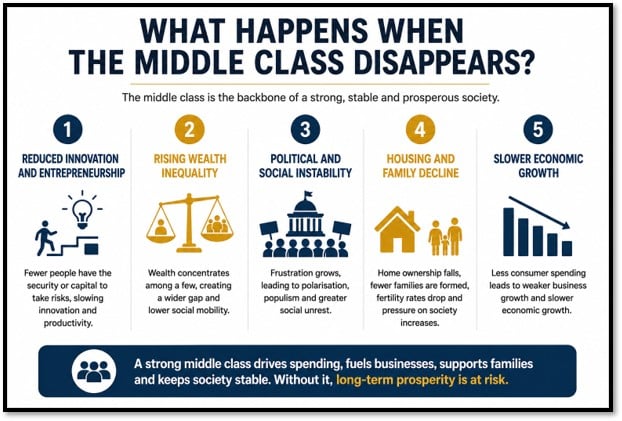
The long-term consequences extend beyond housing. A prolonged rental crisis could widen wealth inequality, weaken the middle class and reduce Australia's long-term economic and social stability.
If you think we are in a rental crisis now, hold onto your hat!
The Australian property market is currently navigating a "perfect storm," but it’s not the kind that clears the air.
Instead, it’s a convergence of policy shifts, supply shortages, and economic pressures that threaten to fundamentally reshape the fabric of our society.
Based on recent data following the latest federal budget, the rental landscape is moving from a "crunch" to a full-blown crisis.
Here is a deep dive into why this is happening and what it means for the average Australian.

The numbers don’t lie: rents are skyrocketing
Following the federal budget, there has been much speculation about what will happen to rents. While many hoped for a cooling period, the first full month following the budget has shown the opposite.
Of course, landlords can’t renew rents every week, so expect a lag until existing leases come up for renewal, when we can expect a significant jump in rentals.
But even before this happens nationally, rents are rising at a rate of approximately 6% annually
However, when we drill down into specific capital cities, the figures are even more alarming:
- Perth, Hobart, and Darwin: Seeing increases closer to 8–10%.
- Melbounre near 5%, Sydney closer to 6% and Brisbane 6.4%
- National Average: Rents are currently growing higher and significantly outpacing both inflation (5.4%) and wage growth (3.6%).
For the average Australian tenant, this means your wage is effectively going backwards, as the gap between what you earn and what you pay to keep a roof over your head is widening every single day.
The "vanishing" rental supply
The most concerning trend I see is the disappearance of rental stock.
Despite political rhetoric suggesting that selling off investment properties helps first-home buyers, the data tells a different story.
In major hubs, the "bedroom count" is even more alarming:
- Sydney: While 2,159 bedrooms were added, 3,744 were sold.
- Melbourne: Lost 640 rental homes in May alone, representing over 1,000 bedrooms no longer available to tenants.
- Brisbane: Saw a net loss of over 330 properties from the rental pool.
Some argue that investors selling to owner-occupiers is a win, and it very well may be in some cases.
However, this ignores the 450,000 people entering the country each and every year.
Of course, these new arrivals don't bring homes with them and almost exclusively rent for their first few years while they find jobs and establish roots.
- Also read:Migration Is Falling: What Happens to Australian Property Prices Now? | Property Insiders

- Also read:This week’s Australian Property Market Update – Latest Data, State by State September 22nd 2026

- Also read:Latest Property Price Forecasts. Australian Property Market Outlook 2026-2027: Navigating a Market Correction

- Also read:National Weekly Auction Report – September 19th 2026 | Clearance Rates Ease as Auctions Surge

- Also read:Adelaide housing market update | September 2026

If we strip away supply while adding record demand, we aren't "fixing" the market - we are creating a recipe for disaster.
The Policy Paradox: negative gearing and tax reform
Negative gearing reforms are already casting a shadow over the market before they’ve even fully kicked in.
The government has traditionally relied on private investors to provide the "social housing" the state fails to build, but by disincentivising these investors, the rental pool is shrinking.
In addition, new home construction has hit 12-year lows. Under the recent tax reforms, it is estimated that 35,000 fewer homes will be built each year.
When you combine this with "thought bubble" policy changes regarding superannuation funds and residential property, the pipeline for new housing is effectively being choked off.
The threat of stagflation
It isn't just housing. We are seeing a "skyrocketing" of non-discretionary costs:
- Energy Prices: Up 20% in the last 12 months.
- Essential Utilities: Gas, fuel, and water have all outpaced discretionary spending.
While people can cut back on "discretionary" items like small appliances or personal care, they cannot cut back on electricity or rent, which are spiralling upward.
If inflation continues to rise while GDP growth falls, Australia faces the looming threat of Stagflation - an economic nightmare that most modern economies strive to avoid at all costs.
The disappearing middle class
Perhaps the most significant takeaway is the long-term social impact to our culture and society.
A strong middle class is the engine of the Australian economy; it drives spending, fuels small businesses, and maintains social stability.
If the current trajectory continues, we face:
- Rising Wealth Inequality: Wealth concentrating among a small group of Australians, with the gap widening for everyone else.
- Reduced Innovation: When "having a go" or investing in property becomes impossible for the average person, entrepreneurship dies.
- Social Instability: We are seeing early signs of the polarisation and unrest that have already gripped parts of Europe and the US.
The bottom line
The rental crisis is much more than just a housing issue; it is a direct threat to the Australian way of life.
When home ownership rates fall, and the cost of living outstrips wages, the "middle class rock" of our society begins to crumble.
We need to stop relying on policy "thought bubbles" and start addressing the fundamental reality of supply and demand.
It should be every Australian’s right to have a pathway to build a future for their families and improve their circumstances, which in turn takes the burden off of Governments come retirement.
Without a course correction, the divide between the "haves" and the "have-nots" will become a permanent canyon and threaten this great nation.