

Key takeaways
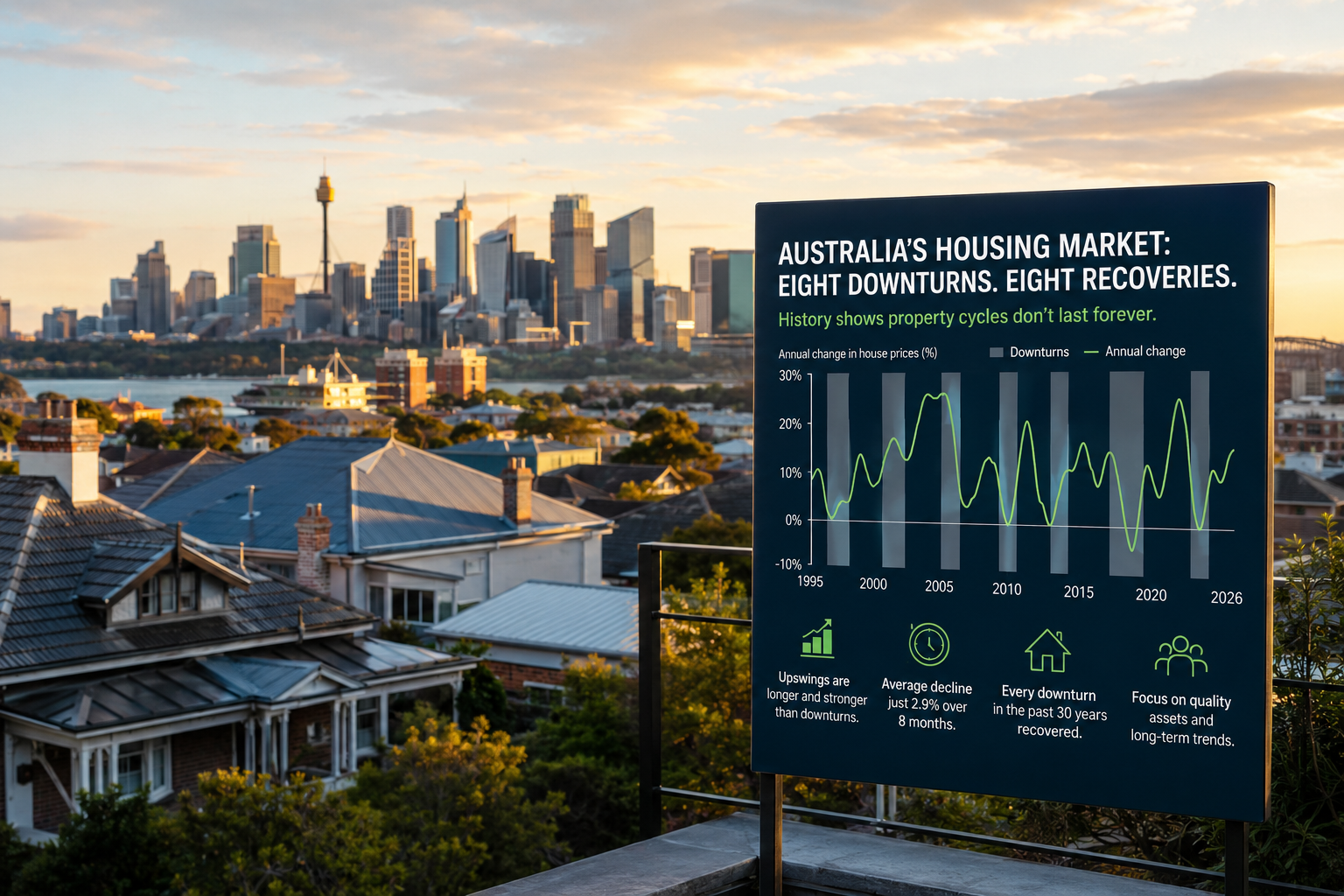
Australia's housing market has experienced eight downturns since the mid-1990s. Each one was followed by a recovery that pushed prices to new highs.
Property booms have consistently lasted longer and delivered much larger gains than the downturns that followed. Long-term investors have historically come out ahead.
Each downturn has been triggered by different factors, including credit tightening, interest rates or economic shocks. While the causes change, the cyclical pattern remains consistent.
Australia doesn't have one property market. While Sydney and Melbourne are slowing, Brisbane, Perth and Adelaide continue to be supported by strong population growth and housing shortages.
Australia still faces a chronic shortage of housing, with strong population growth and tight rental markets. These structural factors provide long-term support for quality property values.
History shows that property recoveries typically begin when borrowing conditions improve. Lower interest rates boost borrowing capacity, confidence and buyer demand.
Short-term price falls are part of every property cycle. Investors who stay focused on quality assets and long-term fundamentals are usually rewarded over time.
If you've been following the property headlines lately, you could be forgiven for thinking Australia is heading towards another housing crisis.
House prices are easing across many of our capital cities, consumer confidence has weakened and borrowing has become more expensive.
Some commentators are once again predicting large price falls and urging buyers to stay on the sidelines.
I've seen this movie before. In fact, if you've been investing long enough, you've probably seen it several times yourself.
After more than five decades of investing through multiple property cycles, I've learned that while every downturn feels different at the time, they almost always share one characteristic.
People assume this time is different, yet history tells a remarkably consistent story.
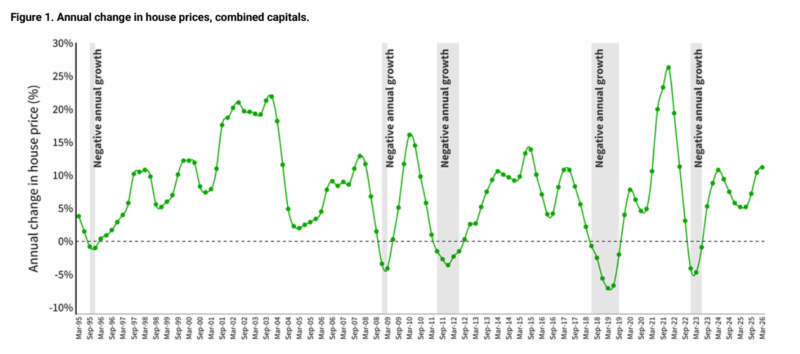
A recent analysis by Domain looked back over more than 30 years of Australian housing data and identified eight separate housing downturns across the combined capital cities since the mid-1990s.
The remarkable part?
Every one of those downturns was followed by a recovery that more than erased the losses and ultimately pushed prices to new highs.
That doesn't mean prices can't fall further in the short term.
It simply reminds us that corrections are a feature of Australia's property market, not a flaw.
Property markets don't move in straight lines
One of the biggest misconceptions many investors have is expecting property values to rise steadily year after year.
Markets simply don't work that way.
Property moves through predictable cycles driven by changing economic conditions, credit availability, affordability, population growth, sentiment and interest rates.
There are periods when prices accelerate rapidly. There are periods when they pause. And there are periods when prices drift backwards.
The problem is that while booms create excitement, downturns create fear. Fear attracts headlines.
Unfortunately, headlines rarely provide perspective.
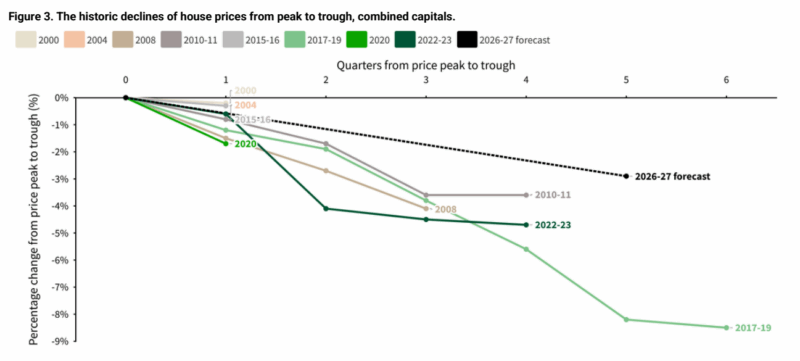
According to Domain's research, Australia's eight completed downturns have averaged a peak-to-trough decline of just 2.9% over approximately eight months.
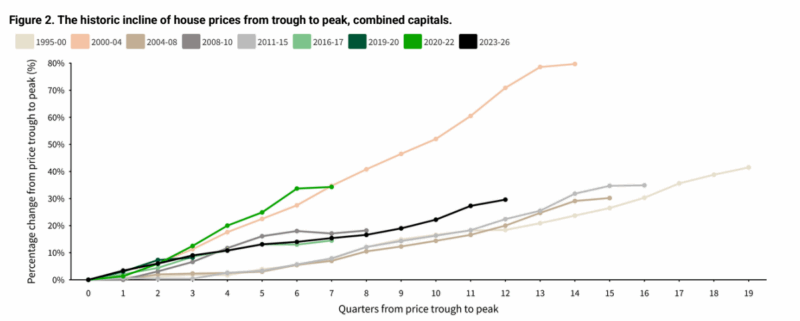
By comparison, the average upswing delivered gains of 32.3% over almost three years.
That's a very different picture from the impression many media reports create.
As Domain's Chief of Research and Economics, Dr Nicola Powell, explains:
"Australia has recorded eight distinct housing downturns since the early 1990s. Each one was followed by a recovery that erased the losses and pushed prices to a new high."
That's an observation investors shouldn't ignore.
The gains have consistently outweighed the losses
When most people think about market cycles, they tend to focus on the downturn.
Experienced investors focus on the complete cycle.
Domain's research compared every growth phase with the downturn that followed.
In every completed cycle, the upswing was larger than the subsequent correction. In almost every case, it also lasted considerably longer.
The longest expansion ran for almost five years. The strongest produced almost 80% capital growth across the combined capitals between 2000 and 2004.
Even the current cycle, which is now coming to an end, has delivered extraordinary gains in some cities.
Perth house prices have risen almost 78% from their most recent trough.
Brisbane has climbed more than 63%.
Those gains didn't disappear because prices have recently begun easing elsewhere.
This is exactly why successful investors think in decades rather than quarters.
Every downturn has its own trigger
Although every cycle follows a familiar pattern, the causes are rarely identical.
The 2008 correction coincided with the Global Financial Crisis.
The 2017-19 downturn was driven largely by regulatory intervention rather than economic weakness.
APRA restricted investor lending. Banks tightened serviceability requirements.
The Banking Royal Commission made lenders far more conservative. Credit became harder to obtain. Prices adjusted accordingly.
Then lending conditions gradually improved. Confidence returned. And the next upswing began.
Today's environment is different again.
Higher interest rates have reduced borrowing capacity. Households are feeling pressure from higher living costs. Confidence has softened.
Some investors are reassessing their positions following taxation changes and policy uncertainty.
Different causes. Same cycle.
The current downturn isn't affecting every city equally
One of the biggest mistakes investors make is talking about "the Australian property market" as though every city behaves the same way.
They don't.
Property markets are highly fragmented.
Sydney and Melbourne are currently leading the downturn.
Brisbane, Perth and Adelaide are not.
According to Domain's forecasts, Perth house prices are expected to continue rising between 5% and 9% over FY2027, while Brisbane is forecast to grow by between 3% and 7%.
- Also read:Latest Property Price Forecasts. Australian Property Market Outlook 2026-2027: Navigating a Market Correction

- Also read:Brisbane Property Market Forecast [2026 & Beyond] – What The Olympics Decade Means for Investors.
- Also read:Sydney property market forecast for 2026 and 2027 | Why the short-term softness is a long-term opportunity

- Also read:Melbourne property market forecast for 2026 & 2027 | Separating the fundamentals from the sentiment

- Also read:Home Prices Slide Further Downwards Over August | Latest Property Market Stats

Those markets continue to benefit from strong interstate migration, population growth, extremely tight rental markets and ongoing housing shortages.
In other words, the underlying fundamentals remain intact.
That's why sophisticated investors spend less time worrying about national averages and more time understanding individual markets.
Melbourne may offer opportunity rather than risk
Many investors have become increasingly cautious about Melbourne.
That's understandable.
Domain forecasts Melbourne house prices could decline between 4% and 8% during FY2027, making it the weakest-performing capital city over the coming year.
But I'd encourage investors to look beyond the next twelve months.
Melbourne didn't experience the extraordinary growth enjoyed by Perth or Brisbane during the recent cycle.
That means it's entering this correction from a much lower starting point.
History tells us that markets which temporarily underperform often provide attractive buying opportunities for investors prepared to look beyond today's headlines.
Melbourne remains Australia's second-largest city.
Its population continues growing. Its economy is highly diversified. It remains significantly more affordable than Sydney on many measures.
Those long-term fundamentals haven't disappeared.
Supply shortages haven't gone away
Whenever markets weaken, many people assume demand has collapsed.
Often the real story is far more nuanced.
Australia continues to face a chronic shortage of housing.
Population growth remains strong.
Vacancy rates across many cities remain historically low.
Construction activity continues struggling with labour shortages, rising costs and planning delays.
These structural imbalances don't disappear simply because buyer sentiment weakens for a few quarters.
In fact, Domain notes that these supply shortages continue providing an important floor beneath prices, particularly in cities such as Brisbane and Perth where demand remains exceptionally strong.
This is one reason I remain optimistic about the long-term outlook for quality residential property.
Interest rates will determine the timing
If history teaches us one lesson above all others, it's this.
Recoveries almost always begin when borrowing conditions improve.
Every previous recovery has been supported by the interest rate cycle turning.
Lower interest rates increase borrowing capacity.
Greater borrowing capacity allows buyers to pay more.
Confidence gradually returns. Demand rebuilds. Prices begin rising again.
Dr Powell points out that while the exact timing remains uncertain, the path of interest rates will largely determine both the depth and duration of the current downturn.
A delayed reduction in rates could prolong weaker conditions, but it wouldn't necessarily change the longer-term trajectory.
The biggest risk isn't the downturn itself
In my experience, investors rarely build wealth by perfectly timing the market.
They build wealth by owning quality assets for long periods while allowing compounding to work its magic.
Ironically, the biggest risk during downturns often isn't falling prices.
It's making emotional decisions.
I've seen investors sell quality properties at exactly the wrong time because they became caught up in negative headlines.
I've also seen others wait years for the "perfect" buying opportunity, only to discover the recovery had already begun before they felt comfortable enough to act.
Markets don't send invitations when they reach the bottom.
By the time confidence returns, prices are usually already moving higher.
The lesson history keeps teaching
History never repeats itself perfectly.
Every cycle has different drivers.
Different economic conditions. Different policy settings. Different levels of confidence.
But Australia's housing market has now experienced eight major downturns over the past three decades.
Each one felt uncomfortable while it was unfolding. Each one generated predictions that things had fundamentally changed.
And each one was eventually followed by a recovery that carried prices beyond their previous highs. That doesn't guarantee the current cycle will unfold exactly the same way.
But it does reinforce an important investing principle. Short-term corrections are part of investing.
Long-term wealth is created by understanding the cycle rather than fearing it.
For investors with a strategic plan, today's market shouldn't simply be viewed through the lens of falling prices.
It should also be viewed as another chapter in a property cycle that has rewarded patient, well-informed investors time and time again.