


Key takeaways
Australia's 11.5 million residents aged 25-54 are the single most powerful force driving housing demand, consumer spending, and the tax base - and where this cohort grows, property markets follow.
Official projections show this key cohort will grow by 13 per cent nationally over the decade to 2036, but the variation between locations is enormous - from 71 per cent growth in Victoria's Mitchell Shire to an 18 per cent decline in Sydney's Mosman.
Victoria leads all states with projected 15 per cent growth in this cohort, reinforcing the long-term investment case for Melbourne and its surrounding regions.
Areas like Mitchell Shire, Baw Baw, and the Sunshine Coast are set to absorb significant new household formation over the coming decade - the kind of structural demand that drives sustained capital growth.
Some of Australia's most prestigious addresses, including Mornington Peninsula and Sydney's Mosman, face a shrinking productive-age population as older residents age in place and younger buyers are priced out.
From around 2036, the Great Wealth Transfer - as baby boomers pass on wealth in large numbers - is likely to inject younger buyers into many of these established markets, creating a second wave of opportunity for patient investors.
Demographics don't move fast, which means investors who position themselves ahead of these trends have a significant advantage over those who wait for the story to hit the mainstream media.
Long-term capital growth follows people - specifically, where peak-earning, home-buying households are forming and growing in number.
Most property investors spend their time watching interest rates, tracking auction clearance rates, and debating where the market is heading next month.
But the investors who really build serious wealth over time tend to focus on something much more fundamental, and far more predictable.
They watch demographics.
There's a concept I've talked about for years: in the long run, property markets are driven by people. Where people want to live, how many of them there are, what stage of life they're in, and how much money they earn.
Get those fundamentals right, and the rest tends to take care of itself.
Which is why analysis published by demographer Bernard Salt in The Australian caught my attention, and I think every serious property investor should understand what it's telling us.

The cohort that drives everything
Salt has zeroed in on Australians aged 25 to 54 - currently 11.5 million people born between 1972 and 2001.
He describes this group as "the demographic piston that delivers our way of life," and that’s not an overstatement.
This is the cohort that's earning peak income, paying peak taxes, forming households, buying homes, raising families, and driving consumer spending.
Their training is done, serious health issues haven't yet arrived, and income - along with spending - is at its peak.
This group underpins our tax base, the housing market, and consumer demand all at once.
And here's the investment insight: the areas where this cohort is growing are the areas where housing demand will be strongest over the coming decade.
Victoria leads the nation
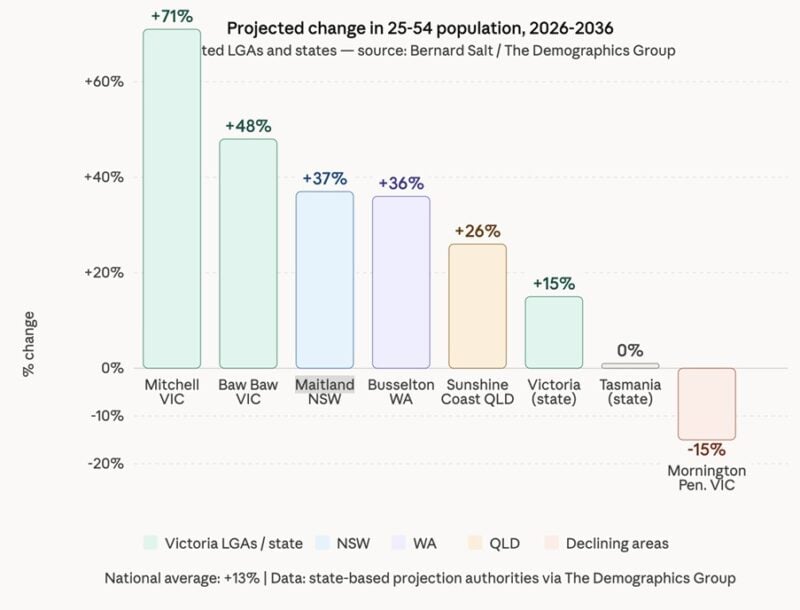
At a state level, official projections show Victoria is set to grow its 25-54 cohort by 15 per cent over the decade to 2036, which is the strongest growth rate of any state.
Tasmania sits at the other end of the spectrum at zero growth.
The national average sits at 13 per cent, or about 1.5 million additional people in this key cohort across Australia.
When you drill down to individual local government areas, the picture becomes even more interesting for property investors.
Salt's analysis, compiled with data scientist Hari Hara Priya Kannan, shows the Shire of Mitchell - just beyond Melbourne's northern fringe - is projected to grow its 25-54 population by an extraordinary 71 per cent over the decade to 2036.
Victoria's Baw Baw follows at 48 per cent, then NSW's Maitland at 37 per cent, WA's Busselton at 36 per cent, and Queensland's Sunshine Coast at 26 per cent.
What this means for property
When a region's peak-earning, home-buying cohort swells by 71 per cent over ten years, the implications for housing are significant.
You're looking at sustained demand for new housing across the full spectrum - first homes, upgrader homes, family homes.
Consumer spending growth follows, which supports local employment and infrastructure investment.
The rate base expands, which tends to attract further government investment.
These are the conditions that drive capital growth over a decade, and they don't rely on interest rate forecasts or short-term sentiment.
They're baked into the population data that's already been published.
The flip side: areas facing demographic headwinds
The other side of this analysis is equally instructive, and it's a warning that some of Australia's most desirable addresses may face real structural pressure.
Sydney's Mosman is projected to record an 18 per cent fall in its 25-54 cohort over the decade.
- Also read:This week’s Australian Property Market Update – Latest Data, State by State September 15th 2026

- Also read:Latest Property Price Forecasts. Australian Property Market Outlook 2026-2027: Navigating a Market Correction

- Also read:Brisbane Property Market Forecast [2026 & Beyond] – What The Olympics Decade Means for Investors.

- Also read:Melbourne property market forecast for 2026 & 2027 | Separating the fundamentals from the sentiment

- Also read:Sydney property market forecast for 2026 and 2027 | Why the short-term softness is a long-term opportunity

Salt's explanation is interesting - it's not that productive-aged workers are leaving Mosman, it's that existing residents are choosing to age in place. Younger people simply can't afford to move in and replace them.
Victoria's Mornington Peninsula is looking at a 15 per cent contraction in this cohort, Brisbane's Redland is down 13 per cent, and Perth's Bassendean faces a 9 per cent decline.
Now, I want to be careful about how you interpret this as a property investor.
Many of these areas are genuinely desirable, established locations with strong owner-occupier demand - exactly the kind of markets I've always advocated for.
But they face the challenge of delivering growing services from a shrinking productive-age population, and without meaningful new housing supply, it's hard for younger cohorts to move in.
This matters for investors because the rental pool, household formation, and long-term demand growth will all look different in these markets compared to the high-growth corridors.
Melbourne: still the place to be
For investors who've heard me defend Melbourne through a period where many commentators have been bearish, the demographic picture here offers a further reason for confidence.
Victoria as a whole leads all states in projected growth of this key cohort.
And within Victoria, it's not just the outer fringe that benefits - strong migration into greater Melbourne consistently fills inner and middle-ring suburbs with exactly the kind of professional households that drive demand for investment-grade property.
Salt flags an interesting longer-term dynamic too.
From around 2036, as Australia's baby boomers begin passing on wealth in significant numbers, areas like Mosman and Mornington Peninsula may experience what he calls "demographic redemption" - a surge of younger buyers moving in as inherited wealth enables purchases that were previously out of reach.
That's a story for the next cycle, but it's worth having on your radar.
Demographics as a strategic filter
I've always said that the investor who understands why a market will grow has a serious edge over the one who's simply following last quarter's price movements.
Demographic analysis like Salt's gives you a 10-year view of where demand is being built - not just demand today, but the structural conditions that will sustain it.
Areas with a fast-growing 25-54 cohort need housing, they generate income, they pay taxes, and they build communities.
That's where infrastructure follows, where retail and services expand, and where property values tend to compound over time.
It doesn't mean you throw your other filters out the window.
Proximity to employment, quality of schools, transport access, and supply constraints still matter enormously.
But overlaying demographic growth on top of those filters is a powerful way to identify markets where the fundamentals are working with you rather than against you.
The data is telling a clear story. Victoria leads the nation. Melbourne's middle and outer rings are going to absorb an enormous amount of new household formation over the next decade.
And the investors who position themselves in the right locations now - rather than chasing last year's hotspot - are the ones most likely to be looking back in 2036 feeling very pleased with their decisions.
The demographic trends Bernard Salt has mapped out don't lie, and by the time a suburb's growth story makes the evening news, the best buying opportunities have usually already passed.
That's exactly why working with a team that understands these long-term structural forces - and knows how to position a portfolio to take advantage of them - makes such a difference to your financial outcomes over a decade or more.
If you'd like to understand how these demographic tailwinds apply to your property strategy, click here now and organise a chat with one of Metropole's wealth strategists.
We help investors cut through the noise and build portfolios around the fundamentals that actually drive long-term wealth - and right now, the fundamentals are pointing in some very clear directions.
We're much more than just another buyer’s agent. We help our clients grow, protect, and pass on their wealth through strategic property and wealth advice.
Property is the vehicle, strategy is the driver.