


Key takeaways
NSW drove nearly half of Australia’s first-home buyer rebound, contributing 1,488 of the 3,186 additional FHB loans nationally
Victoria recorded the second-largest absolute increase (all FHB loans), from 10,765 to 11,545 FHB loans
The biggest impact yet from the expansion of the 5% deposit scheme is on the average FHB owner-occupier annual loan size which jumped 12% to a record $608,574
This significantly exceeded our forecasts of $570,116, with average loan sizes coming in $38,458 higher — or 6.7% above projections
If growth trends continue through 2026, the average national FHB loan size could reach $679,653 by year’s end. This would represent an increase of $71,079.
For many Australians, getting into the property market has never been more challenging, so it’s no surprise that policies aimed at helping first-home buyers are gaining traction.
According to Money.com.au, first-home buyer market could take until 2030 to return to peak levels following 5% deposit scheme expansion.
First-home buyer (FHB) loans surged 9.7% in the December 2025 quarter, marking the strongest quarterly growth in two years and reversing four straight quarters of decline.
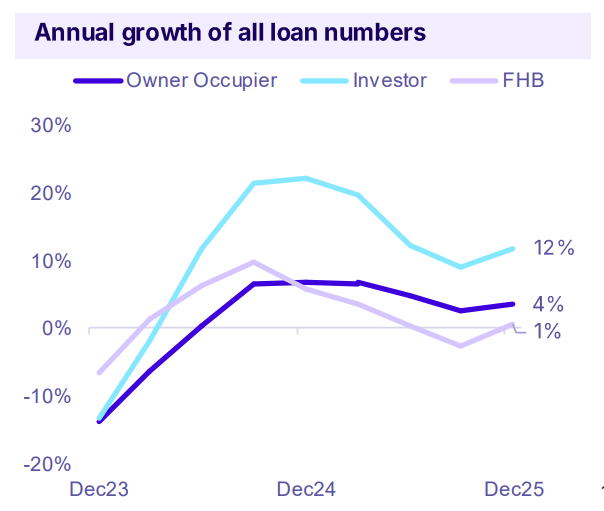
Despite this shift, FHB lending remains 30% below its 2021 peak of 180,945 annual loans.
Based on current growth trends, the gap could narrow to 23% by year’s end if momentum continues, though returning to 2021 levels could still take until 2030 or later, as rising interest rates create conditions opposite to those that supported growth during the previous peak.
Money.com.au’s Property Expert, Nick Burgess, says that while the expansion of the 5% deposit scheme is translating into stronger lending activity so far, broader market conditions could limit its long-term impact.
He explains:
"Housing supply hasn’t increased meaningfully, interest rates are rising, and lending conditions are tightening; all of which have the potential to offset some of the scheme’s benefits and slow the pace of recovery in the first-home buyer lending space.
While the scheme is clearly helping more first-home buyers overcome deposit barriers, affordability remains a major challenge, and the broader economic environment will ultimately determine how far this recovery can go.”
FHB owner-occupier loans drove the recovery in the December 2025 quarter, rising 10% compared to 7% growth for FHB investor loans.
NSW and Victoria emerge as key engines of FHB recovery
According to Money.com.au's data, NSW drove nearly half of Australia’s first-home buyer rebound, contributing 1,488 of the 3,186 additional loans nationally.
It also recorded the strongest growth among major states, though its 19% quarterly surge still leaves it 21% below 2020 peak levels.
On an annual basis, NSW also shifted from a -5.7% decline to 1.8% growth, emerging as the primary driver of Australia’s national turnaround from -1.1% to 2.0%.
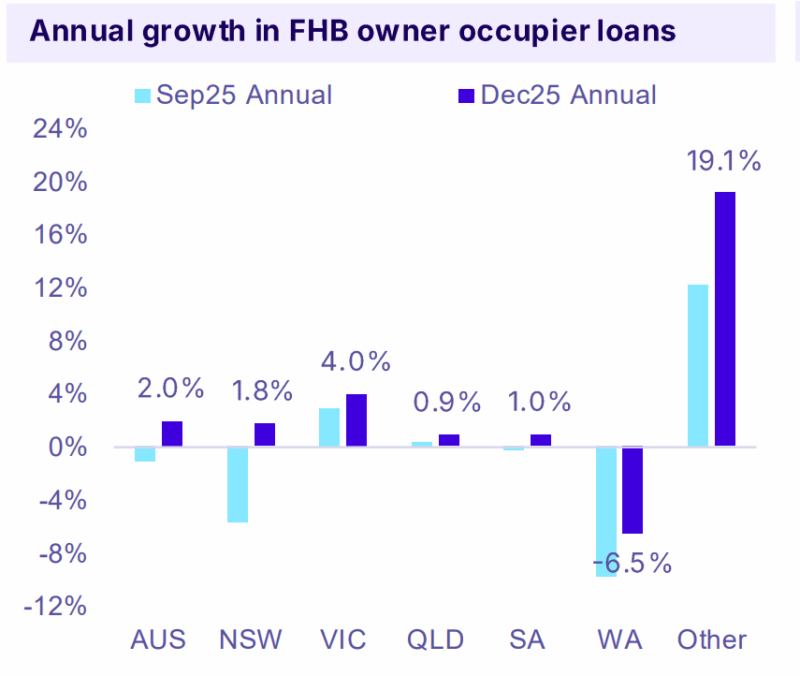
This suggests the 5% deposit scheme is, so far, addressing key barriers preventing owner-occupier first-home buyers from entering the market, although rising interest rates are likely to temper this momentum.
The data also show that Victoria recorded the second-largest absolute increase (all FHB loans), from 10,765 to 11,545 FHB loans.
Its annual loan growth rose from 2.9% to 4.0%, suggesting a steadier, more sustainable increase in a market generally considered more accessible to first-home buyers.
Notably, Victoria’s FHB owner-occupier loans remain around 31% higher than NSW’s, despite its smaller population, with 11,082 loans in Victoria compared to 8,458 in NSW.
FHB investor lending remains subdued despite December rebound
Money.com.au's report highlights that First-home buyer investor loans recorded 7% growth in the December 2025 quarter.
The investor segment accounts for just 5.4% of total FHB loans, so it remains a relatively niche market.
- Also read:Melbourne housing market update | October 2026

- Also read:National Vacancy Rate Rises to 1.4% | SQM Research

- Also read:Australian housing market update | October 2026

- Also read:This week’s Australian Property Market Update – Latest Data, State by State October 13th 2026

- Also read:Latest Property Price Forecasts. Australian Property Market Outlook 2026-2027: Navigating a Market Correction

However, this share could increase as rising interest rates reduce borrowing capacity for first-home buyers, potentially prompting more to consider investment properties where serviceability may be strengthened by rental income.
Burgess notes:
“For some first-home buyers, the inclusion of rental income in serviceability assessments may outweigh the benefits of the 5% deposit scheme alone, making investment pathways outside the scheme a more achievable stepping stone into the property market."
Annual investor FHB loans remain down 18% year-on-year, with December’s growth only beginning to reverse the downward trend that started around September 2024.
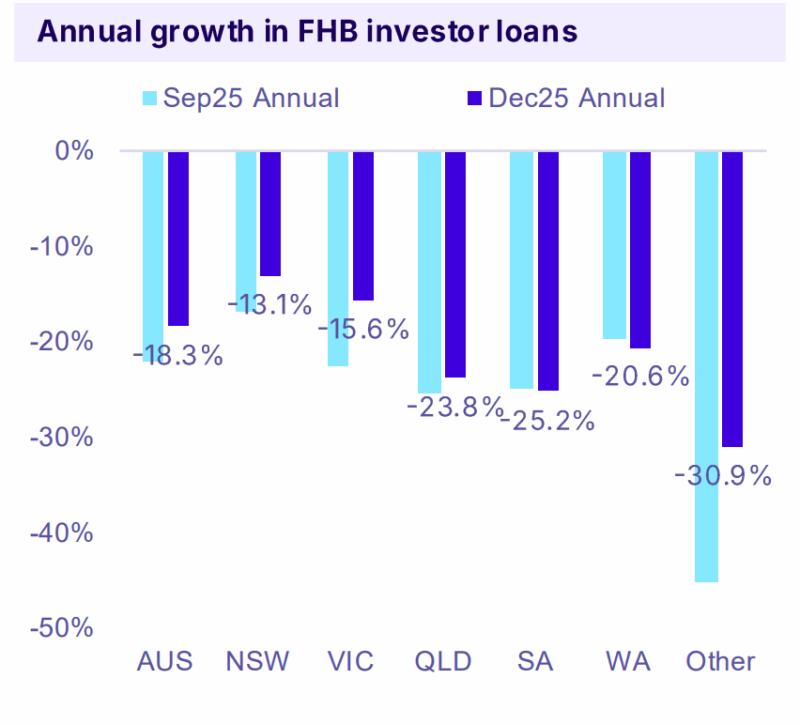
Victoria emerged as the only major market showing a relative increase in first-home buyer investor activity, with investor FHB lending accounting for 4% of the state’s total, up from 3.7%.
First-home buyers now borrowing record amounts & loan sizes potentially rising by another $71K
Burgess says this is attributable, in part, to the scheme’s expanded access and suggests that many first-home buyers were previously borrowing below their true capacity, constrained by deposit requirements.
He further explains:
“Demand-side schemes like this can unlock the front door for more buyers, but also risk putting more fuel on the fire and pushing up property prices, increasing loan sizes, and ultimately intensifying competition.
With rising interest rates, persistent inflation, and growing global economic pressures already squeezing households, these broader forces are likely to expose the limits of demand-side housing support if supply remains constrained.”
The report notes that first-home buyers in more ‘affordable’ states appear to have leveraged the 5% deposit scheme to secure larger mortgages.
Queensland’s average FHB loan size surged by $90,054 to $624,674 (+17%), while Western Australia rose by $84,972 to $582,045 (+17%).
South Australia also recorded strong 13% growth. All three states now exceed Victoria’s average loan size, despite Victoria continuing to record the highest volume of FHB loans.
NSW’s 9% growth in average loan size trailed the national average, suggesting first-home buyers in the state are primarily using the scheme to overcome deposit barriers rather than to upscale their purchases.
If the 12% quarterly growth trajectory continues through 2026, the average national first-home buyer loan size could reach $679,653 by year’s end. This would represent an increase of $71,079.
End note
Ultimately, while demand-side incentives may help more Australians overcome the initial deposit hurdle, they don’t solve the structural imbalance between housing supply and demand.
In fact, history shows that when more buyers compete for a limited pool of properties, prices tend to rise further, often reducing the very affordability these schemes are designed to improve.
The challenge for policymakers is that sustainable housing affordability won’t come from easier credit or lower deposits alone - it will require meaningful increases in housing supply, improved infrastructure, and long-term economic stability.
Until then, first-home buyers are likely to continue facing an uphill battle despite well-intentioned support measures.