


Key takeaways
Investor lending is driving growth in loans, but this momentum may slow as interest rates rise and policy uncertainty increases.
NSW remains the largest investor market, while Victoria is rapidly closing the gap with stronger growth.
Queensland is losing momentum as investors shift toward more affordable markets with better yields.
South Australia is stable in volume, but rising loan sizes suggest increasing property values rather than higher activity.
Western Australia is entering a slowdown after a strong run, while smaller markets like Tasmania are seeing sharp investor growth from a low base.
Australia’s housing loan market is facing potential headwinds, particularly in the investor segment, amid speculation around changes to the Capital Gains Tax (CGT) discount for investors and a cap on negative gearing.
Despite that, according to Money.com.au's latest State-by-State Mortgage Insights Report, home lending growth is forecast to hit 7% in 2026 (to 594,279 loans), with the investor segment set to grow at nearly twice that rate (13%) to 246,598 loans, based on current growth rates.
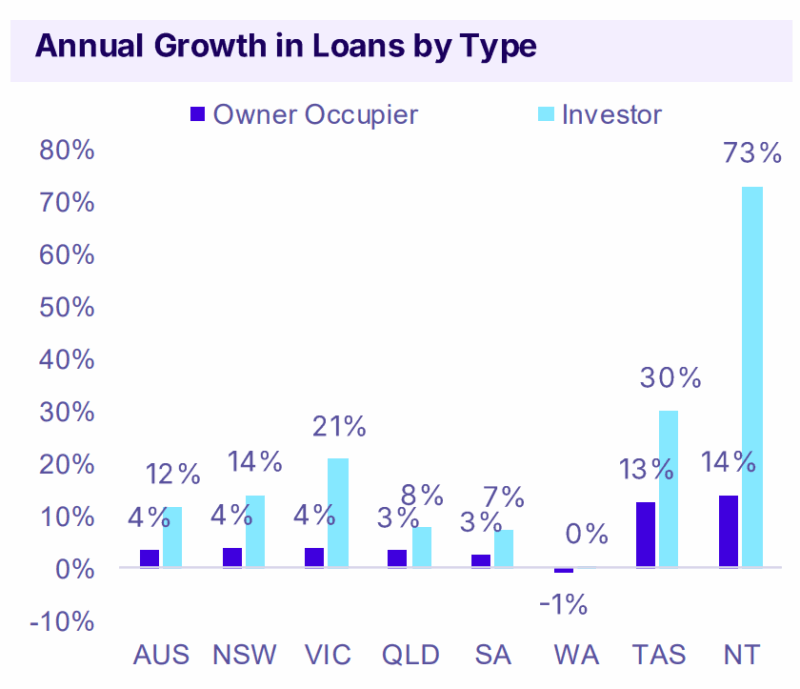
However, with two 0.25% cash rate hikes already delivered this year and further increases expected, owner-occupier loan growth is forecast to ease slightly to 3% in 2026 as rate pressures build.
NSW still going strong as investor demand and land loans surge
Total lending in New South Wales is forecast to grow by around 9% in 2026, with investor demand doing most of the heavy lifting.
Investor loans are expected to jump 16% to 77,470, compared with a more modest 4% growth in owner-occupier lending, based on current growth trends, according to the report.
In retrospect, the December 2025 quarter marked the state’s strongest result since December 2021, with 25,033 loans issued, up 13% year-on-year.
However, NSW continues to trail Victoria in owner-occupier volumes, with 85,808 annual loans compared to Victoria’s 98,856, a trend that has persisted since 2020.
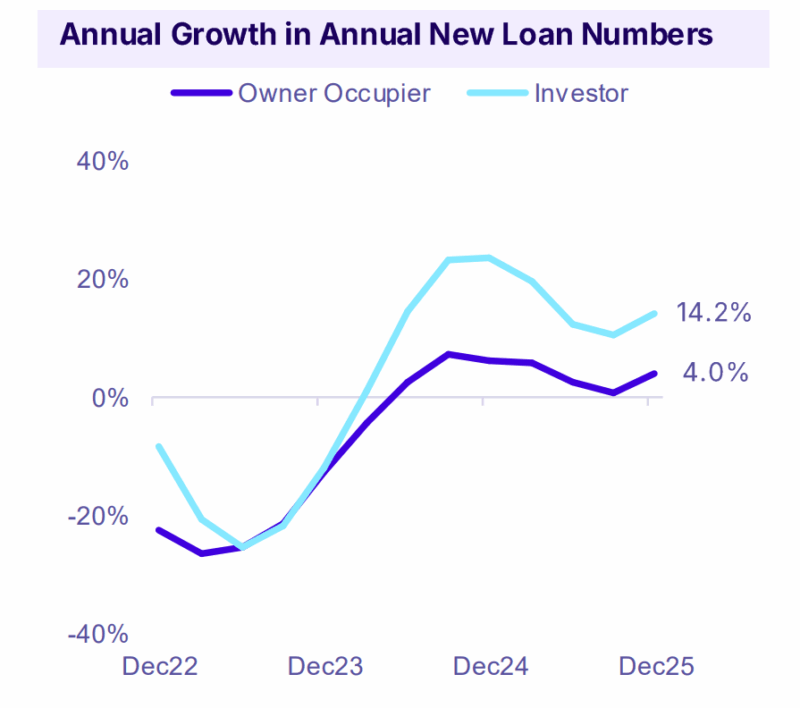
Over the past year, investor lending in NSW rose 14%, while owner-occupier growth came in at 4%.
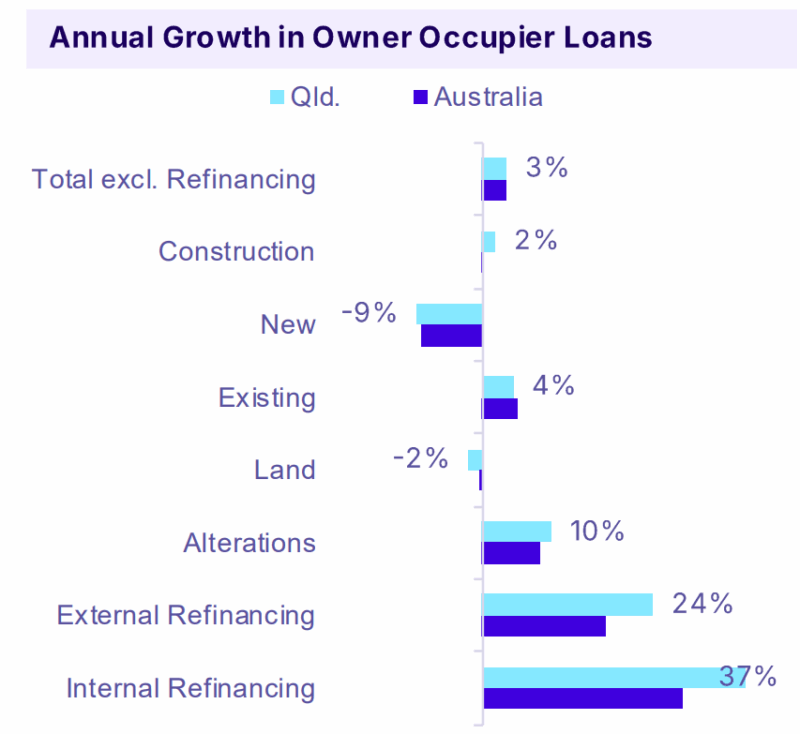
The state is also leading the country in land loan growth across both segments: up 14% for owner-occupiers and 25% for investors, pointing to strong demand for new builds and development opportunities.
NSW now accounts for 31% of all new investor loans nationally, the biggest share since March 2022.
Victoria closes in on NSW as fastest-growing loan market
Data from the report highlights that Victoria is on track to nearly match New South Wales as Australia’s largest lending market in 2026, with total loans forecast to reach 166,345, putting it just 300 loans behind NSW.
Total lending is expected to rise by around 10%, based on current growth trends. This would make Victoria the fastest-growing major state this year.
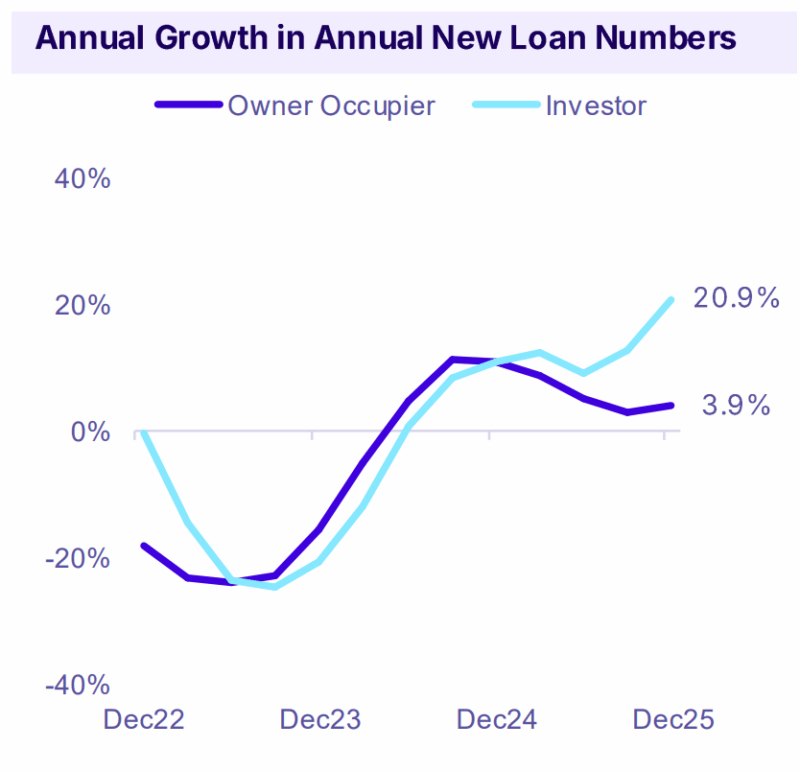
The report notes that the turnaround is being driven by a sharp rebound in investor activity. Investor lending rose 21% over the past year, more than five times the pace of owner-occupier growth at 4%.
This allowed Victoria to reclaim second place from Queensland in investor market share.
At the same time, Victoria continues to cement its position as the country’s largest owner-occupier market, with 98,856 loans issued in the 12 months to December 2025, just shy of the 100,000 milestone.
Victoria recorded 13,048 more owner-occupier loans than NSW in 2025, but it still trails NSW by 14,712 loans in the investor segment.
Money.com.au’s Property Expert, Debbie Hays, says Victoria is regaining momentum as affordability draws buyers back into the market.
She further said:
“Melbourne’s relative affordability compared to other capital cities is drawing investors back, while also generating renewed interest from owner-occupiers and first-home buyers.
Victoria remains one of only two states yet to exceed its 2022 investor loan levels, which suggests there’s still significant room for growth as the market continues to recover."
Queensland loses investor momentum as growth moderates
Queensland’s lending market is expected to grow more modestly in 2026, with total loans forecast to rise 4% to 128,034, according to the report.
This includes 2% growth in owner-occupier loans (to 74,856) and 6% growth in investor lending (to 53,178), based on current growth rates.
If current trends continue, Queensland could fall more than 10,000 loans behind Victoria in investor activity this year, despite starting ahead a year earlier.
This shift highlights how demand is moving toward markets offering a mix of affordability and stronger rental yields, tempering Queensland’s previously strong position.
Over the past year, investor lending in Queensland grew 8%, but this still lags the stronger gains seen in NSW and Victoria.
Owner-occupier lending rose 3%, with total volumes reaching their highest level since the year to December 2022.
Debbie Hays said:
- Also read:Migration Is Falling: What Happens to Australian Property Prices Now? | Property Insiders

- Also read:This week’s Australian Property Market Update – Latest Data, State by State September 22nd 2026

- Also read:Latest Property Price Forecasts. Australian Property Market Outlook 2026-2027: Navigating a Market Correction

- Also read:National Weekly Auction Report – September 19th 2026 | Clearance Rates Ease as Auctions Surge

- Also read:Adelaide housing market update | September 2026

“Queensland is losing some of its investor edge, with some buyers increasingly turning to other states offering better value and the potential for stronger returns.
That said, the state will continue to draw strong interest from both lifestyle investors and homebuyers."
South Australia stable, but rising loan sizes tell a different story
Data shows that South Australia’s lending market is expected to remain relatively steady in 2026, with owner-occupier loan growth forecast at around 3% and investor lending at 6%, based on current growth trends.
This broadly mirrors performance over the past year, when owner-occupier lending rose 3% and investor lending increased 7%, both below national growth rates, pointing to stable but subdued market conditions.
However, loan sizes in South Australia tell a different story.
The average loan has now pushed past $600,000 for both segments, with investor loan sizes rising 13% year-on-year, more than double the national average of 6%.
The average investor loan size ($603,838) is now more than $69,000 higher than a year ago.
This suggests the state is being driven more by rising property values than an increase in transaction volumes.
Western Australia set for lending pullback after five-year boom
The report also highlights projections based on current growth trends show Western Australia is expected to be the only state to see home lending decline in 2026, with total loan volumes forecast to fall by around 1%.
This includes a 2% drop in owner-occupier lending and a 0.3% dip in investor loans, or roughly 1,000 fewer loans than in 2025.
The slowdown follows a strong five-year run, during which investor lending more than tripled, rising from 7,433 to 25,963 as buyers capitalised on the state’s booming property market.
However, momentum began to ease toward the end of 2024 and has continued to soften.
Western Australia was also the only state to record a decline in lending in 2025, with total volumes down slightly year-on-year.
The drop was driven by owner-occupier lending, which fell 1% from 41,316 to 40,870 loans, while investor activity remained largely flat at 0.4% from 25,860 to 25,963 loans.
The pullback suggests the market may be entering a consolidation phase following several years of rapid growth.
Tasmania leads the nation in investor growth, from a low base
Growth trends show Tasmania is forecast to surpass 10,000 annual loans in 2026, reaching 11,297, although this would still be below 2021 peak levels.
According to the report, total lending is projected to grow by 18% annually, once again driven by investor demand, which could push the state’s investor market above both the ACT and Northern Territory.
Investor lending has surged 30% over the past year, one of the highest growth rates nationally, as buyers move to capitalise on emerging opportunities in the state.
Despite this surge, investor volumes remain relatively small, with 2,819 loans accounting for just 1.3% of all new investor loans nationally.
Owner-occupier lending has also been strong, rising 13% and accounting for 71% of all new loans in the state (6,785).
Notably, investor lending is still yet to surpass historical peaks, suggesting further upside potential.
What this really shows is...
While the lending cycle is still moving forward, the landscape is becoming more complex and fragmented.
We’re likely to see investors become more selective, not retreat, particularly if policy changes around CGT and negative gearing create uncertainty.
In my experience, these types of headwinds don’t stop investment; they just separate strategic investors from speculative ones.
Rather than chasing hotspots or getting caught up in short-term lending trends, successful investors will focus on fundamentals: buying quality properties in locations underpinned by strong owner-occupier demand, proven long-term growth, and solid rental appeal.
Because in the long run, it’s not lending volumes or policy tweaks that build wealth… it’s owning the right assets and holding them through the cycle.