
Key takeaways
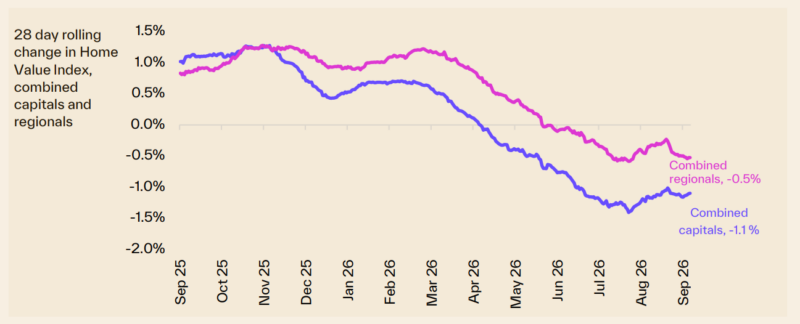
National dwelling values fell 0.9% in August and are down 3.6% from their March peak, with the downturn spreading to 93% of capital city suburbs during winter.
Sydney remains the weakest capital, down 7.1% from its February peak, while Melbourne, Brisbane, Adelaide and Perth are also easing from their monthly highs even though most are still higher over the year.
Spring auctions opened 31% below last year's volumes, though clearance rates have steadied in the low 50s as buyers who remain active keep competing for the better properties.
Melbourne and Sydney posted the strongest clearance rates of the major auction markets this week, both climbing to multi-week highs even as volumes stayed subdued.
Asking prices are telling a similarly patchy story, with Perth and Brisbane houses pulling back while Sydney, Melbourne and Adelaide are holding firmer.
The RBA has left the cash rate on hold at 4.35% but with underlying inflation still above target, a further rate rise later this year remains firmly on the table.
Rental markets remain historically tight despite the vacancy rate drifting up to 1.9%, and rents are still growing solidly across most of the country. Falling values and rising rents have pushed the national gross rental yield to 3.79%, its highest level since 2019.
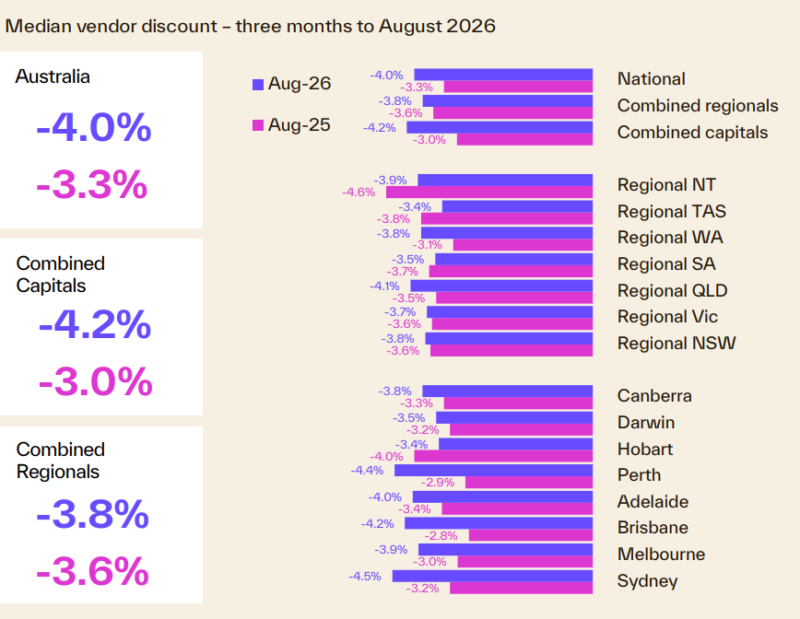
Properties are taking a little longer to sell, with the median time on market now 35 days nationally, up from 32 days the month before.
None of this changes my long-term view. Well-located, investment-grade properties will keep outperforming through this phase of the cycle, and current conditions are giving prepared investors more negotiating room than they've had in years.
Before we get into this week's numbers, it's worth stepping back and looking at where we sit in the cycle.
The Reserve Bank held the cash rate at 4.35% at its August meeting, and it won't sit down again until the 29th of September.
Underlying inflation is still running above the RBA's target band, and the big banks are now split on whether the next move is a rate rise in September or November rather than the rate cut plenty of borrowers were hoping for.
That's the backdrop our property markets are adjusting against.
Values are falling across most of our capital cities, but not because buyers have disappeared. Higher borrowing costs, tighter lending standards and now the federal government's property tax changes have combined to knock confidence and reduce how much people can borrow.
Sellers are having to adjust to this new reality too, and that's showing up clearly in this week's auction results and vendor metrics.
So let's look at what's actually happening on the ground, starting with last weekend's auctions.

On the auction front this week... combined capitals clearance rate rises to 58.5%, its strongest in 19 weeks
The preliminary combined capitals clearance rate increased by 5.8 percentage points last week, reaching 58.5%, which represented the strongest result in 19 weeks.
Throughout the same 19-week period, the preliminary rate remained below 60% and was significantly lower than the rate recorded a year earlier, when 69.0% of homes sold at auction.
See Cotality's full auction report below.
This week, Cotality also reports that:
- Sydney property prices declined -0.3% over the last week, also declined -1.3% over the last month, and are -5.4% lower than they were 12 months ago.
- Melbourne property prices declined -0.2% over the last week, also declined -0.9% over the last month, are -5.5% lower compared to 12 months ago.
- Brisbane property prices declined -0.4% over the last week, declined -1.3% over the last month and are 9.4% higher than they were 12 months ago.
Overall, Australian capital dwelling prices declined -1.1% over the last month and are now 0.2% higher than they were 12 months ago.
Clearly, the property cycle is moving on but our markets are very fragmented.
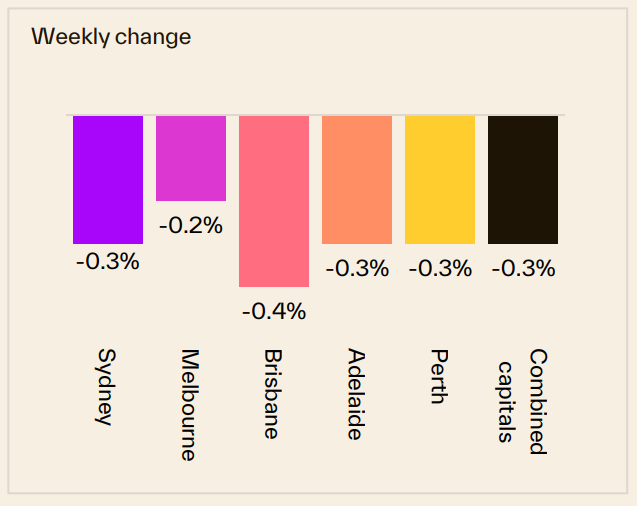
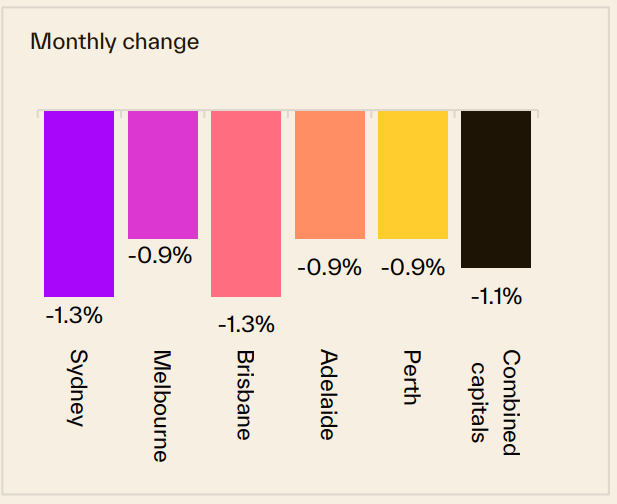
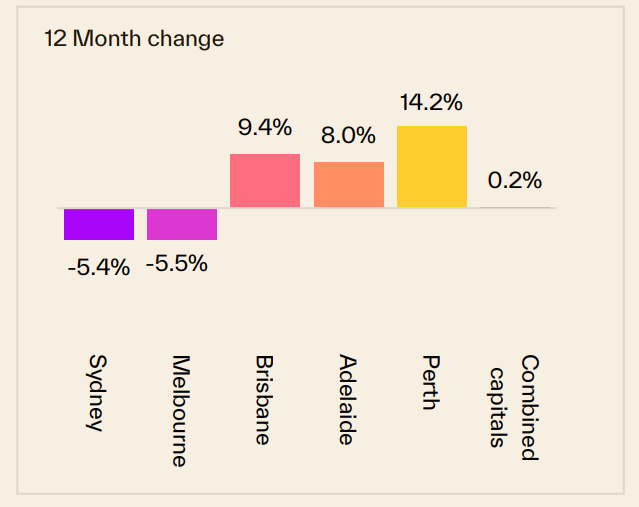
Source: Cotality September 14th 2026
Of course, these are "overall" figures - there is not one Sydney or Melbourne or Brisbane property market.
And various segments of each market are performing differently.
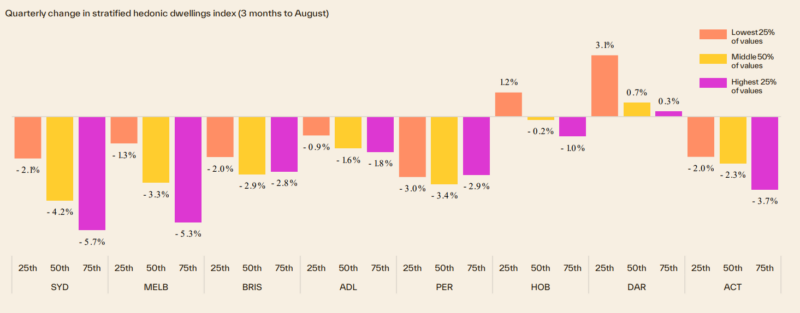
At the beginning of this cycle the upper quartile of the market lead the upswing but last year the lower quartile across every capital city recorded a stronger outcome for housing values relative to its upper quartile counterpart.
The following chart shows how various segments of each capital city market are performing differently, with median-priced properties performing well.
To help keep you up-to-date with all that's happening in property, here is my updated weekly analysis of data and charts as of 14th September 2026, provided by SQM Research, Cotality, and realestate.com.au.
Current property asking prices
Property asking prices are a useful leading indicator for housing markets - giving a good indication of what's ahead.
Here is the latest data available:
Sydney
| Property type | Price ($) | Weekly Change | Monthly Change % | Annual % change |
|---|---|---|---|---|
| All Houses | 2,045.771 | 1.103 | 0.2% | -1.4% |
| All Units | 892.532 | -5.032 | 0.2% | 2.5% |
| Combined | 1,573.922 | -1.474 | 0.2% | -0.7% |
Source: SQM Research
Melbourne
| Property type | Price ($) | Weekly Change | Monthly Change % | Annual % change |
|---|---|---|---|---|
| All Houses | 1,302.641 | -2.087 | 0.1% | 0.2% |
| All Units | 677.957 | -0.557 | 0.1% | 5.8% |
| Combined | 1,105.313 | -1.450 | 0.1% | 1.2% |
Source: SQM Research
Brisbane
| Property type | Price ($) | Weekly Change | Monthly Change % | Annual % change |
|---|---|---|---|---|
| All Houses | 1,352.221 | -7.571 | -1.8% | 5.5% |
| All Units | 835.438 | -4.839 | -2.1% | 9.6% |
| Combined | 1,220.960 | -7.015 | -1.9% | 6.1% |
Source: SQM Research
Perth
| Property type | Price ($) | Weekly Change | Monthly Change % | Annual % change |
|---|---|---|---|---|
| All Houses | 1,252.243 | -3.394 | -3.6% | 6.4% |
| All Units | 774.779 | -4.429 | -1.2% | 16.2% |
| Combined | 1,126.554 | -3.728 | -3.1% | 8.0% |
Source: SQM Research
Adelaide
| Property type | Price ($) | Weekly Change | Monthly Change % | Annual % change |
|---|---|---|---|---|
| All Houses | 1,118.567 | 0.933 | 1.1% | 6.0% |
| All Units | 631.232 | -0.932 | 0.1% | 9.8% |
| Combined | 1,030.522 | 0.521 | 1.0% | 6.3% |
Source: SQM Research
Canberra
| Property type | Price ($) | Weekly Change | Monthly Change % | Annual % change |
|---|---|---|---|---|
| All Houses | 1,227.639 | 2.848 | -0.3% | 0.3% |
| All Units | 607.784 | 1.953 | 1.7% | 4.0% |
| Combined | 990.610 | 2.099 | 0.1% | 0.6% |
Source: SQM Research
Darwin
| Property type | Price ($) | Weekly Change | Monthly Change % | Annual % change |
|---|---|---|---|---|
| All Houses | 845.884 | 1.916 | -0.7% | 7.5% |
| All Units | 482.950 | -4.450 | -1.4% | 9.5% |
| Combined | 703.160 | -0.565 | -0.9% | 8.0% |
Source: SQM Research
Hobart
| Property type | Price ($) | Weekly Change | Monthly Change % | Annual % change |
|---|---|---|---|---|
| All Houses | 909.429 | -2.884 | 0.2% | 7.2% |
| All Units | 529.614 | -5.914 | -1.3% | 8.3% |
| Combined | 851.131 | -3.381 | 0.1% | 7.3% |
Source: SQM Research
National
| Property type | Price ($) | Weekly Change | Monthly Change % | Annual % change |
|---|---|---|---|---|
| All Houses | 1,068.645 | 4.446 | 0.6% | 4.1% |
| All Units | 657.523 | -0.427 | -0.2% | 9.1% |
| Combined | 978.948 | 3.332 | 0.5% | 4.7% |
Source: SQM Research
Cap City Average
| Property type | Price ($) | Weekly Change | Monthly Change % | Annual % change |
|---|---|---|---|---|
| All Houses | 1,514.574 | -2.471 | -0.5% | 0.6% |
| All Units | 788.841 | -6.424 | -0.7% | 4.4% |
| Combined | 1,296.571 | -3.748 | -0.6% | 1.1% |
Source: SQM Research
The value of property asking prices as a leading indicator for housing markets is quite significant.
In fact it's more valuable than median prices which can be quite misleading.
Let's delve into why this is the case and how it impacts the real estate market.
- Early Market Sentiment Indicator: Asking prices often reflect the current sentiment of sellers in the real estate market.
If sellers are confident, they might set higher asking prices, anticipating strong demand.
Conversely, if sellers are uncertain or perceive a market downturn, they might lower their asking prices to attract buyers.
This makes asking prices a real-time indicator of market sentiment, often preceding changes in actual sales prices. - Predictive of Future Price Trends: Trends in asking prices can be predictive of where the actual property prices are headed.
For example, a consistent rise in asking prices over a period can signal an upcoming rise in transaction prices. - Impact of Economic Factors: Economic factors such as interest rates, employment rates, and broader economic health influence asking prices.
For instance, changes in the Reserve Bank of Australia's policies or shifts in the job market can quickly reflect in the asking prices, providing insights into how these factors are influencing the housing market. - Regional Variations: In a diverse market like Australia's, asking prices can also provide insights into regional disparities.
For instance, the property markets in Melbourne and Sydney might behave differently from those in Brisbane or Perth. Asking prices can give early indications of these regional trends. - Influence of Supply and Demand: Asking prices are also a response to the balance of supply and demand in the market.
In areas with limited supply and high demand, asking prices tend to be higher and vice versa.
However, it's important to note that while asking prices are a valuable indicator, they should not be used in isolation.
Other factors like actual sales prices, time on the market, auction clearance rates, and economic conditions also play crucial roles in understanding the property market dynamics.
READ MORE: The latest median property prices in Australia’s major cities
Last weekend's auction report
Combined capitals clearance rate rises to 58.5%, its strongest in 19 weeks
The preliminary combined capitals clearance rate increased by 5.8 percentage points last week, reaching 58.5%, which represented the strongest result in 19 weeks.
This improvement followed a period of relatively low rates.
Throughout the same 19-week period, the preliminary rate remained below 60% and was significantly lower than the rate recorded a year earlier, when 69.0% of homes sold at auction.
The increase in clearance rate occurred alongside higher auction volumes, with 1,594 capital city homes taken to auction.
Auction numbers rose by 11.4% compared to the previous week but remained 33.6% lower than the same period last year, marking the fifth consecutive week with a decline in excess of 30% on the previous year.
- Also read:This week’s Australian Property Market Update – Latest Data, State by State September 15th 2026

- Also read:Latest Property Price Forecasts. Australian Property Market Outlook 2026-2027: Navigating a Market Correction

- Also read:Brisbane Property Market Forecast [2026 & Beyond] – What The Olympics Decade Means for Investors.
- Also read:Melbourne property market forecast for 2026 & 2027 | Separating the fundamentals from the sentiment

- Also read:Sydney property market forecast for 2026 and 2027 | Why the short-term softness is a long-term opportunity

This decline is attributed to fewer new listings and a greater proportion of vendors choosing to sell by private treaty rather than at auction while clearance rates remain subdued.
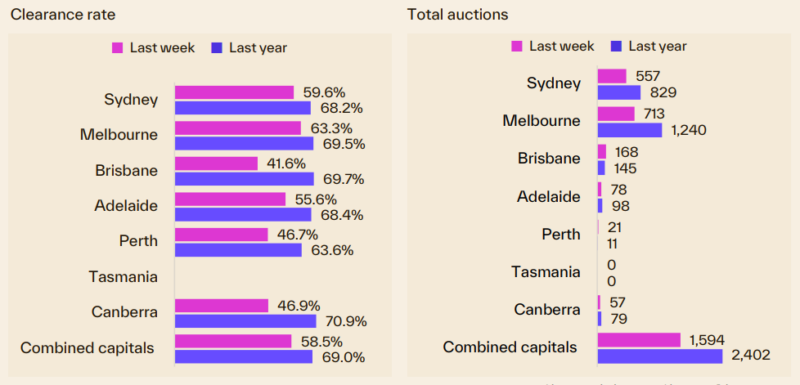
Melbourne held 45% of all auctions, with 713 homes going under the hammer. That was an 8.7% rise on two weeks ago but 42.5% down on a year ago, the largest drop of any capital against the same week in 2025.
At 63.3%, Melbourne's preliminary clearance rate was a 24 week high and the strongest across the capitals.
Sydney's preliminary clearance rate rose 1.9 percentage points to 59.6%, its highest result in 19 weeks.
The city held 557 auctions, an increase of 11.2% on two weeks ago, though still 32.8% below the level of a year earlier.
Brisbane held more auctions than a year ago, with 168 in total, up 15.9% over the year and 28.2% on the previous week.
The preliminary clearance rate increased sharply to 41.6%, the highest early result in four weeks and 16.8 percentage points above lasts week’s 24.8%.
That said, it remained around 28 percentage points below the 69.7% recorded a year ago, and Brisbane still finished below every other capital.
In Adelaide, 78 homes were taken to auction, representing a rough 17% decrease from the previous week and a 20.4% decline compared to the same period last year.
At 55.6%, the preliminary clearance rate was 21 percentage points above the 34.5% recorded two weeks earlier.
There were 57 auctions held in the ACT, up from 35 two weeks ago but down almost 28% on the volume a year ago.
The preliminary clearance rate came in at 46.9%, up 10.2 percentage points.
Auction volumes are expected to rise as the spring season advances, although they are likely to remain lower than the levels recorded last year.
Approximately 1,930 homes are scheduled for auction this week, with the number projected to decrease to around 1,510 next week due to the AFL Grand Final long weekend in Victoria.
Our rental markets
Cotality's the national vacancy rate crept higher in August, reaching 1.9%, its highest level since January 2025 and up from the record low of 1.5% recorded in February this year.
Although vacancy rates have drifted higher, rental markets remain tight by historical standards, with the national vacancy
rate still well below the pre-COVID decade average of 3.3%.
The latest result continues a period of exceptionally low rental availability, with vacancy rates mostly holding below 2%
nationally since early 2022.
Sydney is now recording the highest rental vacancy rate among the mainland capital cities at 2.2%, while Adelaide continues to have the tightest rental market, with a vacancy rate of just 1.3%.
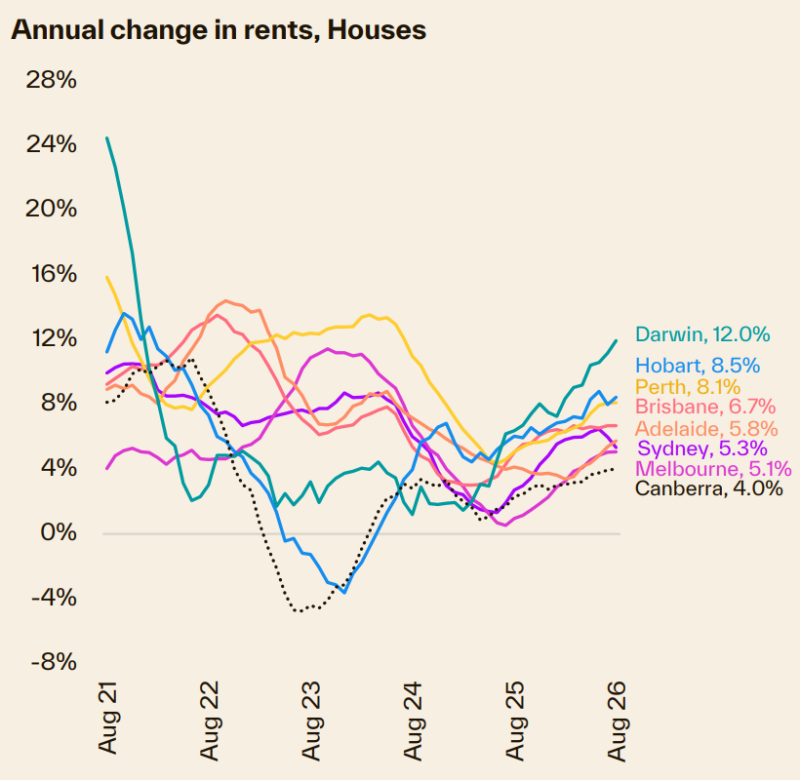
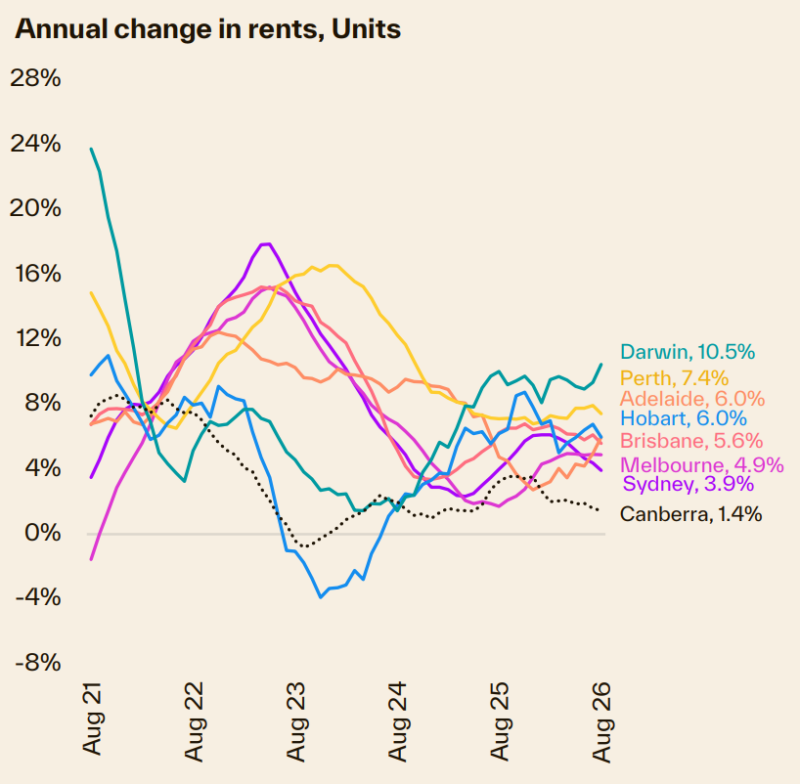
With vacancy rates remaining low, rental values continue to rise across every broad region of the country.
Nationally, Cotality's rental index increased 0.4% in seasonally adjusted terms over August, matching the July increase and broadly in line with the average monthly rise over the past two years.
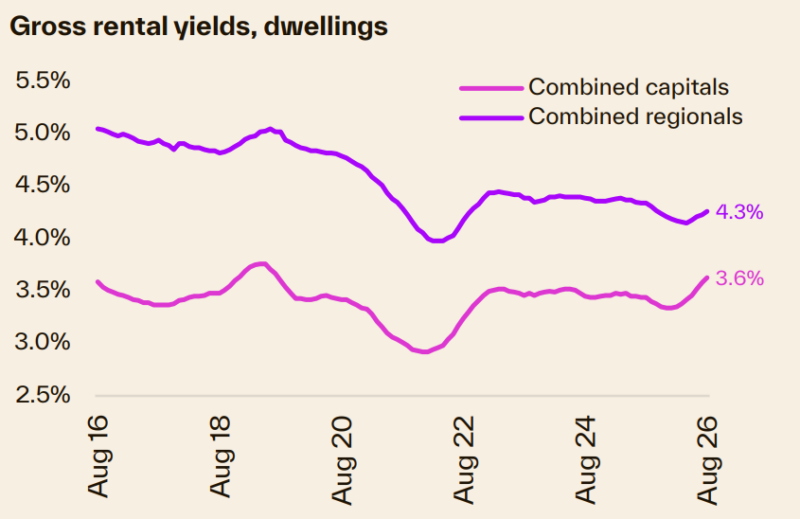
With rents rising and home values falling, gross rental yields have continued to trend higher.
At 3.79%, the national gross rental yield is at its highest level since September 2019.
While yields are substantially higher in smaller capital cities such as Darwin (6.3%) and Hobart (4.4%), gross yields across the larger capitals remain well below the level required to achieve a neutral cash flow position for most investors.
Sydney
| Property Type | Rent ($) | Weekly change | Monthly change | 12 Months change |
|---|---|---|---|---|
| All Houses | $1,131.17 | 7.84 | -0.7% | 4.4% |
| All Units | $756.88 | -2.88 | -0.3% | 5.6% |
| Combined | $908.77 | 1.47 | -0.5% | 5.0% |
Source: SQM Research
Melbourne
| Property Type | Rent ($) | Weekly change | Monthly change | 12 Months change |
|---|---|---|---|---|
| All Houses | $826.79 | 5.21 | 1.1% | 7.7% |
| All Units | $600.86 | -1.86 | -0.8% | 4.3% |
| Combined | $696.00 | 1.11 | 0.2% | 6.1% |
Source: SQM Research
Brisbane
| Property Type | Rent ($) | Weekly change | Monthly change | 12 Months change |
|---|---|---|---|---|
| All Houses | $840.34 | -5.33 | -0.4% | 9.0% |
| All Units | $650.34 | 2.67 | 0.5% | 6.1% |
| Combined | $754.69 | -1.74 | -0.1% | 7.8% |
Source: SQM Research
Perth
| Property Type | Rent ($) | Weekly change | Monthly change | 12 Months change |
|---|---|---|---|---|
| All Houses | $891.77 | -4.77 | -0.4% | 8.5% |
| All Units | $664.44 | -2.44 | -0.2% | 2.6% |
| Combined | $798.13 | -3.81 | -0.3% | 6.5% |
Source: SQM Research
Adelaide
| Property Type | Rent $) | Weekly change | Monthly change | 12 Months change |
|---|---|---|---|---|
| All Houses | $698.59 | 7.41 | 1.8% | 4.9% |
| All Units | $557.67 | 8.32 | 0.9% | 6.2% |
| Combined | $651.26 | 7.72 | 1.5% | 5.3% |
Source: SQM Research
Canberra
| Property Type | Rent ($) | Weekly change | Monthly change | 12 Months change |
|---|---|---|---|---|
| All Houses | $792.06 | -0.06 | -2.6% | 2.1% |
| All Units | $601.73 | -1.72 | -0.3% | 5.6% |
| Combined | $686.89 | -0.99 | -1.5% | 3.6% |
Source: SQM Research
Darwin
| Property Type | Rent ($) | Weekly change | Monthly change | 12 Months change |
|---|---|---|---|---|
| All Houses | $823.67 | 20.33 | -2.4% | 5.7% |
| All Units | $670.31 | 5.68 | 1.0% | 17.0% |
| Combined | $733.23 | 11.70 | -0.6% | 11.5% |
Source: SQM Research
Hobart
| Property Type | Rent 9$) | Weekly change | Monthly change | 12 Months change |
|---|---|---|---|---|
| All Houses | $615.91 | -6.91 | -3.8% | 5.1% |
| All Units | $587.49 | 3.52 | 1.0% | 19.8% |
| Combined | $604.61 | -2.76 | -2.0% | 10.3% |
Source: SQM Research
National
| Property Type | Rent ($) | Weekly change | Monthly change | 12 Months change |
|---|---|---|---|---|
| All Houses | $776.00 | 0.00 | 0.5% | 7.0% |
| All Units | $618.00 | 3.00 | 0.8% | 8.6% |
| Combined | $702.92 | 1.39 | 0.6% | 7.7% |
Source: SQM Research
Cap City Average
| Property Type | Rent ($) | Weekly change | Monthly change | 12 Months change |
|---|---|---|---|---|
| All Houses | $925.00 | 9.00 | 0.2% | 6.6% |
| All Units | $679.00 | -3.00 | -0.4% | 5.1% |
| Combined | $794.46 | 2.64 | -0.1% | 5.9% |
Source: SQM Research
Here's how many properties are for sale at the moment
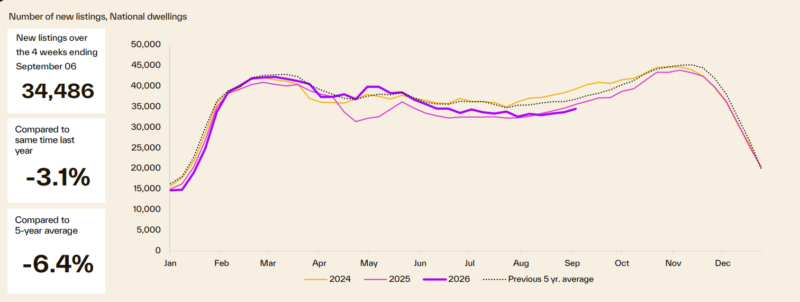
The flow of new listings is 3.1% lower nationally than at the same time last year and 6.4% below the five-year average.
New listing volumes have now fallen below the levels recorded over the past three years, reversing the trend seen earlier in the year, when listing activity was comparatively stronger, close to the five-year average and above year-ago levels.
Vendor metrics
Compared to a year ago, homes are taking slightly longer to sell.
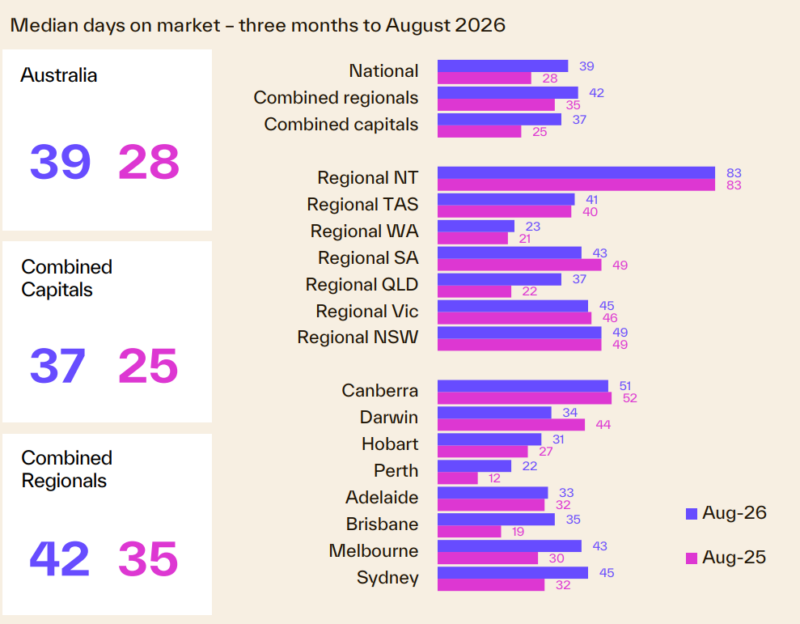
Selling conditions continue to lose momentum, with homes taking a median of 39 days to sell, compared to 28 days a year earlier.
Canberra is experiencing the longest median selling time at 51 days, while Sydney and Melbourne follow at 45 and 43 days, respectively.
Perth is fastest at 22 days, though that is up from 12 days a year ago. Adelaide, Hobart, Darwin and Brisbane range from 31 to 35 days.
The median time on market across regional areas has risen to 42 days, closely approaching the 43-day peak observed in February 2025.