Key takeaways
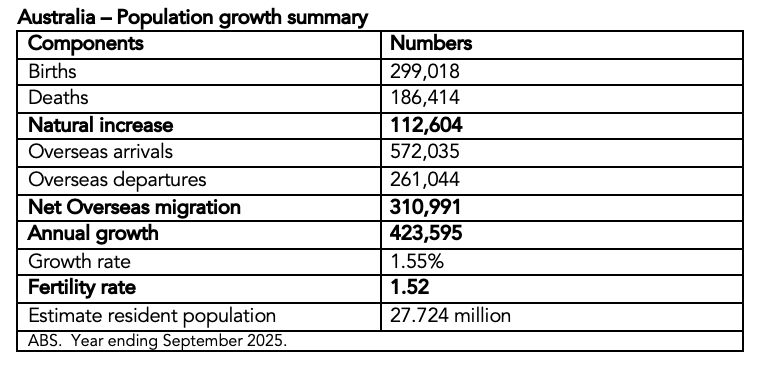
Australia's population grew by 423,600 in the year to September 2025, with net overseas migration accounting for around 311,000 of that - roughly three in every four new Australians arriving from overseas.
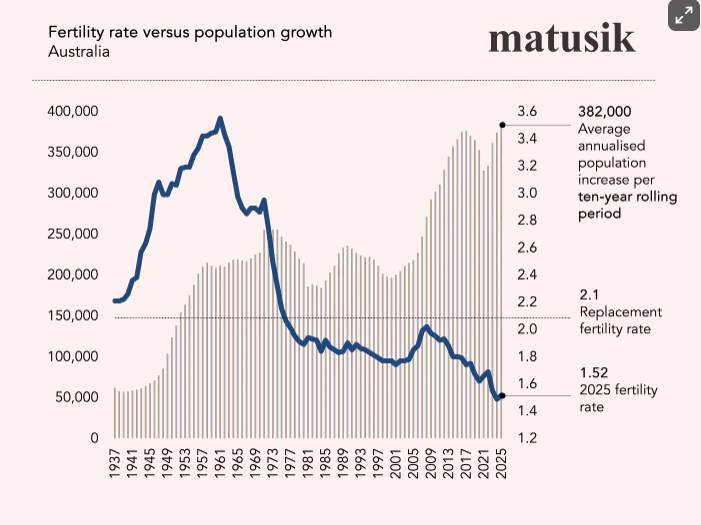
With a fertility rate of just 1.52 - well below the 2.1 replacement level - natural population growth is shrinking, and migration is the only mechanism keeping Australia's population moving forward.
An economy grows through more people, better productivity, or more debt. With productivity stalling and debt already stretched, population growth through migration is doing most of the heavy lifting.
Some 83% of new arrivals fall into the 15-44 age bracket - exactly the working-age, tax-paying, household-forming cohort an ageing country needs, given that 43% of Australians are already over 45.
Cutting migration doesn't solve the housing shortage - it actually makes it worse, reducing the workforce available to build homes, shrinking the buyer pool, and weakening the broader economy that funds construction.
Housing construction and renovation activity combined represents an estimated $260 billion annually - close to 10% of the Australian economy - making it one of the country's most significant economic drivers, not a side issue.
The real problem is that Australia isn't building enough homes, and more importantly, isn't building the right ones - more rental stock and genuinely affordable product for key workers are what's needed most.
The answer lies in smarter, skills-focused migration, faster planning decisions, better use of land, and a serious lift in productivity - not in pulling back from the population growth that sustains demand for housing and the broader economy.
Let’s get into it from the get go. “If we can’t house them, stop them.”
Sounds neat. Sounds logical. It’s also wrong.
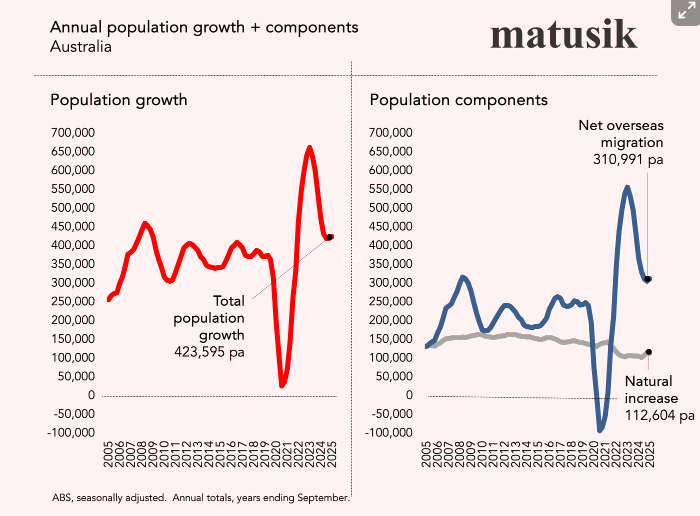
The latest numbers show Australia’s population grew by 423,600 over the year to September 2025.
Of that, about 311,000 came from net overseas migration. Just some 112,600 came from natural increase.
And the fertility rate? Just 1.52. That’s not a dip. That’s a structural shift.
It needs to be well over 2.1 to replace the cats already living here and it hasn’t been that high for yonks.
Even Costello’s baby bonus didn’t shift the bar enough.
And nothing in our future suggests that changes anytime soon.
So let’s not kid ourselves. Pun intended!
Without migration, we don’t grow. And in time, we go backwards.
The post-Covid surge has now washed through
Population growth has settled back into the low-400,000 range.
Migration has eased too, being now just north of 300,000 a year. But still doing the heavy lifting though.
Roughly three in every four new Australians are arriving from overseas.
And they’re not retirees. They’re younger. Working age. Tax paying. Spending.
Exactly what an ageing country needs. Because the other side of the ledger isn’t helping. Births are going nowhere. Deaths are rising. The natural increase is thinning out.
That gap gets filled one way. Overseas migration.
We need more bums on seats
We keep talking about demand like it’s optional. It isn’t.
An economy grows in three ways: more people, better productivity, or more debt.
We’ve maxed out the third one. Yet the federal and state governments keep dishing out more dough like it grows in trees.
The latest gambit is the three month reduction in fuel excise, saving most of us about $20 when will fill up the tank, yet costing the tax payer an estimated $2.55 billion by the 30th June this year.
How much is a billion?
If you were paid $1 for every step you took, to earn a billion Australian dollars, you have to walk around the centre of the earth some 31 times.
Now, if you were a really fit bugger and walked eight hours non-stop, every weekday, it would take you some 60-odd years to walk that distance.
But that is somewhat silly, so let’s look at something more reasonable.
The most quoted walking target is 10,000 steps per day. So, that’s 70,000 steps per week, or 3.64 million steps per annum.
If you keep this up every week, it would take about 274 years or – if you were lucky enough to live to the average age of an Aussie (currently 82 years) – almost three and a half lifetimes to walk far enough to earn $1A billion.
So it is a bloody lot and our government’s keep dishing it out like candy. Which is the whole point.
A sugar hit now, tooth decay - no, root canal - later. And not just for you but your kids, grandkids and probably their kids too.
Now back to the other economic drivers
The second driver - productivity - is still struggling that best. And that’s me being very optimistic!
- Also read:Latest Property Price Forecasts. Australian Property Market Outlook 2026-2027: Navigating a Market Correction

- Also read:Brisbane Property Market Forecast [2026 & Beyond] – What The Olympics Decade Means for Investors.
- Also read:Melbourne property market forecast for 2026 & 2027 | Separating the fundamentals from the sentiment
- Also read:Sydney property market forecast for 2026 and 2027 | Why the short-term softness is a long-term opportunity
- Also read:Home Prices Down Again Over September – But Not as Much | Latest Property Market Stats

Which leaves the first. People. More specifically, younger people.
Because here’s the rub - 43% of Australians are already over 45. And climbing.
Meanwhile, the bulk of new arrivals - some 83% - sit in that 15 to 44 sweet spot.
They work. They pay tax. They form households. They underpin demand. They help keep the whole thing moving.
And given that 80% of our jobs are in services - and most of these services are oriented to a domestic audience - we either change the way we do business or continue to grow our market.
And now the housing angle
Yes, more people means more housing demand.
Yet we struggle to build efficiently, especially when costs are high and rising plus builders hands are shackled. We especially can’t deliver affordable product at scale.
We’re still battling construction costs, labour shortages, feasibility gaps, and a planning system that often gets in the way more than it helps.
Turning off migration doesn’t fix any of that.
It just means:
- fewer workers to build homes
- fewer buyers to support projects
- less economic activity
- and ultimately, less capacity to solve the problem
You don’t fix a supply issue by shrinking demand. You just make our economy smaller and weaker.
Bigger than most think
The Housing Industry Association says the residential building industry contributed more than $140 billion in the 12 months to September 2025, equal to about 5.5% of Australia’s GDP. That is not just bricks, timber and tradies.
It also reflects the broader chain around new housing delivery - design, approvals, sales, marketing and professional services.
Then there are renovations.
The official ABS “alterations and additions” figures put approved renovation work at only about $15 billion a year, but that clearly misses a lot of smaller home improvement activity that never touches a planning system.
It is estimated that about half of Australian homeowners renovated their home last year, with a median spend of $35,000.
Using roughly 10.6 million households, a 67% home ownership rate, and that current renovation rate and median spend, the implied renovation market is closer to $120 billion a year.
Put the two together and housing construction plus renovation activity lands at around $260 billion annually - or close to 10% of the Australian economy.
Housing is not some side issue. It is one of the country’s biggest economic engines.
So what do we do?
We must be smarter. We need to target migration better. Skills, not just numbers.
We align population growth with housing delivery, not pretend one can operate without the other. We build what people can actually afford.
Smaller homes. Better use of land. Faster decisions. Both public and private delivery.
And we lift productivity because right now, it’s not pulling its weight.
Bottom line
Australia is now a low-fertility, ageing nation. Migration isn’t the problem. It’s the mechanism keeping the whole thing from stalling.
The real issue?
We’re not building enough homes. And more importantly, we’re not building the right ones. We need more rental digs. We need homes that key workers can afford.
Blame migration if you like. But it won’t fix a thing.
Matusik Missive by independent property analyst, Michael Matusik. Each week Michael shares his thoughts on the Australian housing market. Visit www.matusik.substack.com to find out more.”