
Key takeaways
Familiarity can create a false sense of security, particularly when financial conditions are changing.
Following the crowd may feel reassuring, but the crowd is frequently most confident near the top of a market and most fearful when opportunities improve.
Holding all your money in cash avoids short-term volatility while exposing your wealth to inflation and lost growth.
Avoiding debt altogether can limit your financial progress, while using debt strategically can help you build a productive asset base.
A well-researched property purchase can feel uncomfortable because it requires a substantial commitment, but delaying indefinitely carries risks of its own.
Genuine financial security comes from preparation, diversification, cash flow management and a long-term strategy rather than simply avoiding uncertainty.
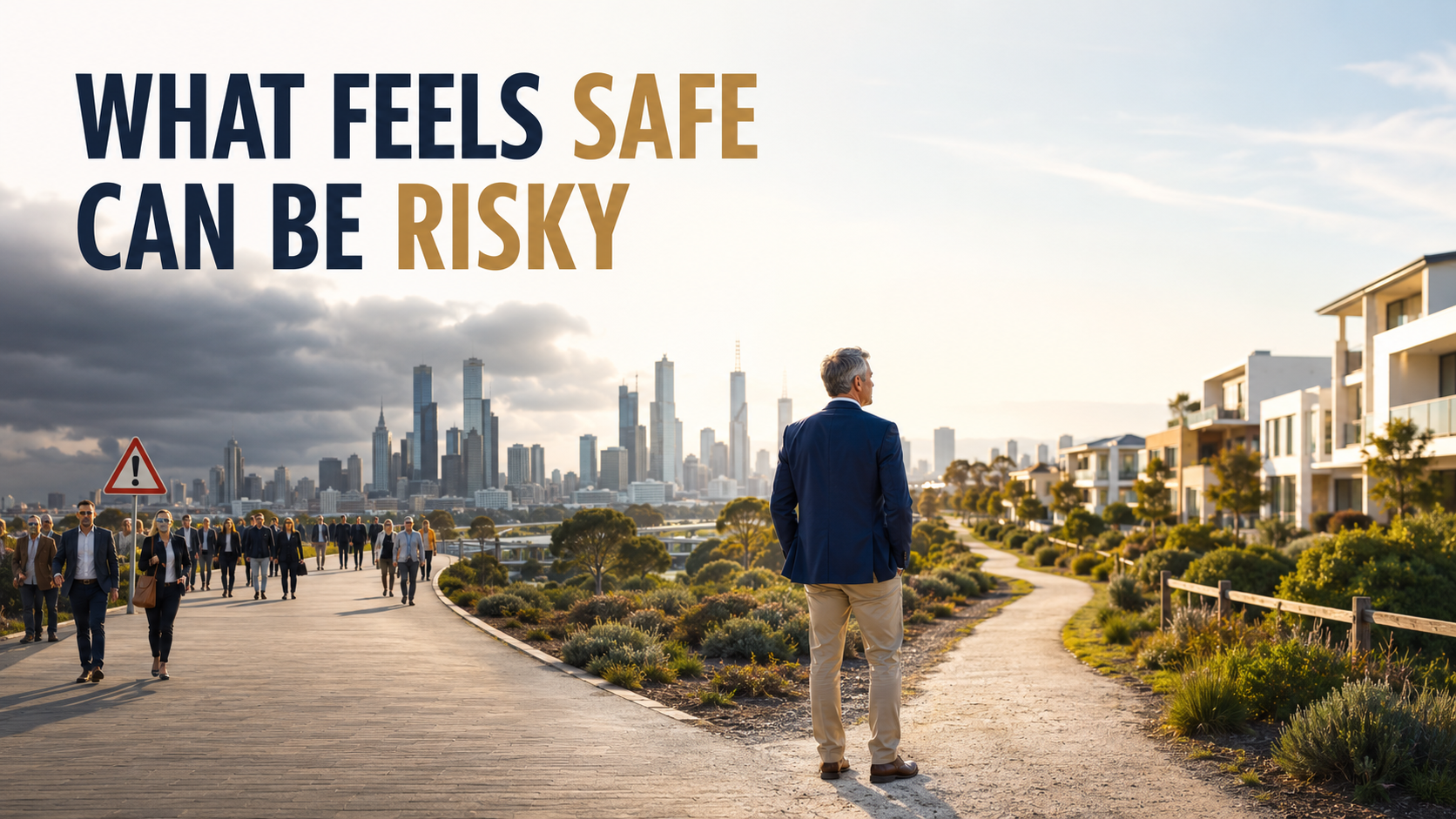
Most of us like to believe we make rational decisions about money, property and our future, yet our choices are often guided by something much more powerful than logic: the desire to feel safe.
We gravitate towards familiar options, follow what others are doing, and avoid decisions that make us uncomfortable.
Unfortunately, what feels safe today may quietly expose us to greater risks tomorrow.
At the same time, some decisions that initially feel risky, such as investing when others are nervous, changing an outdated strategy, or seeking independent advice, can ultimately make our financial position more secure.
Our brains confuse familiarity with safety
Human beings are wired to seek certainty and to stay close to the group. For much of history, that instinct helped keep us alive, so it is hardly surprising that it still influences how we behave.
The problem is that financial markets reward independent thinking rather than emotional comfort.
If everyone around us is making the same decision, we tend to assume it must be sensible, even when few people have properly examined the risks.
We see this in property markets all the time. When prices are rising strongly and optimistic forecasts dominate the headlines, buyers feel reassured because everyone else seems confident.
Yet this is often when people become careless. They stretch their borrowing capacity, compromise on property quality, and justify almost any purchase because they fear missing out.
When markets slow and the media turns pessimistic, many of those same buyers retreat. Competition eases, vendors become more negotiable, and investors have more time to complete their due diligence, but buying suddenly feels dangerous.
Interestingly, the asset may carry less market risk, yet the decision feels considerably riskier.
Following the crowd can be expensive
There is comfort in doing what everyone else is doing because we feel that if the decision goes wrong, at least we will not be wrong alone.
That may protect our ego, but it does little to protect our wealth.
Property investors regularly chase locations that have already experienced strong growth because recent performance makes them feel safe. By the time a suburb becomes the latest hotspot and is being promoted everywhere, much of the easy growth may have already occurred.
This doesn’t mean investors should automatically move against the market. Being contrarian for its own sake can be every bit as dangerous as following the herd.
The more sensible approach is to understand where the crowd may be mispricing risk and then make decisions based on research, fundamentals and a clear strategy.
That could mean buying an investment-grade property in an established capital city market while others are distracted by short-term headlines. It may also mean walking away from a popular regional location, a new apartment tower, or a new house-and-land package in the outer suburbs, even though everyone seems to be talking about them.
Cash provides certainty because its value does not appear to jump around from one day to the next. A balance of $100,000 will still show as $100,000 on next month’s bank statement, assuming you haven’t spent any of it.
However, the number on the statement tells only part of the story.
Inflation steadily erodes what that money can buy, while tax may consume a meaningful share of the interest it earns. Over a long period, the purchasing power of cash can fall significantly even though its nominal value remains intact.
Cash plays an important role in a sound wealth strategy. Investors need financial buffers, often held in offset accounts, for vacancies, repairs, unexpected expenses, and changes in interest rates or income.
The danger arises when temporary safety becomes permanent inaction. Keeping every available dollar in the bank for years because investing feels uncomfortable can create a different kind of risk: the possibility that your wealth fails to keep pace with the rising cost of living.
Avoiding debt can also carry a cost
Australians are often told that all debt is dangerous and that becoming debt-free should be their top financial priority. I know that's what my parents taught me.
That advice is appropriate for high-interest consumer debt, which typically finances items that depreciate. However, it becomes less useful when applied indiscriminately to productive investment debt.
- Also read:This week’s Australian Property Market Update – Latest Data, State by State October 13th 2026

- Also read:Latest Property Price Forecasts. Australian Property Market Outlook 2026-2027: Navigating a Market Correction

- Also read:Brisbane Property Market Forecast [2026 & Beyond] – What The Olympics Decade Means for Investors.
- Also read:Sydney property market forecast for 2026 and 2027 | Why the short-term softness is a long-term opportunity

- Also read:Melbourne property market forecast for 2026 & 2027 | Separating the fundamentals from the sentiment

Used carefully, debt allows investors to control a larger asset base and to benefit from capital and rental growth and from inflation over time. It can accelerate wealth creation in ways that saving from employment income alone just can't do.
Of course, borrowing heavily without adequate buffers or a reliable income is risky. So is borrowing to buy a poor-quality asset simply because it is cheap or offers an attractive initial yield.
The real issue is the quality of the debt, the quality of the asset and the investor’s capacity to hold through the inevitable ups and downs of the property cycle.
For some people, refusing to use any debt may feel prudent, yet it could leave them approaching retirement with an insufficient asset base. That is a genuine risk, even though it develops so gradually that it is easy to overlook.
Waiting for certainty is rarely a safe strategy
Many potential investors tell themselves they will act when interest rates stabilise, economic conditions improve, or the property market becomes clearer.
Unfortunately, clarity generally arrives after prices have already reacted to the improved conditions.
There will always be a reason to delay. Elections, inflation, geopolitical conflict, tax changes and economic forecasts continually create uncertainty, while property markets continue to move through their cycles.
Now, I’m certainly not suggesting anyone invest before they are financially prepared.
Some people need to improve their cash flow, reduce consumer debt, build a buffer, or strengthen their borrowing capacity before purchasing another property.
However, there is a difference between becoming properly prepared and waiting for every uncertainty to disappear. The first is sensible risk management, while the second can become an expensive habit.
Employment security is changing too
A regular salary has long been regarded as one of the strongest forms of financial security. Yet employment is changing rapidly as technology, artificial intelligence, automation and global competition reshape Australian workplaces.
Relying on one employer and one source of income may feel secure because it is familiar, but that dependence can leave a household financially exposed.
Investing in your skills, building professional networks and developing additional sources of income can initially feel uncertain. Over time, these choices may make you far more resilient than staying in a comfortable role as your industry changes around you.
The same principle applies to business owners. Continuing with a model that worked well ten years ago may feel safer than adapting, even though customer behaviour, technology and competition have moved on.
Real safety comes from resilience
Financial security does not come from eliminating every possible risk because that simply cannot be done. It comes from ensuring that one setback can’t derail your entire financial future.
For property investors, this means owning the right assets, maintaining financial buffers, protecting income, managing debt responsibly and avoiding excessive exposure to any single market or strategy.
It also means having a written strategic investment plan that accounts for changing interest rates, periods of weak growth and unexpected life events.
A person with a well-selected property portfolio, manageable loan-to-value ratios, appropriate insurance and sufficient cash reserves may be safer than someone with no investments who depends entirely on their next pay cheque.
The first person’s position may appear more complicated, but complexity and risk are not always the same thing.
The comfort test
Whenever a financial decision feels especially comfortable, it is worth asking why.
Does it feel safe because the risks have been carefully assessed, or because the decision is familiar and everyone else seems to be doing the same thing?
Similarly, when an opportunity feels uncomfortable, determine whether the discomfort comes from genuine danger or simply from uncertainty and unfamiliarity.
Successful investors learn to separate emotional discomfort from financial risk. They conduct their research, prepare for what could go wrong, and then make decisions based on where they want to be in ten or twenty years.
The goal is not to become fearless or reckless. It is to recognise that avoiding every uncomfortable decision can expose you to the greatest risk of all: reaching the future with fewer choices than you expected.