

Key takeaways
Residential property offers a rare combination of growth and stability.
Leverage turns moderate gains into outsized returns, and the associated risk can be managed with buffers and a long-term horizon.
Compounding does its heaviest lifting in the later decades, so avoid interrupting it by selling.
Use growing equity, not fresh savings, to fund your next purchase.
Set up your buffers before you need them and choose decisive action over perfect timing.
Do it now; your future self will thank you!
If you want to build wealth for your family, it helps to start with a plan rather than the property listings.
It's very easy to get distracted by all the headlines right now.
Inflation is proving stubborn, interest rates remain a pressure point, and the federal government is facing growing scrutiny over its policies and economic record.
Politics will play out however it plays out, and policy settings may well shift before the next election.
So remember… short-term noise is exactly that: noise.
Wealth is built over decades, not news cycles.
So, step back and focus on the long-term fundamentals and more specifically why residential property, used with leverage and compounding, remains one of the most reliable wealth-creation vehicles available.

Start with the end in mind
Before you decide what to buy, be clear about what you want your investment to achieve.
Your goal might be financial independence, more choices later in life or something to pass on to your family. The property is a means to that end.
Once you know where you are heading, you can choose an investment strategy and a level of debt that suit your circumstances.
Why residential property?
A good investment needs two things: strong, compounding capital growth to build wealth, and a secure income stream that rises over time.
Well-located, investment-grade property in our capital cities has the potential to deliver both, although results vary considerably by asset and market.
It's also worth reframing how we think about risk.
Today, one of the biggest risks is doing nothing and letting inflation quietly erode your savings.
The people who believe they're playing it safe are often the ones taking the biggest risk of all.
In this day and age, doing nothing will leave you faltering as the gap between the wealthy and poor, escalates at a faster rate than ever.
Anyone can play the game of Property Investment.
Property is an asset class most people understand, and it has consistently been a major source of wealth for Australian millionaires.
Those who make their money elsewhere, in business for example, very often end up parking their money in property.
You don't need to be a financial specialist to succeed; you need the right strategy and the right mindset.
Banks will typically lend up to 80% of a property's value, and in some cases 90% or more.
That means most people with a steady job and disciplined savings can get started and if you've owned your home for some years, you may be sitting on an untapped resource: usable equity.
The market has built-in stability
Residential property is a large, diverse market, and around two-thirds of homes are owner-occupied.
In fact, Australian residential real estate is the country's largest asset class, valued at more than $11 trillion, at least four times the size of the ASX.
Importantly, housing debt represents only a relatively modest share of that total value, which helps explain why the market isn't the fragile bubble some commentators suggest.
That doesn’t prevent price falls. It does mean property transactions tend to unfold differently from trading on a stock exchange. Owner-occupiers usually make their buying decisions with their household needs and a long holding period in mind.
They can’t sell a house with a click, and many try to keep their home through periods of financial pressure.
On the other hand, share market investors can panic and sell en masse, which is why markets can drop sharply in a single day.
Four ways property pays you
Investment property generates returns in four distinct ways.
First, rental income provides regular cash flow from your tenant, and rents are expected to keep rising substantially over the next three to five years.
Second, capital growth has been strong over the past five to seven years, and while it may be more subdued in the near term, long-term growth remains firmly on the agenda.
Third, tax benefits are still available even though the rules are changing, and structuring for them is covered later in this series.
Fourth, property acts as an inflation hedge: if you owe $1 million and inflation runs at 4%, the real value of that debt shrinks, so debt effectively becomes easier to carry and pay down, the longer you hold it.
The power of compounding
Compounding is easiest to appreciate over a long period. It is slow at first, then dramatic, much like a snowball rolling downhill.
Just look at out results of $1 million, compounding at 7% over the decades.
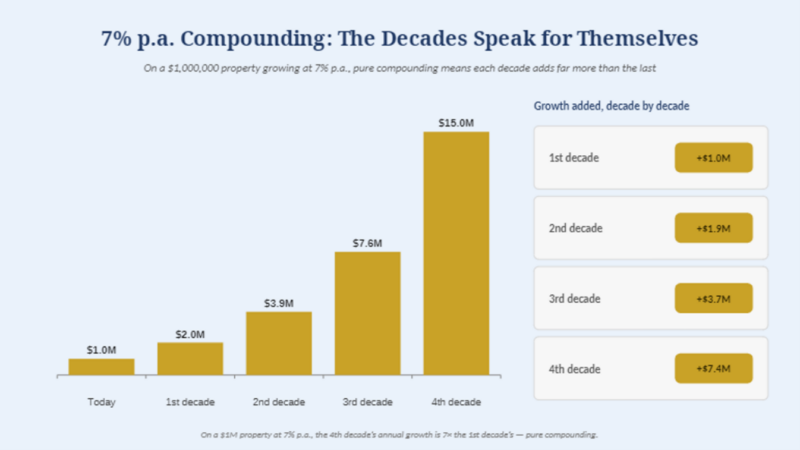
Notice where the real gains happen: in the later decades. The larger gains come later because each year’s growth builds on a bigger asset value.
This is where many investors go wrong. They buy, sell, flip and restart, and never reach the back end of the holding period where the most substantial growth occurs.
If you accept that the market will continue to compound over time, then holding through that final stretch is critical.
What interruption costs you
To see how powerful uninterrupted compounding is, imagine starting with $1 and doubling it every day for 30 days. After 30 doublings, you'd have just over $1 billion.
Now run the same exercise but take out 37% tax at every step before doubling.
Instead of a billion dollars, you'd finish with just over $1,000.
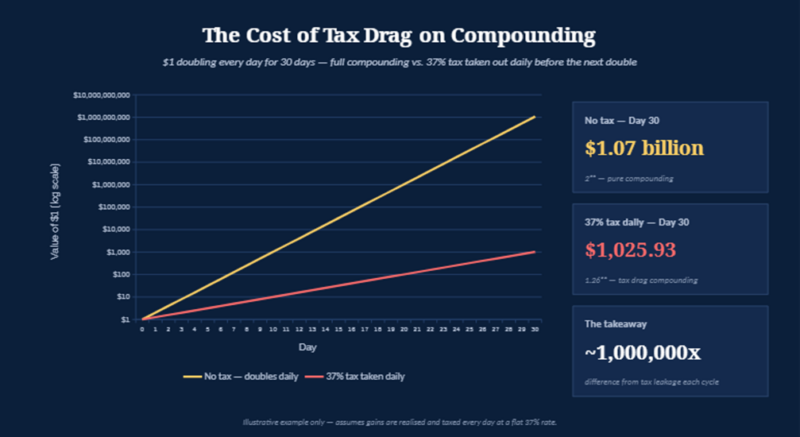
That's precisely why selling a good property after five or seven years simply because it has performed well is usually a mistake.
Between capital gains tax and agent fees, you can easily lose $100,000 or more.
Then, when you re-enter the market, you pay stamp duty, conveyancing, building and pest inspections all over again, it’s a major step backwards.
- Also read:Melbourne housing market update | October 2026

- Also read:Australian housing market update | October 2026

- Also read:Latest Property Price Forecasts. Australian Property Market Outlook 2026-2027: Navigating a Market Correction

- Also read:Brisbane Property Market Forecast [2026 & Beyond] – What The Olympics Decade Means for Investors.

- Also read:Melbourne property market forecast for 2026 & 2027 | Separating the fundamentals from the sentiment

A better approach is to buy one or two high-quality properties and hold them for the long term – simply set and forget.
The power of leverage
Leverage, using other people's money, magnifies the effect of compounding.
Consider two investors, each with $100,000 to invest, in a market that grows at 10% per year.
The investor who pays cash controls a $100,000 asset.
The investor borrowing at an 80% loan-to-value ratio controls a $500,000 asset and, before costs, earns five times the capital growth on the same $100,000.
Leverage can also protect you.
If you can buy with a smaller deposit, say $100,000 rather than $200,000, you can hold the difference in an offset account as a safety buffer while still reducing your interest costs.
This also puts recent commentary in perspective.
Some prominent voices have argued that $1 million is better invested in shares than property. All else being equal, that argument may have merit.
But all else is not equal: $1 million can support the purchase of several million dollars' worth of property (subject to serviceability).
Once you combine compounding with leverage on a much larger asset base, the outcomes diverge dramatically.
From "when to" to "how to"
Share investors tend to often obsess over timing the top or bottom of the market.
On the other hand, property rewards a different mindset.
What matters is how you buy, how much you leverage, how you add value and what your long-term strategy is.
Property is less liquid than shares, but it's steady and a forgiving asset for long-term holders.
Research shows that even buying at the very peak of a cycle makes relatively little difference to the outcome over 10 to 20 years.
In other words, a long horizon may give you time to recover from a poorly timed purchase, but it will not turn a poor property or unaffordable loan into a good investment.
Plan the purchase around your own finances rather than a prediction about next month’s prices.
Case study: Liz and Gavin
Liz and Gavin bought their home seven or eight years ago for $500,000.
It's now worth $1 million, and they owe $300,000 on their mortgage.
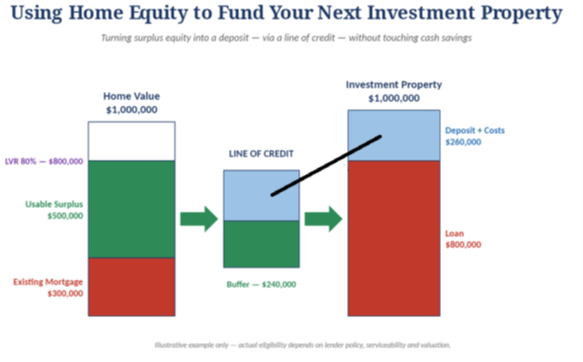
At an 80% loan-to-value ratio, they could borrow up to $800,000 against their home.
After their existing $300,000 loan, that leaves $500,000 in usable equity.
They draw $260,000 of that equity to buy a $1 million investment property: $200,000 for the deposit and $60,000 for purchase costs.
The investment property itself is funded with an 80% loan.
The remaining $240,000 of equity is set up as a line of credit and left untouched as a safety buffer.
Its purpose is to cover the property's holding shortfall. If the gap between rent and costs is $24,000 to $30,000 a year, the buffer covers it, with the interest capitalised rather than paid from Liz and Gavin's own pockets.
That buys them roughly eight to ten years, and because it's a line of credit, it costs nothing until it's drawn.
This is not a two or threeyear strategy; it's designed to be set up over five, seven or ten years.
Ten years later
Assuming growth of roughly 7–8% a year, their home would now be worth around $2 million, and their investment property has also doubled to around $2 million, giving them $4 million in property.
Their total debt is approximately $1.36 million in original borrowings, plus up to $240,000 in capitalised shortfall.
That leaves them with roughly $2.4 million or more in equity.
At 8% growth, $2 million of property adds around $160,000 in value in a single year, and that figure keeps compounding.
Meanwhile, Liz and Gavin have simply gone about their lives.
Their property "business" has effectively paid for itself, and they now have options: refinance to unlock additional equity for another purchase, or start paying down debt.
Two businesses, not one
To build lasting wealth, you need two businesses: a cash-flow business, typically your job or your business, and an asset-appreciation business, which is your property portfolio.
Many investors confuse or try to merge the two into one.
Flipping and developing are cash flow businesses, not capital growth strategies, when you retire so does your ability to maintain cash flow.
Keep them separate and understand which one you're running and why.
What separates the successful from the rest
A long-cited statistic suggests that of 100 people starting their careers today, by age 65, one will be wealthy, four will be financially independent, five will still be working, 54 will be broke and dependent on others, and the rest will have passed.
What separates the successful few? They decide to act.
They tune out short-term noise, put a long-term plan in place, use their savings and debt strategically, and follow through and they do it with enough time to take advantage of compounding.
We've all heard someone say, "I wish I'd bought a property ten years ago." The question is whether you'll be saying the same thing ten years from now.
This article contains general information only and does not take into account your personal objectives, financial situation or needs. Consider seeking professional advice before making investment decisions or book a time to speak with our Property Strategist.