

Key takeaways
Australia’s economy is growing, but our living standards have stalled. Population growth has lifted headline GDP without delivering the same gains per person.
Weak productivity is the core problem - Australia is producing too little extra value for each hour worked.
Migration helps the economy, but it must be better aligned with productivity. Population growth works best when housing, infrastructure and skilled employment keep pace.
Younger Australians are falling further behind on wealth. Higher housing costs, later workforce entry and more debt have widened the generational gap.
Australia needs another serious reform era. Tax, productivity, business investment, housing supply and infrastructure all need attention.
For decades, Australians became accustomed to the idea that each generation would enjoy a better standard of living than the one before it.
We worked, we saved, we bought homes, we built businesses and, despite the occasional recession or economic shock, most households expected their incomes and wealth to rise over time.
Unfortunately, that expectation has been badly shaken.
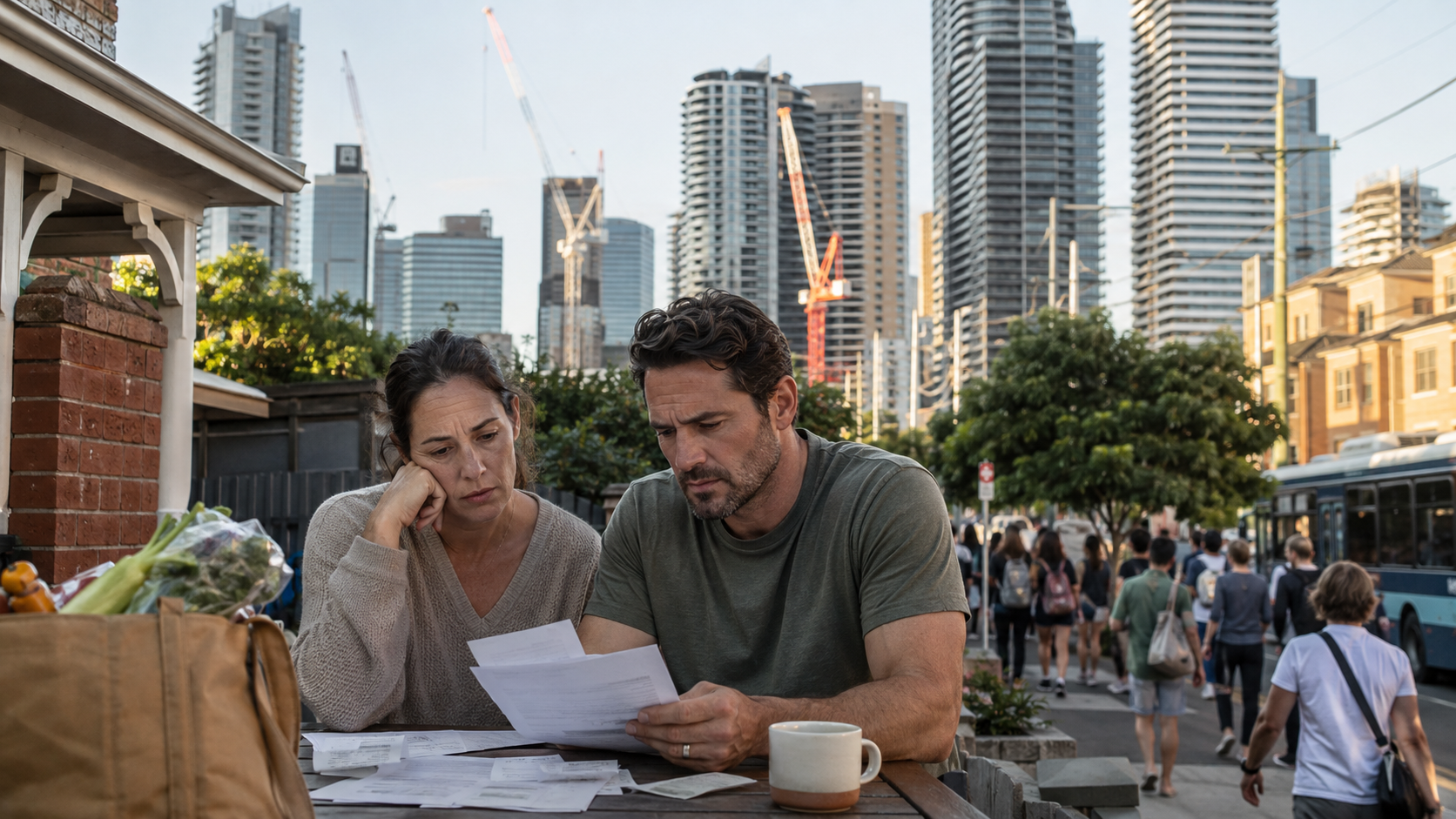
Over the past decade, growth in Australians' real household incomes has slowed dramatically, and today many people are working just as hard as they ever have while feeling they are going backwards.
Of course, you don't need an economist to tell you that. You can see it when you pay your mortgage, fill your shopping trolley, renew your insurance, pay an electricity bill or try to help your children get a foothold in the housing market.
But what worries me is that we are increasingly blaming the symptoms rather than dealing with the deeper problem.
Interest rates matter. Inflation matters. Tax matters. Housing affordability certainly matters. Yet underneath all of these sits a much bigger economic challenge that has been developing for years.
Australia has stopped becoming significantly more productive, and while our population continues to grow, our economic pie has not been growing fast enough on a per-person basis.
That distinction explains a great deal about why Australia can have a growing economy while simultaneously so many Australians feel poorer.

For weekly insights, subscribe to the Demographics Decoded podcast, where we will continue to explore these trends and their implications in greater detail.
Subscribe now on your favourite Podcast player:
The decade when Australia's economic engine slowed
Australia enjoyed an extraordinary economic run through the 1980s, 1990s and early 2000s.
There were substantial economic reforms, the global technology revolution lifted productivity, and then the resources boom delivered an enormous boost as China's rapidly industrialising economy demanded the commodities we happened to have sitting beneath our feet.
For a time, Australia could seemingly do very little wrong.
In fact as recently as 2018, The Economist famously described Australia as the "Wonder Down Under."
Yet the economic environment today looks very different.
Demographer Simon Kuestenmacher describes the past decade as a period of missed opportunity.
As Simon puts it,
"This is a story of a country that could be richer, but somehow isn't."
That is an important distinction because Australia remains an extraordinarily wealthy country by global standards. We have strong institutions, abundant natural resources, a highly educated workforce, enormous accumulated household wealth and a stable political system.
The problem is that we have not been turning those advantages into rising living standards nearly as effectively as we once did.
Real disposable income per person has grown at a fraction of its previous pace, and our performance has been poor compared with many comparable developed economies.
That means the frustration many Australians feel isn't simply psychological.
As Simon explains,
"This is not actually just a thing that you feel... this is terrible economic data."
When people continually hear that GDP is growing while their own financial position feels increasingly stretched, they understandably begin to lose confidence in the economic story being told to them.
Why population growth can make GDP look healthier than households feel
One of the most misunderstood parts of this discussion is the difference between total economic growth and economic growth per person.
Australia has experienced very strong population growth, much of it driven by migration.
More people generally means more economic activity - new residents work, earn incomes, pay taxes, rent or buy homes, purchase goods and services and contribute to economic demand, and all of that lifts headline GDP.
But headline GDP only tells you how large the economy is, it doesn't necessarily tell you whether the average Australian is becoming wealthier.
Simon summarises the problem neatly:
"The economy looks fine because ultimately there's more money. But when you divide it by more people, so there's less left over."
Of course, the real economic mechanics are more complicated than that simple equation, but the principle is important.
An economy can grow because it has added more workers and consumers without materially improving the productivity or income of each person.
That is one of the reasons Australia's population can be booming while households still experience declining living standards.
Of course, this doesn't mean migration is the problem, nor does it mean Australia should shut the door.

Note: Australia needs skilled migrants, particularly as our population ages and shortages emerge across healthcare, construction, aged care, engineering and many other sectors.
The challenge is to ensure population policy works alongside infrastructure policy, housing policy, skills policy and productivity reform.
Migration should increase Australia's economic capacity, rather than simply increasing the number of people sharing the existing capacity.
Productivity is the real long-term problem
Productivity is one of those economic terms that gets thrown around regularly without always being properly understood.
In simple terms, productivity measures how much economic output we produce for every hour worked.
If one worker can produce more goods, services or economic value in an hour than previously, productivity has increased.
Historically, this is how societies become wealthier. Businesses invest in better machinery, employees become more skilled, technology improves, work processes become more efficient and each hour of human effort produces more value.
The gains can then flow through the economy in higher wages, stronger profits, greater tax revenues and improved living standards.
For many years Australia did this rather well.
Simon notes that productivity growth through parts of the 1990s and 2000s was running at around 2 per cent per annum.
Over recent years, however, productivity growth has come close to stalling, and that should concern every Australian because there is ultimately a limit to how much wages can sustainably rise unless workers and businesses are producing more value.
Interestingly, technology alone won't save us.
We now have artificial intelligence, sophisticated business software, automation, cloud computing and communications technology that would have seemed almost unimaginable a generation ago. Yet merely introducing new technology doesn't automatically create productivity.
As Simon says, using AI to write emails faster doesn't necessarily make an employee more economically productive. If the saved time is simply filled with more administration, meetings or low-value work, the economic output may barely change.
Note: The real productivity gains will come when businesses use technology to produce more, reduce costs, improve logistics, automate repetitive tasks, create new products or allow workers to perform genuinely higher-value activities.
That requires investment, and investment requires confidence, access to capital and a policy environment where businesses believe taking risks will ultimately be rewarded.
Australia also has a capital allocation problem
There is another uncomfortable element to Australia's productivity debate.
Australians have accumulated enormous wealth, but a significant share of that capital is tied up in residential property.
Now, as a property investor myself, I obviously recognise the role residential property plays in building household wealth.

Tip: Well-located investment-grade property has been an excellent long-term wealth creation vehicle for many Australians, and I believe it will continue to be.
However, from a purely economic productivity perspective, buying an established home doesn't usually create the same productive capacity as investing capital into a company that builds a factory, develops new technology, purchases machinery or expands an export business.
Simon argues that Australia needs more capital flowing toward businesses that can increase their productive capacity.
As he explains, productivity rises when companies invest in "the robots that allow you to produce more stuff", better software, smarter logistics and technologies that allow the same workforce to generate greater output.
Of course, this doesn't mean Australians should abandon property investment.
- Also read:This week’s Australian Property Market Update – Latest Data, State by State October 13th 2026

- Also read:Latest Property Price Forecasts. Australian Property Market Outlook 2026-2027: Navigating a Market Correction

- Also read:Brisbane Property Market Forecast [2026 & Beyond] – What The Olympics Decade Means for Investors.
- Also read:Sydney property market forecast for 2026 and 2027 | Why the short-term softness is a long-term opportunity
- Also read:Melbourne property market forecast for 2026 & 2027 | Separating the fundamentals from the sentiment
It means our economic settings need to encourage productive business investment rather than making entrepreneurship increasingly difficult or capital increasingly expensive.
Unfortunately, businesses today face higher borrowing costs, significant regulatory burdens, labour shortages and a tax system that often seems to discourage additional employment and investment.
Note: Payroll tax is a good example. At Metropole we employ people in Melbourne, Sydney and Brisbane, yet once payroll passes certain thresholds businesses effectively pay an additional tax for employing more Australians.
You don't need to be an economist to recognise the strange incentive built into that arrangement.
The generational wealth divide is becoming harder to ignore
The decline in living-standard growth is also affecting Australians very differently depending on their age and whether they already own assets.
Older Australians generally entered the housing market when property was significantly more affordable relative to household incomes.
Many have since enjoyed decades of capital growth while steadily reducing or eliminating their mortgages.
Younger Australians face almost the reverse circumstances. They frequently spend longer studying, enter the workforce later, begin their careers carrying education debt and then attempt to purchase housing at much higher price-to-income ratios.
That has created a widening wealth divide.
Simon points to data showing that younger Australians have certainly become wealthier over time, but the wealth of older Australians has increased considerably faster.
Home ownership is a large part of that difference.
This is why I have long said that Australia's housing debate involves far more than simply whether property prices rise or fall.
Home ownership has profound implications for long-term financial security and the consequences become particularly serious as people approach retirement.
An increasing number of Australians are entering retirement while still renting or carrying significant mortgage debt.
And that is a problem we should be addressing now because Australia's retirement system was largely designed around the assumption that most retirees would own their homes outright.
A retiree who owns their home has very different financial requirements from someone who must fund market rent for another 20 or 30 years.
As Simon says,
"You want to make sure that you own the home that you live in in your retirement years."
And, I couldn't agree more.
Our ageing population matters, but it can't become an excuse
Australia's ageing population is also placing downward pressure on economic growth per person.
Baby Boomers are progressively leaving the workforce, and many are retiring at the point in their careers when they are at their most experienced and economically productive.
They are being replaced by younger workers who naturally have less experience and therefore, at least initially, tend to generate lower economic output.
At the same time, a smaller share of the population is working while a larger share requires healthcare, aged care and government support.
That inevitably creates fiscal pressure.
However, ageing alone doesn't explain Australia's economic underperformance. Many countries, including Germany and Japan, face substantially more challenging demographic profiles.
Australia has a comparatively younger population, strong migration flows and enormous resource wealth.
As Simon points out, we have had enough demographic and economic advantages that ageing shouldn't become an excuse for poor productivity.
Taxing work harder won't make Australia wealthier
Another reason households increasingly feel squeezed is the interaction between inflation, taxation and bracket creep.
When wages rise merely to compensate for inflation, workers can move into higher tax brackets even though their real purchasing power has barely improved.
In other words, someone can receive a salary increase, pay more tax and still find their living standard has declined.
Simon is particularly critical of this arrangement because tax thresholds don't automatically adjust for inflation.
His broader argument is that Australia should reconsider the balance between taxing income, consumption and accumulated wealth.
Whatever model we ultimately adopt, I believe the principle should be straightforward - we should encourage productive activity.
People who work harder, build businesses, employ Australians, innovate and invest capital should feel there is a worthwhile reward for doing so.
Note: Every tax system requires trade-offs, but when taxation and regulation consistently discourage additional effort, employment or investment, the long-term economic consequences eventually show up in productivity.
And I suspect that is part of what we are seeing today.
Australia eventually needs another serious reform era
Looking back, many of the economic reforms Australia continues to benefit from were politically difficult when introduced.
The Hawke, Keating and Howard eras delivered changes to financial markets, taxation, competition policy, industrial relations and government finances that helped create decades of improving productivity and rising household wealth.
Somewhere along the way we became complacent. Strong commodity exports helped disguise weaknesses elsewhere in the economy.
Rapid population growth kept headline GDP moving higher.
Governments could point to a growing economy, while the lived experience of households gradually moved in another direction.
Eventually that divergence becomes impossible to ignore.
Australia needs another serious reform conversation covering productivity, taxation, energy costs, infrastructure, housing supply, planning, business investment, skills and migration.
Simon believes Australians are capable of accepting that conversation if political leaders are prepared to have it honestly.
He argues there is already a reform blueprint available through work such as the Henry Tax Review, and what has been missing is sufficient political appetite to tackle difficult changes, and I suspect he is right.
Australians can handle uncomfortable economic truths....what frustrates people far more is being told everything is going well when their everyday experience suggests otherwise.
Why I'm still optimistic about Australia's future
Despite everything I've just outlined, I remain optimistic about Australia's long-term future.
That doesn't mean I expect the next few years to be easy.
We have accumulated structural problems over many years, and structural problems rarely disappear quickly.
But Australia still possesses many advantages other nations would love to have.
We have extraordinary natural resources, a growing population, close proximity to the rapidly expanding economies of Asia, strong institutions, world-class cities, a well-educated workforce and enormous private wealth.
We also remain one of the world's most desirable destinations for talented migrants.
Those are significant economic advantages. What we need now is to use them more effectively.
For investors, business owners and anyone building long-term wealth, this environment reinforces something I have repeatedly learned over more than five decades of investing....
You cannot control the economic cycle, government policy, inflation or interest rates, but you can control the quality of the assets you own, the businesses you invest in, the advice you receive and the financial decisions you make.
There will always be periods when Australia gets economic policy wrong. There will also be periods of reform, innovation and renewed growth.
The investors who build lasting wealth tend to position themselves for both.
Australia may have experienced a lost decade of productivity growth, but our future has not been written yet.
If we rediscover our willingness to undertake meaningful reform, encourage productive investment and build the infrastructure and businesses required for a larger population, today's economic frustration could eventually become the catalyst for another period of rising prosperity.
And history suggests that when Australia finally recognises a problem clearly enough, we usually find a way forward.