


Key takeaways
Australia's overall home ownership rate sits at 67%, only a modest dip from 70% in 2006, but that stability masks a much bigger shift underneath.
Ownership among 25 to 29 year olds has fallen from 50% to 36% since 1971, and 30 to 34 year olds have gone from 64% to 50% over the same period.
Comparing birth cohorts tells the real story: those born in the late 1940s hit 82% ownership by their early seventies, while those born in the early 1990s were sitting at just 36% ownership in their late twenties.
First Nations home ownership has climbed to a record 42%, up from 25% in 1981, though it remains around 20 percentage points behind non-Indigenous Australians.
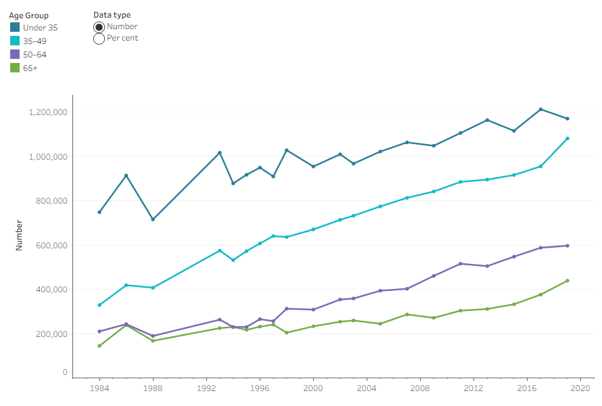
Renting is no longer just a young person's stage of life. The steepest rise in renting since 2000 has been among households aged 35 to 49 and 50 to 64.
More employed Australians are renting long-term, up from 29% in 2000 to 36% in 2019-20, including a growing share of working couples with and without children.
House prices have roughly doubled since 2011 while household income has grown by only about half that, stretching deposit-saving times to 10.6 years, well above the 20-year average.
None of this is bad news for existing investors. It reinforces why owning well-located, investment-grade property for the long term matters more than ever, and why intergenerational planning is becoming essential for families trying to help the next generation onto the ladder.
Here's something that should concern every parent and grandparent in Australia.
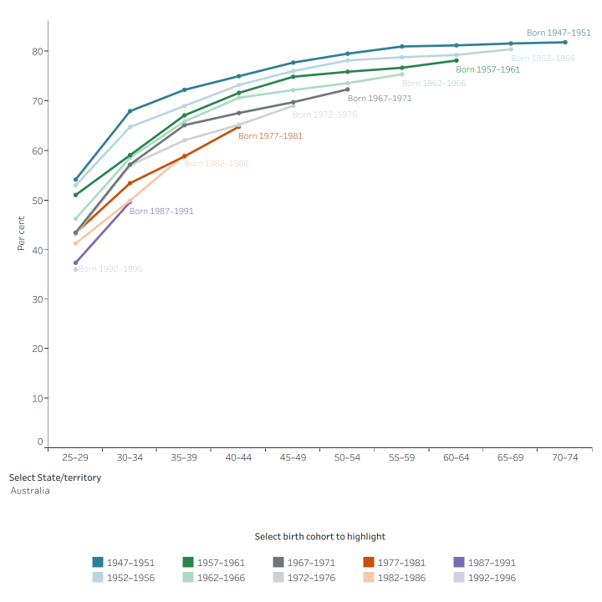
If you were born in the late 1940s, there was a 54% chance you owned a home by your late twenties. If you were born in the early 1990s, that figure has fallen to 36%.
Now that's a significant change in how wealth gets built in this country, which is playing out in front of us right now.
A detailed report from the Australian Institute of Health and Welfare, drawing on the 2021 Census and a range of more recent data sources, has laid out exactly how home ownership and housing tenure in Australia have changed over the past five decades.
The numbers tell a story that goes well beyond politics and headlines and explain why the strategy we’ve been advocating for our clients at Metropole for decades matters more today than ever.
The headline number hides the real story
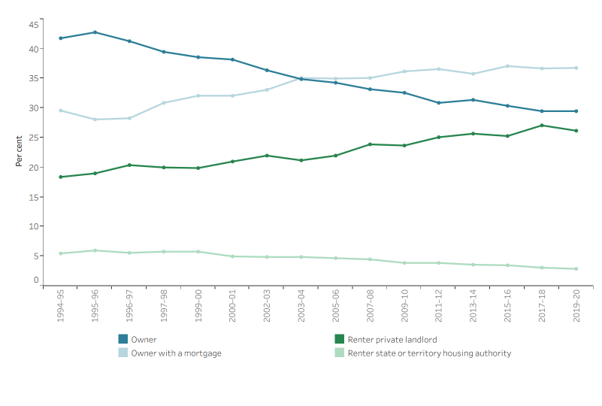
As of the 2021 Census, 67% of Australian households were home owners, down from 70% in 2006.
Now, on the surface, that sounds like a modest decline, but interestingly, overall home ownership has actually remained between 67% and 70% since the early 1970s, and the report explains why.
This stability is largely driven by Australia's ageing population, who are more likely to own their homes outright.
In other words, the aggregate figure is being propped up by older Australians who bought decades ago and have since paid off their mortgages.
However, digging deeper beneath that steady headline number, something quite different is happening to younger generations.
Proportion of households by housing tenure type, 1994–95 to 2019–20
Younger Australians are being locked out
This is where the story starts to get uncomfortable as home ownership among 30 to 34 year olds fell from 64% in 1971 to 50% in 2021, and for 25 to 29 year olds it dropped from 50% to 36%.
Interestingly, even people approaching retirement haven't been immune. Among those nearing retirement, home ownership also declined, with the rate for 50 to 54 year olds decreasing from 80% in 1996 to 72% in 2021.
The birth cohort data makes this even clearer.
Australians born between 1947 and 1951 saw home ownership rise from 54% at age 25 to 29 in 1976, to 82% by age 70 to 74 in 2021. By contrast, those born between 1992 and 1996 had a home ownership rate of just 36% when they were the same age, 25 to 29, in 2021.
Home ownership rate by birth cohort and age group, 1947–1951 to 1992–1996

Note: In other words, each generation is starting the property ladder later and with a bigger climb ahead of them.
And the report notes that home ownership rates have generally decreased with each successive birth cohort, with only two tiny exceptions across seven decades of data.
First Nations ownership is improving, but the gap remains wide
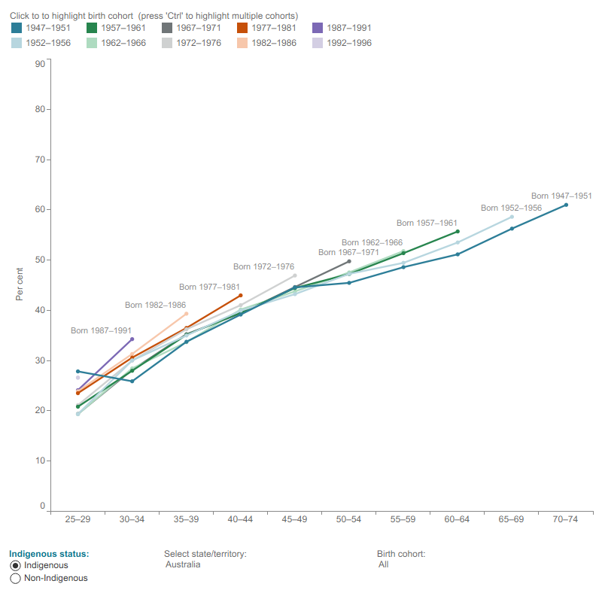
There's also a positive trend buried in this report too. The home ownership rate for Aboriginal and Torres Strait Islander people in 2021 was 42%, the highest rate ever reported, up from 25% in 1981.
That's real progress, but rates for First Nations people were consistently around 20 percentage points lower than home ownership rates for non-Indigenous Australians across all birth cohorts and age groups, so there's still a long way to go.
First Nations home ownership (%), by birth cohort and age group, 1947–1951 to 1992–1996
Renting is no longer just a phase for the young
But an underlying trend has become clear: renting used to be something you did in your twenties, before buying your first home. That's changed now.
Since 2000, the rise in the share of renting households has been most pronounced among those headed by the middle two age groups, aged 35 to 49 and 50 to 64, highlighting a growing reliance on rental accommodation among working-age Australians who, in previous generations, were more likely to be homeowners.
Households renting, by age of household reference person, 1984 to 2019-20
And this isn't confined to people out of work or struggling financially.
In 2019 to 2020, 36% of employed household reference persons were renting, up from 29% in 2000.
There has also been a noticeable rise in the proportion of couples renting, both with children, up from 20% in 2000 to 26% in 2019 to 2020, and without children, up from 18% to 28%.
Households renting, by selected household characteristics, 1984 to 2019–20
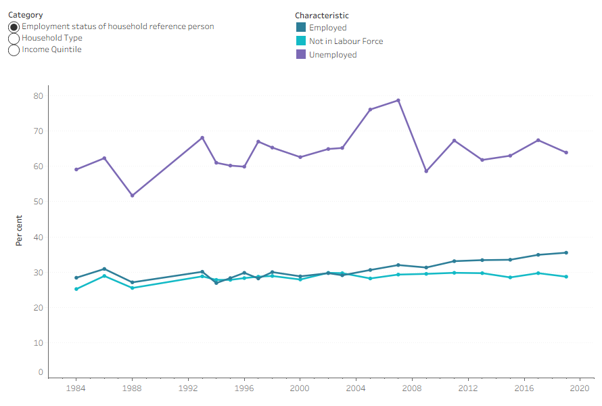
Working couples with good jobs and stable incomes are increasingly renting for longer, or renting permanently - that's a significant shift in the shape of Australian society.
Why is this happening?
The report points to a handful of factors driving this shift…
The first is the widening gap between house prices and incomes.
Between the December 2011 and December 2024 quarters, the mean price of residential dwellings more than doubled, rising from $486,900 to $995,600.
Over roughly the same period, median household disposable income grew by just 56%, compared with a 104% rise in the mean price of residential dwellings.
The practical consequence of that gap shows up in how long it takes to save a deposit.
As of September 2024, it would take a median income household 10.6 years to save a 20% deposit for a median priced dwelling, longer than the 20 year average of 9.0 years since 2004.
The report also points to changing family formation, with more people staying in education longer and marrying later, plus a rise in single-person and single-parent households, both of which tend to have lower ownership rates.
It notes the growth of residential property investment, which has expanded the rental supply but also increased competition for owner-occupiers.
And it points to population growth concentrated heavily in our capital cities, which keeps demand for established housing running hot in the locations most people want to live in.
- Also read:Latest Property Price Forecasts. Australian Property Market Outlook 2026-2027: Navigating a Market Correction

- Also read:Brisbane Property Market Forecast [2026 & Beyond] – What The Olympics Decade Means for Investors.

- Also read:Melbourne property market forecast for 2026 & 2027 | Separating the fundamentals from the sentiment

- Also read:Sydney property market forecast for 2026 and 2027 | Why the short-term softness is a long-term opportunity

- Also read:This week’s Australian Property Market Update – Latest Data, State by State September 29th 2026

What this means if you're already an investor
Think about what's actually happening here...
An entire generation of working Australians, many of them in their prime earning years, are being squeezed out of ownership and into long-term renting.
Now, that's not going to be a temporary blip caused by one interest rate cycle.
It's a structural feature of our housing market now, driven by population growth concentrated in a handful of desirable capital cities and by a persistent gap between what homes cost and what people earn.
Note: For those of us who already own investment-grade property in the right locations, that's a tailwind, not a headwind.
Every household that's pushed from ownership into renting is a household that still needs somewhere to live, and increasingly that's a well located property owned by mum and dad, Australian property investors.
It also reinforces the point that the real wealth in property doesn't come from how many properties you own or how much rent they generate. It comes from holding a small number of well-located, investment-grade assets in inner and middle-ring suburbs with strong owner-occupier appeal, and letting capital growth compound over decades.
The households now locked out of ownership in these very suburbs are the same households competing to rent them, which only strengthens the long-term investment case for owning them.
What this means if you're trying to help the next generation
A lot of our clients at Metropole aren't asking how to buy their tenth property.
They're asking us how to help their kids or grandkids get a foot on the ladder, or how to structure their estate so that the wealth they've built actually benefits the next generation rather than being eroded by tax or poor planning.
This report is a reminder of why that conversation matters so much right now.
If a 25 to 29 year old today has roughly a one in three chance of owning a home, compared with a one in two chance for their parents at the same age, then intergenerational strategy isn't a nice to have anymore - it's becoming essential.
That might mean guarantor structures, family trusts, timing of gifting, or simply building your own portfolio with enough scale and structure that it can support multiple generations rather than just yourself.
These are exactly the conversations we have with clients at Metropole, because building wealth through property was never just about the next purchase. It's about the legacy you leave and how well it's protected along the way.
If this data has you thinking about your own portfolio, or how you might help your family navigate a housing market that looks very different from the one you entered, it's worth having a proper strategic conversation rather than guessing.
Click here now to arrange a Wealth Discovery Session with one of our wealth strategists at Metropole, and we'll map out exactly where you stand and what your next move should be.