

Key takeaways
Financial freedom starts with a clear target. Know your financial independence number so you can reverse-engineer a strategy to achieve it.
Build assets that work for you. Recurring income, capital growth and compounding create a genuine long-term wealth machine.
Follow the fundamentals consistently. Spend less than you earn, invest the difference wisely, reinvest for compound growth and repeat the process.
Income supports your journey, but assets build wealth. Appreciating assets, leverage and compounding can grow your net worth far beyond what saving alone is likely to achieve.
Treat investing as a long-term process. Build financial buffers, improve your knowledge and progressively use growing equity to acquire more assets.
Would you like a Cash Machine?
Imagine flicking a switch in the morning and having it churn out money all day while you get on with the things you love doing.
Building a cash machine gives you the freedom to take your hands off the wheel, live comfortably, and pass wealth on to the next generation.
Many people think this comes down to buying the right property, timing the market or flipping for a profit, but that misses the bigger picture.
That may help explain why fewer than 1% of Australians attain true financial freedom.
It begins with a shift in mindset, an understanding of the bigger picture, and a series of small, deliberate steps that move you towards your goal.
As Dr Stephen Covey said, "Begin with the end in mind."
Think about what you want that end point to look and feel like, because it gives you a very different starting point.

Why "Just Super" Won't Get You There
Here is a sobering statistic: fewer than 1% of Australians ever become truly financially free.
Superannuation alone won't change that.
The reality is hard to ignore - even a super balance of $1-2 million could be significantly eroded by future tax changes, and there is no guarantee the pension will be available when it is needed.
Relying entirely on “the system” as it stands is becoming less viable, making it increasingly important to take control of your own financial position.
In my mind, investing is no longer optional.
Money Is Not Wealth - It Is the Vehicle
Most people chase money and assume it equals wealth.
It doesn’t. Money is simply the vehicle.
Real wealth begins with mindset and includes your health, relationships, personal growth and contribution, and your finances.
One useful starting point is to work out your financial independence number. What's Your Financial Independence Number?
By the way… I’ll help you work this out at our upcoming Masterclass next week with Michael Yardney. We'll show you the three decisions that can turn financial independence from an idea into a strategy. Click here to lock in your spot.
Surprisingly, many investors, including some with years of experience, have never defined what that number looks like. Without a target, there is nothing from which to reverse-engineer a plan and no clear parameters to work within.
When that happens, almost everything can start to look like a great investment.
The Real Cash Machine: Recurring, Compounding Income
Everyone wants a quick win, but that is rarely how long-term wealth or a genuine cash machine is built.
A genuine cash machine is built on recurring income, growing rents, compounding property values and a team of professional advisers helping to keep it running in the background.
It is a useful reminder that hard work does not automatically create wealth. Plenty of people work hard without ever becoming wealthy.
The difference comes down to whether you have built an asset base that allows your money to work for you.
I know many people whose compounding portfolios generate more each year than they could ever dream of earning from a wage, no matter how hard they worked.
The Wealth Pyramid: Five Levels
Understanding where you currently sit is the first step toward moving up.
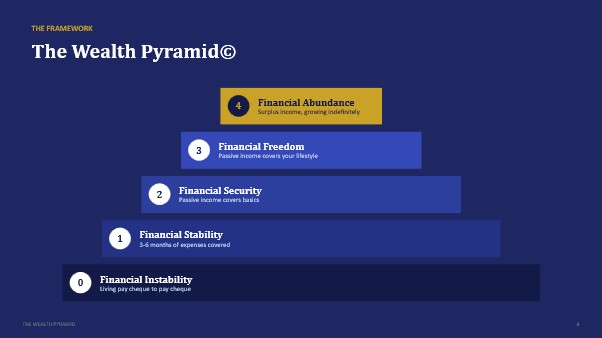
1. Financial Instability
Living paycheque to paycheque means that one broken-down car, job loss or illness can cause debt to spiral, often onto credit cards. Moving forward requires the right mindset, better education and responsibility for your cash flow. Many people struggle when they try to do it alone, without guidance from someone who has already walked the path.
2. Financial Stability
A three-to-six-month buffer is in place. This is the "fit your own mask first" stage, when you put the right insurance in place, protect your income as your most valuable asset and keep building. However, your cash flow is still largely controlled by someone else, whether that is a boss, a business or clients.
3. Financial Security
- Also read:Latest Property Price Forecasts. Australian Property Market Outlook 2026-2027: Navigating a Market Correction

- Also read:Brisbane Property Market Forecast [2026 & Beyond] – What The Olympics Decade Means for Investors.

- Also read:Melbourne property market forecast for 2026 & 2027 | Separating the fundamentals from the sentiment

- Also read:Sydney property market forecast for 2026 and 2027 | Why the short-term softness is a long-term opportunity

- Also read:Adelaide housing market update | September 2026

The basics are covered, including the home, tax, loans, car expenses, groceries and insurance. The focus shifts to building net worth through appreciating assets. During this accumulation phase, the aim is to manufacture growth and build future cash flow, before gradually placing more emphasis on debt reduction and income as retirement approaches.
4. Financial Freedom
The basics are covered, giving you greater choice over your security, lifestyle and legacy.
5. Financial Abundance
This is the ultimate target, and only a small group reaches it. All expenses and lifestyle needs are met, there is a generous surplus for the community and charities, and the asset base continues to compound. It typically takes 15-20 years of disciplined effort to get there, not an overnight achievement.
Four Steps That Apply at Every Level
Regardless of where you sit on the pyramid, the fundamentals don't change:
- Spend less than you earn. This is non-negotiable. Overspending means working forever just to pay others off.
- Invest the difference wisely. Even modest annual savings, invested well, can compound into millions of dollars over a working lifetime. A high income alone does not predict financial freedom, because plenty of high earners never get the basics right.
- Reinvest for compound growth. By the time most people reach financial freedom, the bulk of their wealth has come from compounding capital growth rather than income or rent.
- Repeat the process. Once the first property is established, equity can be used strategically to fund the next step without extra cash outlay. Getting the first purchase right makes everything after it easier.
Multiple Recurring Income Streams
A single income may have been enough in earlier times, but the rising cost of living means most households now need more than one.
That additional income may come from a second job or from investments such as property, shares, ETFs and managed funds.
Recurring income deserves particular attention here.
Flipping properties, for instance, generates linear income: you work, you sell, and you get paid once. It rarely creates enduring wealth because nothing continues to compound, and once you stop there are often few assets left to produce cash flow.
A cash machine, by contrast, keeps generating income and growth. Rent and capital growth continue whether or not you are actively working.
Consider a simple example... Buying a $1 million property, paying down the debt over time and letting compounding do the rest can provide a realistic path to an extra $1 million in equity over a decade, without earning it through additional hours of work.
Assets Create Wealth - Income Supports the Journey
As I often explain, you can’t save your way to substantial wealth.
As a rough guide, generating $30,000 of income from an unencumbered asset requires roughly $1 million in value at a 3% yield.
Aiming for $100,000 a year in retirement income means targeting an asset base of around $3 million.
Doubling your income today is very unlikely to get you to $3 million in savings on its own.
Buying appreciating assets and allowing them to grow, compound and be paid down with the help of leverage is what can get you there.
Five Types of Investors
What type of investor are you?
- The Spender - spends everything and lives paycheque to paycheque.
- The Saver - pays off the family home and squirrels away savings, but continues spending on holidays and cars rather than directing more money towards investments.
- The Passive Investor - knows investing matters but lacks financial literacy, often chasing get-rich-quick schemes that do not work out.
- The Active Investor - takes responsibility, builds knowledge and focuses on growing net worth through assets.
- The Professional Investor - treats investing like a business, using the right structures, a trusted team and a mindset focused on teaching the next generation.
Practical Starting Points
Whatever type of investor you are, and wherever you sit on the wealth pyramid, there are a few practical places to begin.
Pay yourself first. Set aside at least 10% of every pay in an account you don’t touch. This money is reserved for investing, rather than holidays or major purchases.
There are some excellent apps that let you divide your money into separate buckets, and a clearly labelled "do not touch" bucket is essential.
Every investor needs to live below their means and use separate accounts for discretionary spending so that the 10% set aside for investing remains untouched.
Once a deposit has built up in that account, perhaps with the money invested in ETFs or shares in the meantime, it can be directed into property.
Those funds may grow faster than cash savings, while property generally provides greater leverage and access to a higher-value asset than many other investment vehicles.
The first property is usually the hardest to acquire, but it can also prove the most valuable because of the lessons you learn along the way.
As the property grows in value and equity builds, that equity can help fund later purchases and allow you to keep acquiring assets with less additional cash.
Where Do You Sit?
Wealth is built from assets, not income.
Trading time for money produces income, while owning appreciating assets is what builds wealth over time.
Recurring income and compounding growth are more powerful than linear income. At every level of the pyramid, better education and a strong advisory team can help you keep moving forward.
It all starts with shifting your mindset and knowing your number.
Next week: why property remains such a powerful wealth-building vehicle, how compounding and leverage work, and how a modest deposit can grow into a multimillion-dollar property portfolio.