

Key takeaways
You don't have to sell your property portfolio to retire comfortably. A well-structured retirement plan can provide income while preserving your assets.
Managing debt can be more effective than eliminating it. Refinancing and extending loan terms can improve cash flow without selling quality properties.
Sell underperforming properties, not your best assets. Holding investment-grade properties allows you to benefit from future capital growth and rental income.
Start planning for retirement well before you stop working. Understanding your future income needs helps you make better investment decisions today.
Superannuation and property can work together. The right balance can maximise retirement income while preserving wealth.
A strategic approach can deliver more retirement income than expected. One case study achieved $224,000 in projected annual passive income, exceeding the family's $200,000 target.
Older investors may still be able to refinance investment loans. Lenders generally focus on serviceability and a credible exit strategy.
The right professional team makes a difference. Property strategists, financial planners, accountants and mortgage brokers can identify opportunities to improve retirement outcomes.
You can enjoy a comfortable retirement and leave a lasting legacy. A well-structured property portfolio can provide income today and wealth for future generations.
Are you a property investor, wondering how you will put it all together at retirement?
Despite what many people think, you don't have to sell all your properties to retire comfortably.
Most property investors all think a similar way as they approach retirement.
Build a portfolio of half a dozen properties, sell a couple when you stop working, use the proceeds to clear the debt and live off what's left.
It sounds sensible and for some people it works but it often means selling your best-performing assets, paying capital gains tax and giving up years of future growth, while leaving little for the next generation.
In two recent client case studies, restructuring their debt instead of selling, delivered more income than the owners were aiming for and kept their portfolios intact for the next generation.
When working with clients approaching retirement, selling down is rarely the only option and is often not the best one.

Manage the debt, don't sell down the fortresses
The big shift is simple, instead of asking which properties to sell, ask how to manage the debt.
The longer you hold quality property, the more capital growth you capture and the bigger the legacy you can pass on.
Retirement isn't a finish line where everything must be sold down to clear debt, for those of us with children and grandchildren, the goal goes well beyond our own retirement.
So, the question becomes: can you have the retirement income you want and still leave something meaningful behind?
In many cases, the answer is yes….. absolutely!
Let’s take a closer look.
Case study 1: Ken, one year from retirement
Ken has done very well, worked hard and built a strong property portfolio.
His home was paid off, he held five investment properties worth a little over $5 million in total, and he and his wife had $2.5 million in super.
His goal was $150,000 a year in passive income, but more importantly wanted to set his kids up, which would resonate with us all in the current environment.
The problem
- About $1 million of investment debt remained
- Repayments were still based on the original, much larger loan balances
- The portfolio was costing him around $10,000 a year to hold, plus expensive maintenance items.
- One property was a genuine dud: low growth prospects, constant repairs and high costs
His super alone, at a conservative 5% return, could almost fund his $150,000 target without eating into capital but the $10,000 annual property shortfall and costs pulled him below it.
The conventional fix was to sell two or three properties to wipe out the debt completely.
While that would clear the loans, it would also cut his rental income and shrink what he could leave his children.
What we did instead
- Reviewed every property. We identified the underperformer and sold it. He sold before the recent federal budget changes and achieved a reasonable price.
- Boosted his super. Ken paid some capital gains tax, but the sale left him with a healthy pool of cash. On the advice of his financial planner, he moved $300,000 into his self-managed super fund, where it could earn returns in a lower-tax environment.
- Refinanced and extended the remaining loans. Resetting the roughly $1 million balance over a new 30-year term brought repayments down sharply and turned every remaining property cash-flow positive.
We could have used the cash to pay down the loans instead but putting it into Super was expected to deliver a better overall result.
The result
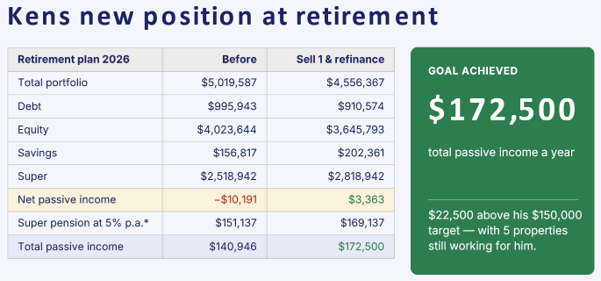
In the end, Ken sold just one property.
He beat his income target, kept the rest of his portfolio, and has no need to sell anything else.
As rents rise and loan balances fall, the properties' income will keep improving, paying off debt and he now has a substantial property legacy to pass on.
"Surely I can't get a 30-year loan in my sixties?"
This is one of the most common misconceptions we hear.
Borrowing for your own home later in life is a different story, but for buying or refinancing an investment property, there are generally no age restrictions on getting a loan.
What lenders want is a credible exit strategy: how the loan will eventually be repaid.
For an investor with several properties, that's straightforward, selling one property down the track can clear the debt.
- Also read:Latest Property Price Forecasts. Australian Property Market Outlook 2026-2027: Navigating a Market Correction

- Also read:Brisbane Property Market Forecast [2026 & Beyond] – What The Olympics Decade Means for Investors.

- Also read:Melbourne property market forecast for 2026 & 2027 | Separating the fundamentals from the sentiment

- Also read:Sydney property market forecast for 2026 and 2027 | Why the short-term softness is a long-term opportunity

- Also read:Adelaide housing market update | November 2026

This is also why it pays to have a property professional working alongside your accountant or financial planner.
Too often, the default position and advice is to sell the property with the most equity or the most debt.
That can mean selling your best asset and paying for it for decades to come.
Case study 2: a young family, 20 years from retirement
The same thinking works at the start of the journey, and that's where it is most powerful.
This couple has two children and a home with plenty of equity, which will be paid off by retirement.
The gap was income.
Their projected super of $1.89 million would generate only about $113,000 a year at a conservative 5% return. Their target was $200,000.
Step 1: one Melbourne investment property
We modelled buying a $1 million investment property in Melbourne within the next six months.
At retirement, that left about $100,000 of debt, which their savings and super could easily clear.
Doing so would turn the property from roughly $28,000 a year negative into about $53,000 a year of positive income.
Add the $113,000 from super and they reach about $167,000 a year.
That's a good result, but still short of the goal.
Step 2: a second property in 2032
The projections showed that by 2032 they could add a second property of similar value.
With compounding capital growth, their real estate could be worth around $8.8 million by 2046.
Because they would be taking on more debt over a 30-year term, about $763,000 would still be owing at retirement.
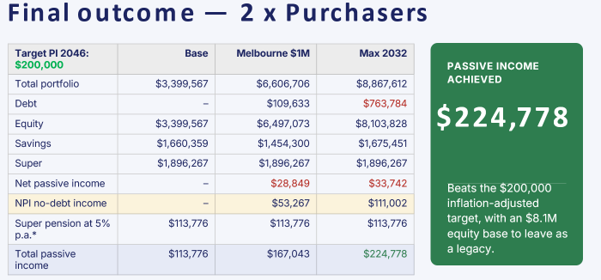
They have two choices at that point:
- Refinance and extend the loan term, re-amortising the remaining debt
- Use savings to clear the debt outright
In this model, we used their savings.
That turns a portfolio costing about $33,000 a year into about $111,000 a year of debt-free income.
Together with super, they reach about $224,000 a year in passive income, comfortably above their $200,000 target.
Of course, 2046 is a long way off and life will change along the way, school fees and family costs may reduce how much they can save and that's fine.
Because the asset base is strong, they keep their options open: refinance, draw on super, renovate, or add a commercial property later to help pay debt down.
What this means for you
We meet many investors who are like the dog that caught the car.
They've built an impressive portfolio, but they have no idea how to turn it into a retirement income.
The lessons from these two case studies:
- Start with the end in mind. Knowing your likely retirement position before you buy makes every decision safer and gives you something clear to aim for.
- Sell only what deserves to be sold. Move on underperformers and keep the assets that will keep growing.
- Debt is a tool to manage, not just a burden to remove. Refinancing, extending loan terms and re-amortising can turn a negatively geared portfolio into a positive one.
- Look at the whole picture. Sometimes cash works harder in super than paying down a loan.
- Build a team. A property strategist, financial planner, accountant and mortgage broker working together will find options none of them would find alone.
Perhaps you need to rethink of you are looking at retirement.
You don't have to choose between a comfortable retirement and leaving a legacy, because with the right plan, you can have both.
If you'd like to know what your own retirement could look like, and whether you need to sell anything at all, book a chat with our team.