

Key takeaways
Renters saw some welcome relief in December, with the rental vacancy rate rising from 1.5% to 1.6% through the month.
However, the vacancy rate is still close to record lows, and the subtle rise could have more to do with seasonal factors through December than an actual loosening in rental conditions.
The higher vacancy rate was accompanied by an easing in the pace of rental growth.
Nationally, rents were up 5.2% in 2025, a step up from the 4.8% rise seen in 2024, but well down from the near 10% jump in rents recorded in 2021, 2022 and 2023 when the double whammy of smaller households and a catch-up in overseas migration amplified rental demand.
Renters saw some welcome relief in December, with the rental vacancy rate rising from 1.5% to 1.6% through the month.
However, the vacancy rate is still close to record lows, and the subtle rise could have more to do with seasonal factors through December than an actual loosening in rental conditions.
The higher vacancy rate was accompanied by an easing in the pace of rental growth.
Cotality’s national rental index was up 0.3% in December, slowing from a 0.5% lift in November.
In seasonally adjusted terms, the slowdown wasn’t as sharp, but still evident, slowing from 0.5%, where the monthly change has held for the previous four months, to 0.4%.
Rental conditions tend to be highly seasonal through December and January, with leasing cycles disrupted by university breaks and the festive season.
We will get a better feel for rental conditions in February.
However, even if conditions have loosened a little, it's from an extremely tight position, and rents are likely to rise further through 2026.
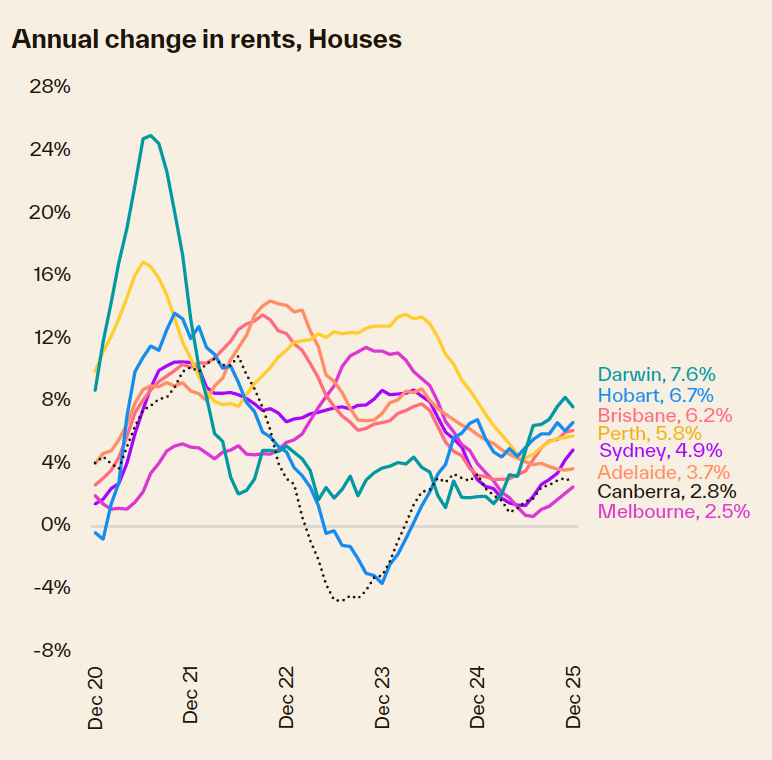
Nationally, rents were up 5.2% in 2025, a step up from the 4.8% rise seen in 2024, but well down from the near 10% jump in rents recorded in 2021, 2022 and 2023 when the double whammy of smaller households and a catch-up in overseas migration amplified rental demand.
In the five years leading into 2020, the average rate of rental appreciation was just 1.2%.
- Also read:Adelaide housing market update | March 2026

- Also read:Brisbane housing market update | March 2026

- Also read:Regional Property Is Booming… But Should Investors Be Careful? | Property Insiders

- Also read:Sydney housing market update | March 2026

- Also read:This week’s Australian Property Market Update – Latest Data, State by State March 17th 2026

The past five years have seen rents rise at the average annual rate of 7.4%.

Rents rose across every major region in 2025.
Regional WA recorded the largest annual rise, up 10.1%, followed by Darwin with an 8.2% lift in dwelling rents.
Melbourne recorded the smallest increase in rents, up 2.9%, followed by the ACT with a 3.0% rise in rents.
Although rents are rising, home values are rising faster, driving a trend towards lower gross rental yields.
The national gross rental yield fell by 11 basis points in 2025, from 3.67% in December 2024, to 3.56% at the end of 2025.
This was the lowest gross yield nationally since September 2022.
Sydney is home to the country’s lowest capital city yields, with investors seeing a gross rental return of just 3.0%, a slight reduction from to 3.01% yield seen in 2024.
Darwin (6.19%) is at the other end of the scale, however, yields have fallen by 61 basis points over the year as value growth outpaces growth in rents