


Key takeaways
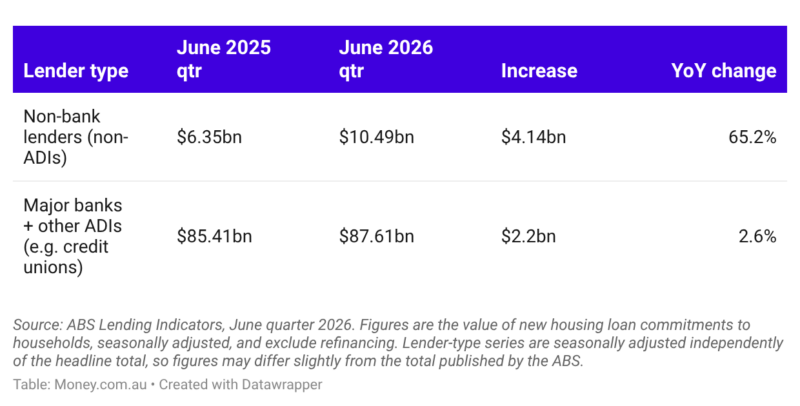
Non-bank lending is surging. New home loans from non-bank lenders jumped 65.2% over the year to June 2026.
Non-banks are gaining market share. They now account for 10.7% of new home lending, up from just 4.8% in 2019.
Borrowers are looking beyond traditional banks. Tighter lending conditions and reduced borrowing capacity are encouraging more Australians to explore alternatives.
Non-banks can offer greater flexibility. They may suit self-employed borrowers, investors and those who don’t fit neatly within mainstream bank lending policies.
Greater borrowing capacity needs to be used wisely. The best loan is one that supports your long-term property strategy, cash flow and risk profile.
Australians are increasingly voting with their feet when it comes to choosing a home loan, with a growing number of borrowers turning to non-bank lenders.
A non-bank lender provides credit products, like home loans, but doesn't hold an authorised deposit-taking institution (ADI) licence, meaning it can't take customer deposits.
According to Money.com.au analysis of the latest ABS Lending Indicators reveals non-bank lenders, classified by the ABS as non-ADIs, issued $10.49 billion in new home loans in the June 2026 quarter.
That’s up from $6.35 billion compared to the same quarter last year, an increase of $4.14 billion, or 65.2%, year-on-year.
By comparison, the value of new home lending across major banks and other ADIs, including smaller banks, credit unions and building societies, grew just 2.6% over the same period, from $85.41 billion to $87.61 billion.
Money.com.au's Mortgage Expert, Nick Burgess, says non-bank lenders are becoming a growing force in Australia's mortgage market.
He further eplanied:
"Non-bank lenders sit outside APRA's prudential rules, including the 3% serviceability buffer banks have to apply.
Most still apply a buffer of their own, but it's often lower, which can mean more borrowing capacity than you'd get from a traditional bank.
This matters more than ever as this year's rate rises, reduced borrowing power and tighter lending conditions for investors following the Federal Budget have squeezed how much people can borrow.
These factors are pushing more borrowers to look beyond traditional banks, and that’s reflected in the growing value of home loans being issued by non-bank lenders."
Mr Burgess also notes there are other reasons some borrowers consider a non-bank lender, particularly when their circumstances don't fit neatly within the lending criteria of a traditional bank.
He explains:
"Mainstream banks generally have fairly rigid lending policies, and not every borrower fits neatly inside that box.
Someone who’s self-employed or has a blemish on their credit report, for example, may find they have more options outside the traditional banking system,” he says.
- Also read:Migration Is Falling: What Happens to Australian Property Prices Now? | Property Insiders
- Also read:This week’s Australian Property Market Update – Latest Data, State by State September 22nd 2026
- Also read:Latest Property Price Forecasts. Australian Property Market Outlook 2026-2027: Navigating a Market Correction
- Also read:National Weekly Auction Report – September 19th 2026 | Clearance Rates Ease as Auctions Surge
- Also read:Adelaide housing market update | September 2026
There’s also a perception that going to a non-bank means paying a higher interest rate, but that’s not always the case.
Some online non-bank lenders are very competitive on price, particularly for straightforward borrowers with good equity. It’s generally at the specialist end of the market, where borrowers have credit issues or complex income, that you’re likely to pay more because the lender is taking on more risk.”




According to the analysis' data, non-bank lenders now account for 10.7% of the value of new home lending, up from 4.8% in September 2019, when the series began. Their share has risen steadily since mid-2023.
Non-bank lending grows as the mortgage market shrinks
Non-bank lending continues to grow even as the overall mortgage market contracts, with the value of non-ADI home loans increasing 3.2% from the March to June quarter, from $10.16 billion to $10.49 billion.
By comparison, the value of total new housing loans fell 5.2% over the same period.
Mr Burgess says that divergence suggests non-banks aren't simply benefiting from a growing mortgage market.
He further explains:
"If every type of lender was growing at roughly the same rate, you could put it down to an overall increase in the value of new home lending. That's not what we're seeing.
The value of non-bank lending has continued to grow while the overall value of new home lending has gone backwards in the latest quarter.
The big question is whether this is a temporary response to current lending conditions or the beginning of a more permanent shift in where Australians get their home loans.
Final note
The growing role of non-bank lenders is another sign of how Australia’s property finance landscape is evolving, and for investors in particular, access to finance will remain an important part of their wealth creation strategy.
However, greater borrowing capacity doesn’t automatically mean you should borrow more, and choosing a lender should never come down to interest rates or borrowing limits alone.
Smart investors structure their finance around their long-term property strategy, cash flow and risk profile, while maintaining financial buffers for the inevitable surprises ahead.
As lending conditions continue to change, having the right finance strategy may ultimately be just as important as choosing the right property.