

Key takeaways
Successful property negotiation is about more than price. Understanding the finer details can make all the difference.
Always negotiate directly with the listing agent. This ensures your questions and offers reach the seller accurately.
Present yourself as a serious, qualified buyer. Clear expectations and a realistic budget help you gain an agent's attention.
Seek independent, experienced property advice. A sound investment strategy and skilled buyer's agent can help you avoid costly mistakes.
Understand the seller's motivations before making an offer. Flexible settlement terms and careful listening can secure a property for less than competing offers.
Don't risk losing an investment-grade property over a few thousand dollars. The best negotiation is ultimately the one that secures the right property.
If you're interested in property, do you have all your ducks in a row and are ready to negotiate?
At this point in the journey, it can often feel like all the heavy lifting is done and that negotiating and buying a property is just a small piece of the puzzle.
While it can feel that way, it is equally important to understand some of the more complex elements to keep the process straightforward and stress-free.
The way you deal with and speak to agents, and who you trust for advice, can make all the difference
So rather than focusing solely on the big picture and negotiating the best price, I suggest you also focus on the details and the simple things within your control to get the best outcome.
Likewise, don't grind a vendor down for the last $5,000 when you could miss a property that grows significantly year after year, and decades later, you won't miss the $5,000.
The best negotiation technique, at the end of the day, is the one that buys you the property.

Start with the right person
When negotiating the purchase of a property, I always recommend that you ensure you are dealing with the listing agent.
These days a property is often marketed by a cast of thousands, and talking to anyone other than the listing agent is a bit like Chinese whispers.
You see, not all agents in the agency listing the property are able to talk directly to the seller, meaning your message may not get passed on in full.
On the other hand, the listing agent signed the seller up, holds the seller's trust, and any offer made to another agent in the company must be passed to them first, risking your precise messaging being lost in translation.
Find out who the listing agent is and direct your questions and negotiation to them. They may be busy and try to shield you off, but stay on the path.
By the way…here's a tactic to watch out for: listing agents sometimes shop an offer to other prospects saying something like:
"There's a $900,000 offer….. beat it and I think we can get it done."
It's a typical sales tactic, and it's the first of several covered below.
Get qualified before you negotiate
Remember, real estate agents are trained negotiation professionals. They spend thousands of dollars on training courses, train each week, and learn to negotiate in the heat of battle.
You may not realise they also train to qualify you.
An agent's time is scarce, so they want to deal with qualified buyers and size up every buyer quickly.
So, be direct and confident. Don't say, "I'm looking for a bargain."
If five other buyers are there, particularly in an A-grade, blue-chip location where prices are strong, an agent will push the bargain hunter to one side.
Say something closer to: "I want a really well-priced investment in Elwood, St Kilda or Elsternwick. My budget is $750,000 to $800,000.
Of course, you can add a little gamesmanship, but agents appreciate a direct approach.
- Also read:Latest Property Price Forecasts. Australian Property Market Outlook 2026-2027: Navigating a Market Correction

- Also read:Brisbane Property Market Forecast [2026 & Beyond] – What The Olympics Decade Means for Investors.

- Also read:Melbourne property market forecast for 2026 & 2027 | Separating the fundamentals from the sentiment

- Also read:Sydney property market forecast for 2026 and 2027 | Why the short-term softness is a long-term opportunity

- Also read:Adelaide housing market update | October 2026

Get to the top of the agent's list
The average investor probably buys a property every three to seven years, with little repetition, so you need to work your way to the top of an agent's list.
Five tricks to get you there.
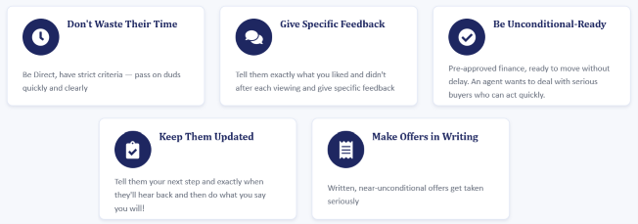
Ask the right people
Even before you negotiate anything, decide whose advice you're taking.
Almost everyone around you has a horse in the race and a reason to sway you in a certain direction.
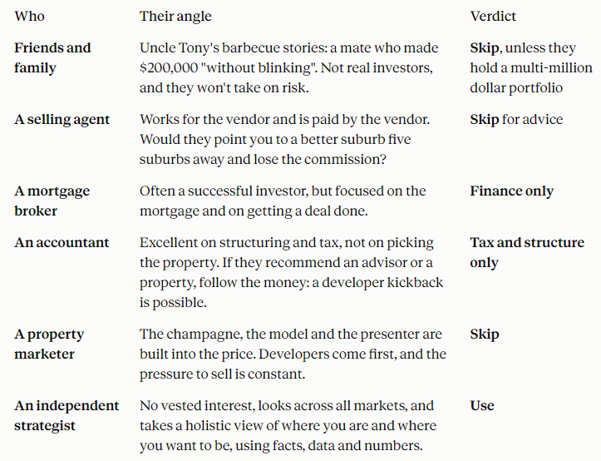
An independent strategist simplifies the complex (finance, tax, law, economics), plays the long game two or three steps ahead, and reviews your portfolio with you every year.
They help you avoid big mistakes and stop you chasing hotspots, because today's hotspot is tomorrow's not-spot.
A strategic advisor can't and doesn't pretend to predict the future, find you a guaranteed hotspot, pick the perfect moment to buy, or get you rich quickly without taking a huge amount of often unnecessary risk.
Now don’t be confused; a property strategist and a buyer's agent do different jobs.
The strategist designs the big picture: your goals and time frame, taking into account your risk profile.
The buyer's agent is an order-taker who executes the plan by finding, negotiating and securing a specific property.
If you are looking to hire a buyer's agent, here are 5 questions to ask:
- Are they qualified and licensed? Check their licence and their membership of peak bodies.
- Do they know your location? When Michael Yardney bought in Brisbane three or four years ago, I helped, because I know the streets, the market, which side of the road to buy on and which to avoid, and the flooding. He knows more about property than I ever will, and he still used a local expert.
- How long have they been doing it? In 2006, "years of experience" was enough because there were few buyer's agents. Today you want decades, through several cycles.
- Do they have a team and a research department, or are they a one-person band?
- How are they paid? It should be by you. If you're not paying a buyer's agent, you're being played. I've had clients tell me they can get property advice for free, only to find it was off the plan with commissions and kickbacks. You're paying a fee either way. You just don't see it.
Information, time and power usually favour you
Three ingredients decide a negotiation, and buyers tend to hold more of each than it feels like.
- Information. You've researched the local market and know the prices, which gives you an edge. You also need to understand the seller's motivation: why they're selling and what their story is. That's harder to draw out of agents, particularly when people are under pressure.
- Time. You have all the time in the world, because there's always another property. The vendor really doesn't. As a buyer's agent, if I don't like one property I can go for another, because I'm not tied to a particular one.
- Power. Perceived power usually lies with the other side. In reality, an emotionally invested vendor shifts it to you. Hold on to that power and negotiate with confidence.
Here are five questions I believe you should ask the selling agent before you submit an offer on any property:
- How did the vendor arrive at the asking price? Did it come from the agent's advice, or did they make it up?
- Have there been any other offers in writing?
- How long has it been on the market?
- Why is the vendor selling? Dig deeper and don't take the first answer. It's surprising what people tell you when their guard is down.
- Has the asking price already been reduced?
Some of these won't be answered at the first open home, but it's worth getting answers, particularly about why they're selling, time on the market, and their expectations.
Negotiation isn't always about talking; it's about listening and taking from it what you will. Poor listening skills mean poor negotiation skills.
Putting it all together
In a transaction we were recently looking at for a client, the property was going to auction and it was established that a vendor wanted $1.8 million and a 120-day settlement.
Other bidders offered $1.8 million or more, but were firm on settling in a shorter timeframe, around 30 to 60 days.
We offered $1.7 million and secured the property because we gave the vendor the one small thing they cared about most.
By listening and understanding the vendor's nerves and emotions about potentially being out of a home with an early settlement, we offered peace of mind with a longer settlement.
Negotiations are won the same way every time: in the small details that most buyers never think to control.