


Key takeaways
Gen X are the quiet winners of Australia’s property boom. They bought when prices were affordable, interest rates were falling, and credit was expanding.
As a result, they’ve accumulated some of the strongest capital gains of any generation, with the average portfolio now topping $1.31 million.
Gen X is the classic “sandwich generation”, supporting ageing parents while housing adult kids for longer. This is reshaping demand toward multigenerational homes, dual-living setups, and knockdown–rebuilds that create space and independence under one roof.
With the highest share of remote workers, Gen X is upgrading homes to include dedicated studies, studios, and work zones.
Many now have the equity to purchase regional lifestyle properties within two hours of major capitals. These “tree change” and “sea change” choices are helping fuel strong price growth in regional markets.
As the first generation to retire with compulsory super — plus a massive influx of incoming inheritances — Gen X will have both liquidity and property equity.
They’ll increasingly gravitate toward quality, low-maintenance inner-suburban apartments and townhouses, influencing the next decade of housing trends.
They’re pragmatic, financially savvy, and quietly sitting on some of the biggest property gains in the nation.
Generation X - those born between 1965 and 1980 - have become the quiet achievers of Australian real estate.
After decades of focusing on work, family, and stability, Gen X now finds itself in a position of significant financial power.
They entered the property market when homes were still relatively affordable, enjoyed the benefit of falling interest rates, and rode one of the strongest housing booms in history.
But the story of Gen X isn’t just about the past – it’s about how their next moves will shape the Australian property market for years to come.

Gen X: the winners of the property race
According to John McGrath’s McGrath 2026 Report, Gen Xers are the “winners” of the generational real estate race.
A 25-year-old Gen Xer who bought a median-priced Australian property in 1997 would have made an impressive $654,910 in capital gains if they sold in mid-2025.
By comparison, Baby Boomers would have made $456,243, and Millennials $405,472 on equivalent purchases at age 25.
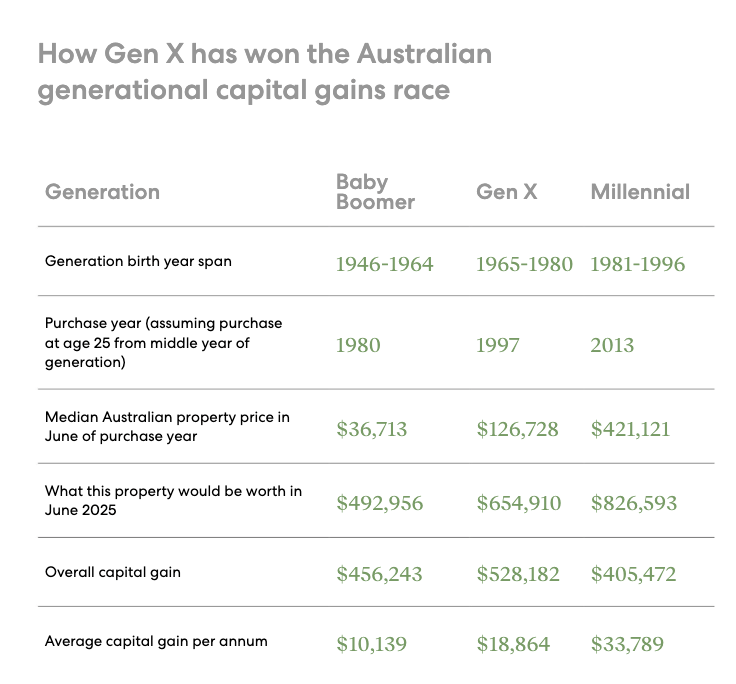
Source: Cotality Research and McGrath Report
Of course, part of that comes down to time in the market – Gen Xers have simply held their properties longer.
But what’s notable is that they also enjoyed more favourable buying conditions.
In the 1990s, the median home price was around six times the average income – today, that ratio has blown out to around ten times, making ownership far tougher for younger generations.
They were also the first cohort to benefit from financial deregulation and rapidly falling interest rates, allowing them to borrow more and build wealth faster.
Now in their late 40s to early 60s, many Gen Xers have paid down their mortgages or are completely debt-free.
McGrath’s data shows the average Gen X property portfolio is worth $1.31 million, slightly higher than Baby Boomers’ $1.3 million.
The Sandwich Generation and the space squeeze
But while Gen X may look financially comfortable, they’re not without pressures.
Dubbed the “sandwich generation,” many are caring for ageing parents while also supporting adult children who haven’t yet flown the nest.
In fact, 72% of 19-year-olds now live at home, up from 63% in 2006.
Combine this with longer life expectancy – men living to 81 on average, compared to 55 a century ago – and you can see why multigenerational living is making a comeback.
Gen X is increasingly searching for homes that can accommodate three generations under one roof, with separate living zones, dual kitchens, or self-contained studios.
Expect to see more knockdown-rebuilds, dual-occupancy projects, and renovations designed for privacy and independence – yet close family proximity.
- Also read:Melbourne property market forecast for 2026 | Is it a good time to invest in Melbourne?

- Also read:Latest Property Price Forecasts Revealed. Australian Property Market Outlook 2026: Where To For Prices With Further Rate Cuts Unlikely.

- Also read:Brisbane Property Market Forecast [2026] – What’s Ahead & Where to Invest

- Also read:Sydney property market forecast for 2026. Is it a good time to invest in Sydney?

- Also read:Everything you need to know about the state of Australia’s property markets in 20 charts – January 2026

Work-life balance and the rise of the home office
Gen X is also driving the continued evolution of the work-from-home property trend.
According to the McGrath 2026 Report, 34% of remote workers come from Gen X – more than Millennials (31%) or Gen Z (18%).
Having witnessed their parents “work themselves to death,” as demographer Simon Kuestenmacher notes, Gen X has a strong belief in work-life balance.
They value flexibility and autonomy, which is now reflected in their housing choices.
Properties with a separate study, converted garage office, or garden studio have become highly sought after.
This generation isn’t chasing flashy new developments; they’re upgrading existing homes to suit hybrid work and family life.
And with an average remaining mortgage balance of $448,000 – compared to just $82,000 for Baby Boomers – many Gen Xers will stay in the workforce longer, meaning this work-from-home lifestyle will continue to influence housing design and suburb selection.
The lifestyle shift: from city hubs to coastal retreats
McGrath also points out that many Gen Xers are now in the enviable position to buy a second home, often in lifestyle-rich regional areas within two hours of Sydney or Melbourne.
Think Orange, Toowoomba, and Gisborne – towns offering urban amenities but with the charm and tranquillity of regional living.
These “tree change” and “sea change” purchases are helping fuel regional price growth, with NSW regional values rising 104% in the past decade, compared to 74% in Sydney.
For many Gen Xers, this second property serves both as a weekend escape and a future downsizer’s haven – part investment, part lifestyle play.
What comes next: The Gen X legacy
As we look toward 2031, about half of Gen Xers will still have a mortgage, but they’ll also be the first generation to retire with compulsory superannuation and one of the largest intergenerational wealth transfers in Australian history is already underway.
Annual inheritances are projected to climb from $120 billion to $500 billion over the next 25 years.
This means Gen X will have both property equity and superannuation assets to fund retirement and lifestyle ambitions – and they’ll likely reshape the downsizer market as a result.
Unlike their parents, Gen Xers are far more open to apartment and townhouse living; one in four lived in such dwellings between ages 25 and 39.
Expect demand for high-quality, low-maintenance apartments in well-connected inner suburbs to grow as this generation seeks to simplify life without sacrificing comfort.
Some final thoughts
Gen X may not be as headline-grabbing as the Millennials or as asset-rich as the Boomers, but they’re arguably the most influential generation in the housing market right now.
They’re driving multigenerational living trends, demanding homes that support hybrid work, and pushing lifestyle demand in regional markets.
They’re also about to release a wave of capital into the downsizer and investment segments.
In short, Gen X is not just the “middle child” of Australian real estate – they’re the bridge generation reshaping the market from both ends.
And as they transition from accumulation to enjoyment, their property decisions will set the tone for the next decade of Australian housing trends.