


Key takeaways
NAB recently reported their suggestions of how the current housing market downturn will affect our economy in general.
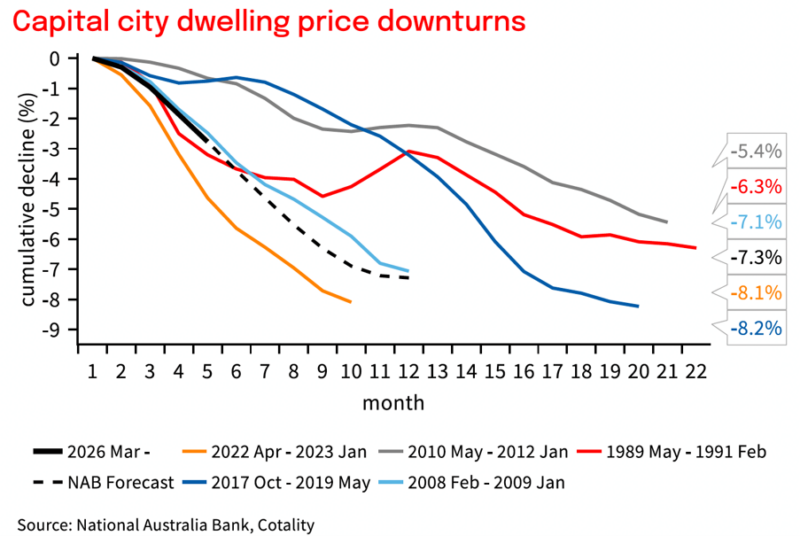
NAB expects house prices to fall ~7% peak to trough, a sharp slowdown from the 9% growth over 2025.
Declines of that magnitude are not outside recent experience, but they do support our forecast for below trend GDP growth.
NAB expects weaker credit demand, especially for investors, tighter borrowing capacity, slower dwelling investment, and softer consumption. Estimates generally find a 10% fall in dwelling prices subtracts ~1ppts from consumption growth over a couple of years.
Elevated construction pipelines in QLD, WA and SA mean near-term completions will be insulated and construction activity may respond more slowly.
While conditions in the established market have softened, rental markets remain tight and homebuilding input costs are likely to support housing CPI this year. Cooler demand should help ease broader inflation in 2027.
For the RBA, below trend growth is necessary amid elevated inflation. Monetary policy will not be a circuit breaker for the housing cycle this year.
The shift in credit demand is still important. The RBA’s assessment of financial conditions has been sensitive to housing lending and housing dynamics both reflect and complement the RBA's somewhat restrictive policy setting.
Australia’s housing market has entered a new phase, and the consequences are likely to extend well beyond homeowners watching the estimated value of their property decline.
According to a new NAB Economics report, national dwelling prices are expected to fall by around 7% from peak to trough, following growth of 8.8% during 2025.
NAB forecasts falls of about 10% in Sydney and Melbourne, with more moderate declines of between 2% and 4% across the mid-sized capital cities.
These falls are well within the range Australia has experienced during recent housing cycles, but they will still have a meaningful effect on household spending, construction, credit growth and the wider economy.
In fact, NAB believes the housing slowdown will contribute to below-trend economic growth over the next couple of years.
Housing is deeply connected to the Australian economy
Australians tend to think about housing downturns primarily in terms of falling property values, however, housing affects the economy through a number of interconnected channels.
Property transactions generate income for real estate agents, conveyancers, mortgage brokers, valuers, building inspectors, removalists and state governments.
New construction supports builders, developers, architects, engineers, suppliers and tradespeople, while rising property values influence consumer confidence and household spending.
Housing is also the main security Australian households use when borrowing money, which means changes in property values can influence borrowing capacity and access to credit.
When the property market slows, these forces begin operating in reverse.
Fewer property transactions will weigh directly on GDP
One of the first economic effects is likely to come from lower property turnover.
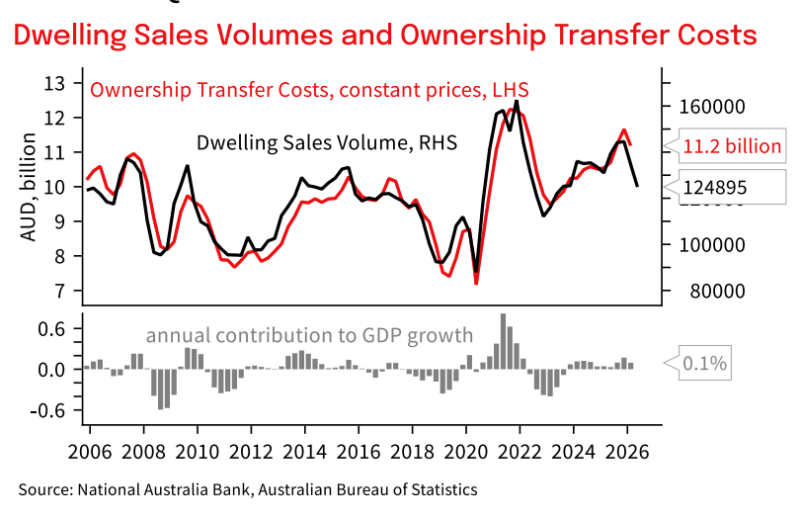
NAB reports that Australia’s seasonally adjusted housing turnover rate fell to 4.1% in July, down from 5.2% a year earlier, and expects turnover to decline further.
This matters because some of the costs associated with transferring property ownership are included directly in Australia’s calculation of economic activity.
During the 2018-19 housing downturn, weaker ownership transfer costs subtracted around 0.4 percentage points from annual GDP growth. During the downturn associated with the Global Financial Crisis, the effect was closer to 0.6 percentage points.
NAB estimates that the sharp reduction in sales volumes during the current cycle could subtract approximately 0.10 to 0.15 percentage points from GDP in the June quarter alone.
Then there are the indirect effects….People who buy homes frequently purchase furniture, appliances, flooring, curtains and other household goods. They may employ removalists, undertake renovations or spend money improving their new property.
A reduction in housing transactions therefore affects a much wider range of businesses than many people realise.
Falling housing wealth could soften consumer spending
The wealth effect is another important transmission channel.
When the value of a household’s home and investment properties rises, that household generally feels more financially secure. This can encourage additional spending, even when its income has not changed.
On the other hand, when property values fall, confidence tends to weaken, and households often become more cautious.
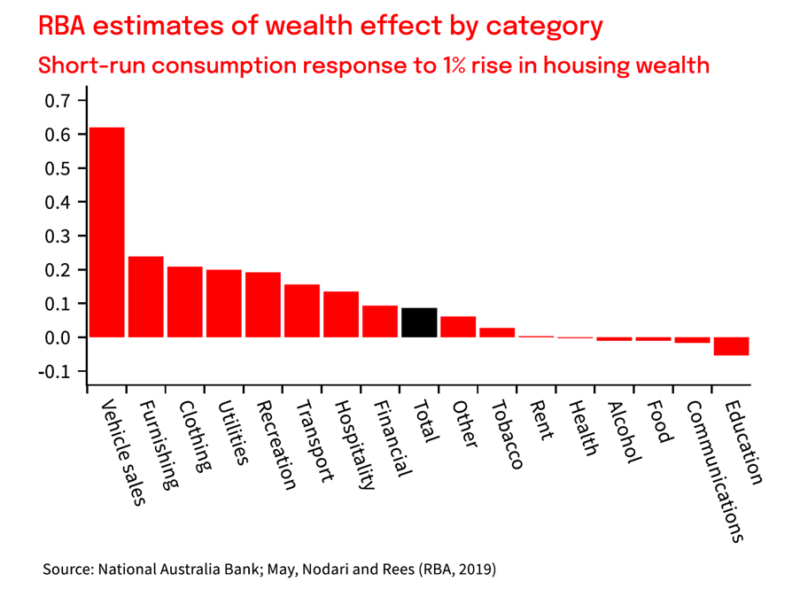
Research cited by NAB suggests that a 1% increase in housing wealth can lift consumption by approximately 0.1% to 0.2% over time.
Applying that relationship in reverse, NAB says a 10% decline in dwelling prices would generally subtract about one percentage point from consumption growth over a couple of years.
Australia’s household consumption is already under pressure from higher mortgage repayments, cost-of-living pressures and weaker growth in real disposable incomes.
A housing downturn adds another reason for households to delay buying a new car, upgrading furniture, eating out or booking an expensive holiday.
Of course, the effect is unlikely to be uniform.
Households with substantial savings, low levels of debt and secure incomes may barely change their behaviour. On the other hand, highly leveraged households, recent buyers and people approaching retirement may react much more cautiously.
Lower property values also reduce borrowing power
The effect of a housing downturn isn’t confined to consumer psychology because property also provides the collateral behind much of Australia’s household borrowing.
Rising property values allow some homeowners to refinance, borrow against accumulated equity or access funds for renovations, investments and major purchases.
And obviously, falling prices reduce that flexibility.
NAB notes that the strength of new housing lending during the second half of 2025 delivered a cash flow boost equivalent to around 2% of household sector income.
As credit demand and property turnover slow, part of that support will disappear.
NAB expects housing credit growth to fall sharply, declining from around 8% annually to approximately 3% by September 2027.
Investor lending is expected to be particularly weak due to reduced demand and changes in the tax treatment of investor-owned property, In particular, negative gearing.
- Also read:Melbourne housing market update | October 2026

- Also read:Australian housing market update | October 2026

- Also read:Latest Property Price Forecasts. Australian Property Market Outlook 2026-2027: Navigating a Market Correction

- Also read:Brisbane Property Market Forecast [2026 & Beyond] – What The Olympics Decade Means for Investors.
- Also read:Melbourne property market forecast for 2026 & 2027 | Separating the fundamentals from the sentiment

This has implications for banks and mortgage brokers, but it could also affect renovation activity, small businesses and household investment decisions.
Residential construction will slow, although the effect will be delayed
Falling established property prices usually weaken the financial case for new development.
If the expected sale price of a completed property falls while land, labour, finance and material costs remain high, fewer projects remain financially viable.
Building approvals are therefore likely to slow, followed eventually by a reduction in dwelling investment.
However, this part of the cycle involves long delays.
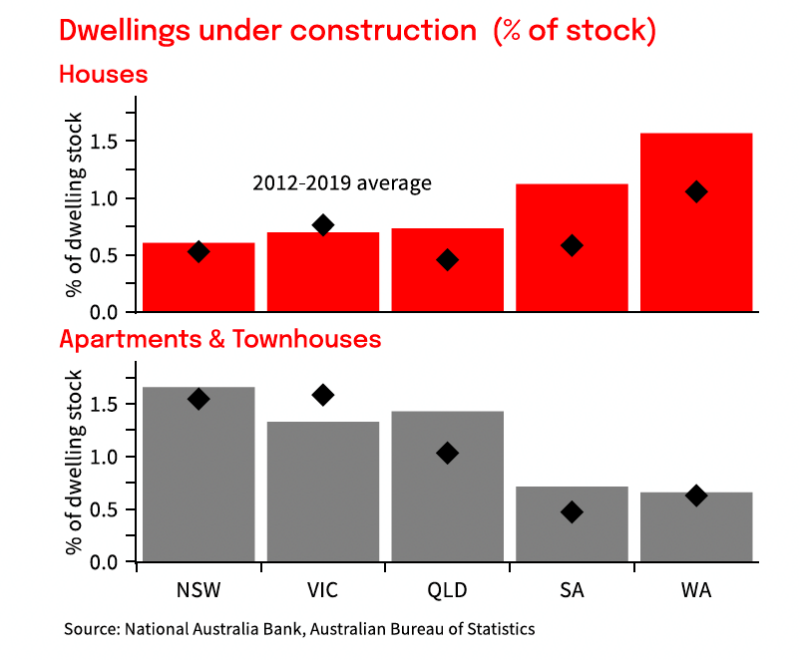
NAB points out that a detached house now takes an average of 45 weeks to build, around 50% longer than before the pandemic. There is also a substantial volume of work already under construction.
Queensland, Western Australia and South Australia have particularly large construction pipelines, which should support completions and construction employment in the near term.
The pipelines in New South Wales and Victoria are less substantial, suggesting weaker demand could flow through to residential construction more quickly in Sydney and Melbourne.
Even before construction activity falls, businesses working near the beginning of the development process could experience weaker demand.
Architects, surveyors, planning consultants, designers and development finance providers may feel the slowdown before builders and finishing trades working through existing projects.
There is also a longer-term risk. Australia remains structurally undersupplied with housing, so a fall in approvals today will contribute to another shortage of completed homes several years from now.
Falling house prices will not immediately solve inflation
It is tempting to assume that falling property values should quickly reduce inflation, but established dwelling prices are not directly included in the Consumer Price Index.
Housing inflation is mainly captured through rents and the cost of building a new home, excluding the value of the land.
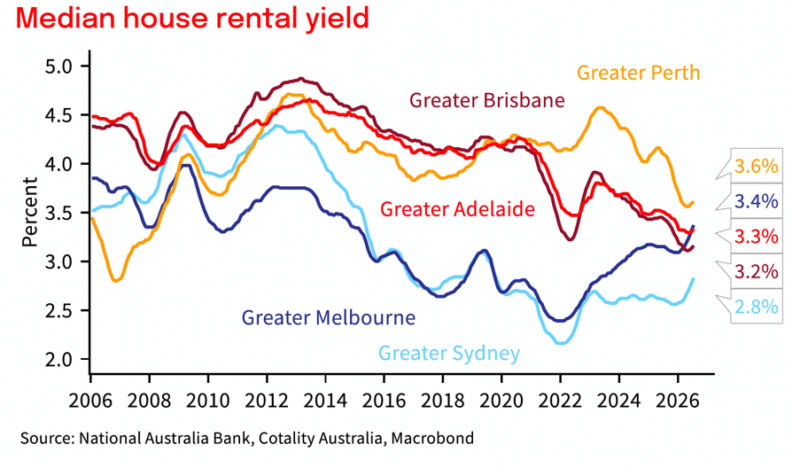
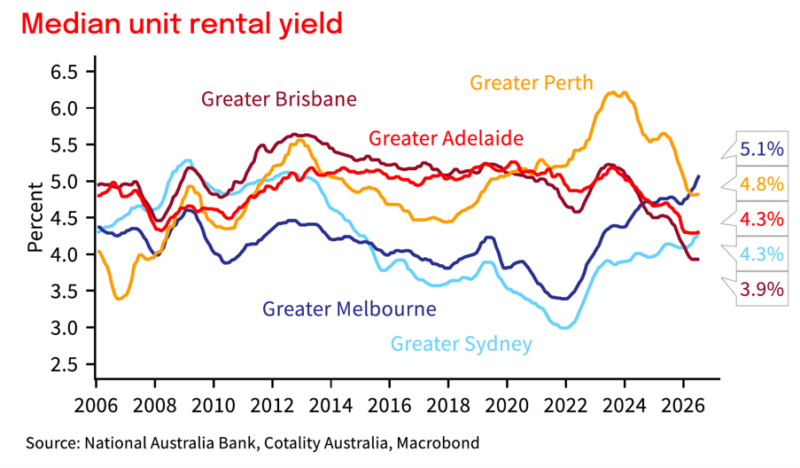
While established property prices are weakening, rental markets remain extremely tight and advertised rents have begun accelerating again in some cities.
Construction costs also remain elevated due to expensive materials, labour shortages and capacity constraints across the building industry.
NAB therefore expects homebuilding costs to support housing inflation during 2026, while softer demand and slower cost growth should become more helpful in reducing inflation during 2027.
This creates a difficult combination in which property owners experience falling asset values while tenants and new-home buyers continue facing high housing costs.
Don’t expect the RBA to rescue the housing market this year
Previous housing downturns have often encouraged the Reserve Bank to lower interest rates.
The current cycle is different because inflation remains elevated and the RBA needs economic growth to remain below trend for a period to bring demand and supply back into balance.
NAB argues that the housing slowdown is evidence that restrictive monetary policy is having its intended effect. As NAB explains, the RBA does not target house prices, but it recognises that housing has much wider economic effects than residential construction alone.
Slower credit growth, softer household spending and weaker housing activity should give the RBA greater confidence that financial conditions are restrictive.
However, NAB does not expect housing weakness to trigger rate cuts during 2026. Its baseline forecast is for the RBA to remain on hold before gradually moving towards less restrictive policy from the middle of next year.
That position could change if the housing downturn becomes considerably deeper than expected or unemployment rises sharply, but a moderate fall in property prices is unlikely to be enough.
My take after watching several of these cycles play out
I've been through enough property corrections to know that they always feel larger in the moment than they end up looking a few years down the track.
A 10% fall in Sydney and Melbourne, concentrated in the established housing market rather than rents, is consistent with cycles we've navigated before, including as recently as 2018-19.
What I find most valuable in NAB's analysis is the reminder that this correction is doing real economic work, cooling consumption, slowing credit growth and giving the RBA room to eventually ease policy, all without needing house prices to collapse.
None of this changes what I've been saying for years about the fundamentals that actually build wealth in property.
Investment grade properties in the inner and middle ring suburbs of our major cities, with strong owner-occupier demand and genuine long-term growth drivers, have come through every one of these cycles and gone on to set new highs within a few years.
Rental markets remain structurally tight according to NAB's own data, and that tells you the underlying supply and demand imbalance driving long-term capital growth hasn't gone anywhere, even while short-term sentiment has turned cautious.
Periods like this, when the headlines are gloomy and buyer competition thins out, have historically been exactly when patient, well-positioned investors do their best buying.
If you'd like to talk through how this economic backdrop might affect your own property strategy, or whether there's an opportunity in the current conditions, get in touch with our team at Metropole.
We've guided investors through multiple property cycles, and this one won't be any different. Click here now to have a wealth discovery chat with one of our wealth strategists.