

Key takeaways
Australia's tax system is becoming increasingly reliant on fewer workers. More than half of federal government revenue comes from income tax, yet Australia's workforce is shrinking relative to the number of retirees.
An ageing population will put growing pressure on government finances. As more Australians retire and healthcare and pension costs rise, relying heavily on income tax becomes increasingly difficult.
Bracket creep acts as a hidden tax increase. Because tax brackets aren't fully adjusted for inflation, many Australians pay higher tax rates even when their real purchasing power hasn't improved.
Wealth creation is shifting from wages to assets. Property, businesses and investments are generating a growing share of wealth, leading many economists to question whether work is being taxed too heavily.
Tax reform is likely to be gradual, not revolutionary. Future governments may slowly reduce reliance on income tax and broaden other revenue sources, giving investors time to adapt to changing policy settings.
Imagine opening your payslip and discovering the government was taking half as much income tax as it does today.
It sounds like the sort of promise politicians make before an election and quietly forget afterwards.
After all, governments need revenue. They have to fund hospitals, schools, roads, aged care, defence, social security and the growing list of services Australians expect.
So how could any government possibly afford to collect dramatically less income tax?
Yet when you step back from the political debate and look at the demographic forces reshaping Australia, an interesting picture emerges.
The real question isn't whether income taxes could be lower.
The real question is whether Australia can continue relying so heavily on income tax at all.
Because while politicians argue about tax cuts and spending programs, a much bigger structural issue is quietly building in the background.
Australia's tax system was designed for a younger nation. The Australia of the future will look very different.
And eventually our tax system will have to adapt.

For weekly insights, subscribe to the Demographics Decoded podcast, where we will continue to explore these trends and their implications in greater detail.
Subscribe now on your favourite Podcast player:
The uncomfortable truth hiding in every Federal Budget
Every Budget night follows a familiar script.
Government ministers line up with worthy causes demanding funding.
Health wants more hospitals. Education wants more teachers. Defence wants more equipment. Aged care requires additional support. Infrastructure projects need billions of dollars. Housing affordability programs demand funding.
The list never ends.
But very few Australians stop to ask a simple question.
Where does the money actually come from?
The answer may surprise you.
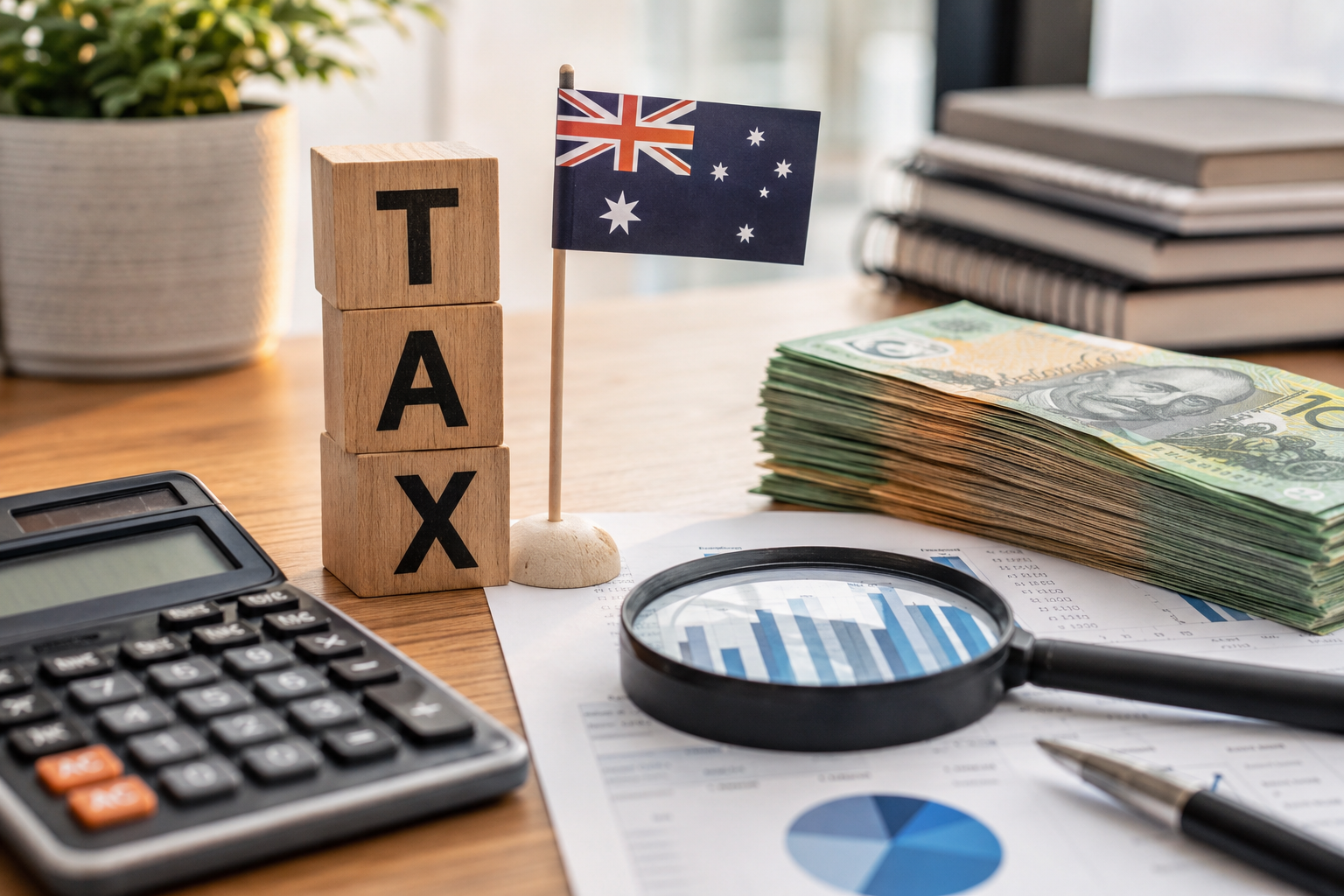
More than half of Federal Government revenue comes from personal income tax.
In other words, Australia's fiscal system relies heavily on workers turning up each day, earning wages and handing a substantial portion of those wages to government.
For decades that wasn't a problem.
Australia enjoyed strong workforce participation, a growing population and a favourable balance between taxpayers and those drawing on government services.
But demographics are changing that equation.
According to leading demographer Simon Kuestenmacher:
"We must really wean ourselves off income tax because otherwise you squeeze an ever-shrinking cohort ever more. And that just clearly is unfair."
His point is simple.

Note: The group paying most of the tax is becoming proportionally smaller while the group requiring government spending is becoming larger. That creates a structural problem that cannot be ignored forever.
Australia is ageing faster than most people realise
The demographic challenge isn't some distant issue for future generations.
It's happening now.
The baby boomers who fuelled Australia's economic growth for decades are moving through retirement.
At the same time, Australians are living longer than ever before.
Today around 17% of Australians are aged over 65. By 2050 that figure is expected to rise to approximately 23%.
At first glance that may not sound dramatic. But percentages can be deceptive.
Older Australians typically consume three to four times more healthcare resources than younger Australians.
Many receive some form of pension support.
Demand for aged care services continues to expand. Health expenditure rises sharply with age.
The challenge becomes obvious.
Government spending obligations increase while the number of workers supporting that spending grows more slowly.
Economists call this the dependency ratio. Demographers simply call it maths.
And the maths is becoming increasingly difficult.
The invisible tax Australians pay every year
Many Australians feel as though they're working harder than ever but not getting significantly ahead.
Part of that frustration comes from a phenomenon known as bracket creep.
Australia has a progressive tax system.
As your income rises, higher portions of your earnings are taxed at higher rates.
Most Australians accept that principle as fair.
The problem is that tax brackets are not automatically indexed to inflation.
As wages rise over time, workers are pushed into higher tax brackets even if their real purchasing power hasn't improved significantly.
Simon describes bracket creep as:
"The invisible tax."
A worker earning $180,000 today may find themselves in a tax bracket originally designed for genuinely high-income earners many years ago.
Yet after inflation, mortgage repayments and rising living costs, they may not feel particularly wealthy.
This process quietly boosts government revenue without requiring politicians to formally increase tax rates.
It's one reason governments have become increasingly dependent on income tax revenue.
But it also creates growing resentment among working Australians.
A wealthy nation with a cash flow problem
One of the more fascinating observations Simon makes is that Australia resembles a wealthy person struggling with cash flow.
The Commonwealth Government owns close to a trillion dollars worth of assets.
These assets include infrastructure, transport networks, schools, defence assets and various financial holdings.
On paper, the balance sheet looks impressive.
- Also read:This week’s Australian Property Market Update – Latest Data, State by State October 13th 2026

- Also read:Latest Property Price Forecasts. Australian Property Market Outlook 2026-2027: Navigating a Market Correction

- Also read:Brisbane Property Market Forecast [2026 & Beyond] – What The Olympics Decade Means for Investors.
- Also read:Sydney property market forecast for 2026 and 2027 | Why the short-term softness is a long-term opportunity
- Also read:Melbourne property market forecast for 2026 & 2027 | Separating the fundamentals from the sentiment
The problem is many of these assets don't generate meaningful income.
At the same time Australia spent decades privatising income-producing assets.
Qantas was sold. The Commonwealth Bank was sold. Telstra was sold.
Ports, airports, electricity networks and other public assets were privatised.
Those sales provided governments with immediate cash injections.
Debt was reduced. Budgets improved. Everyone felt wealthier.
But future income streams disappeared.
As investors we understand this concept instinctively.
Note: Selling an investment property to pay down debt may improve your balance sheet. But you've also eliminated a future source of rental income.
The same principle applies to governments.
Why younger economists are rethinking taxation
One of the more interesting developments occurring beneath the surface is the growing consensus among younger economists.
Increasingly, economists under forty are questioning whether Australia taxes the right things.
Simon notes:
"Essentially all economists under 40 are in broad agreement that you should tax work a bit less and you should tax wealth a bit more."
That doesn't mean taxing success. Nor does it mean punishing investors.
It reflects a recognition that wealth creation has changed.
Historically, most Australians accumulated wealth through employment income.
Today the biggest fortunes are generally built through ownership.
Property. Businesses. Shares. Intellectual property. Productive assets.
The reality is that wages alone rarely create substantial wealth.
There are only so many hours available in a day.
Note: Assets, however, can compound for decades.
As a result, policymakers are increasingly examining whether a tax system heavily focused on wages accurately reflects where wealth is actually being created.
What could replace income tax?
This is where the debate becomes politically difficult.
Reducing income tax sounds attractive. Replacing the lost revenue is much harder.
Potential alternatives include:
- Broader consumption taxes such as GST.
- Greater taxation of natural resource profits.
- Replacing inefficient stamp duties with broader land taxes.
- More effective use of sovereign wealth funds.
- Changes to capital gains taxation.
- Adjustments to wealth-based taxation systems.
Importantly, none of these options are simple.
Every tax creates winners and losers. Every reform has unintended consequences.
And governments must avoid discouraging productive investment.
Simon makes an important distinction:
"If you want to grab more tax from somewhere in Australia, you can do this, but you must cut back income tax at the same time."
That's the critical point.
The discussion is not necessarily about increasing the overall tax burden.
It's about shifting the burden.
What this means for property investors
Whenever tax reform is discussed, investors understandably become nervous.
After all, governments often view property as an attractive source of additional revenue.
But investors should avoid focusing only on short-term policy announcements.
The bigger issue is understanding the direction of travel.
Demographics suggest Australia will eventually move toward a tax system that relies less on labour income and more on broader sources of revenue. That transition is likely to be gradual.
Governments cannot afford sudden shocks. Nor can they risk undermining confidence in investment markets.
Simon himself believes change will occur slowly:
"A slow shift is probably always to be preferred over a big revolution."
History suggests he's right.
Most major tax reforms unfold over decades rather than years. That gives investors time to adapt.
It also creates opportunities for those who recognise long-term trends early.
The bigger lesson for wealth creators
The most successful investors understand that wealth isn't created by reacting to headlines.
It's created by understanding the forces shaping the future.
Demographics is one of those forces.
Long before politicians change policy, demographic trends change the pressures acting on governments.
Those pressures eventually influence taxation. They influence spending priorities. They influence housing demand. They influence economic growth. And ultimately they influence investment returns.
That's why discussions like this matter.
Not because Australia will suddenly halve income tax. It won't.
But because demographic realities are exposing weaknesses in a tax system designed for a different era.
The Australia of the next thirty years will be older, wealthier, more asset-focused and increasingly dependent on a smaller workforce.
A tax system built primarily around employment income may struggle to keep up.
Whether the solution involves GST, land tax, resource taxes, sovereign wealth funds or some combination of all four remains to be seen.
What seems increasingly clear is that the conversation has already begun.
And investors who understand these shifts before they become policy will be far better positioned than those who wait for the headlines.