

Build-to-rent is increasingly being positioned as the solution to Australia’s rental housing shortage.
The concept sounds compelling: large institutions funding purpose-built rental housing, professionally managed, designed specifically for long-term tenants, and held in single ownership rather than sold off to individual buyers.
And to be clear, in my mind build-to-rent (BTR) has a legitimate role to play in Australia’s housing mix. In fact, it could become an important part of the rental market over time.
But we need to be realistic.
Because when you look beyond the headlines, the numbers tell a very different story.
The scale of build-to-rent is still tiny
Despite the increasing pipeline of projects, BTR will remain a very small component of total rental supply for many years to come.
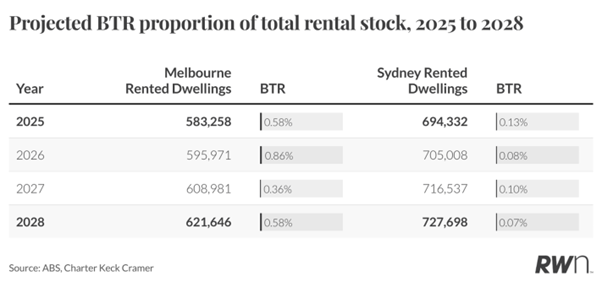
According to projections from Charter Keck Cramer, using ABS data, and reported by Ray White, BTR is expected to make up only:
- 0.58% of Melbourne’s rental stock in 2025
- 0.13% of Sydney’s rental stock in 2025
Even by 2028, it is forecast to remain:
- 0.58% in Melbourne
- 0.07% in Sydney
In other words, even if the sector grows, it is still only a fraction of the total rental supply.
To put this into context, Melbourne is projected to have around 583,258 rented dwellings in 2025, rising to 621,646 by 2028.
Sydney is projected to have around 694,332 rented dwellings in 2025, rising to 727,698 by 2028.
Against that scale, BTR remains a rounding error.
Build-to-rent is slow by design
There is another challenge that rarely gets discussed in the media: timing.
Institutional development operates on long timeframes.
BTR projects require land acquisition, planning approvals, financing structures, design, construction, and then stabilisation once tenants move in.
These projects don’t appear overnight.
Even if governments fast-tracked approvals tomorrow, it would still take years for meaningful numbers of dwellings to be delivered, and decades for BTR to make a genuine dent in Australia’s rental shortage.
In other words, BTR is not a quick fix. It is a long-term supplement.
Private investors are still the backbone of the rental market
And the point most politicians conveniently seem to ignore is that Australia’s rental market is largely supplied by private investors.
Every time a mum-and-dad investor buys a property, holds it, and rents it out, they contribute directly to the supply of housing.
Yes, not every purchase adds to new construction, but investors are a major driver of demand for new development. Without them, many apartment and townhouse projects simply don’t stack up financially.
- Also read:Melbourne housing market update | October 2026

- Also read:Australian housing market update | October 2026

- Also read:Latest Property Price Forecasts. Australian Property Market Outlook 2026-2027: Navigating a Market Correction

- Also read:Brisbane Property Market Forecast [2026 & Beyond] – What The Olympics Decade Means for Investors.

- Also read:Melbourne property market forecast for 2026 & 2027 | Separating the fundamentals from the sentiment

Private investors are the flexible part of the housing system. They can respond quickly. They can increase supply quickly.
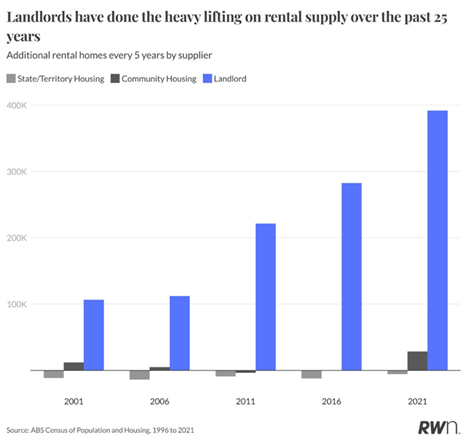
The following chart from Ray White shows how private landlords have done the heavy lifting on rental supply over the last 25 years.
The government can’t have it both ways
Here’s the contradiction we’re seeing today.
Governments say they want to encourage more rental supply, and they talk up build-to-rent as the future.
Yet at the same time, they are increasingly:
- increasing land taxes
- introducing tougher rental regulations
- creating uncertainty around tenancy rules
- publicly criticising and scapegoating investors
- suggesting changes to CGT.
So on one hand, governments are effectively saying: “We need more rental properties.”
But on the other hand, their actions say: “We don’t want private investors providing them.”
That’s not policy. That’s confusion.
And it’s making the rental crisis worse.
If investors exit, rental supply shrinks immediately
The government should absolutely be encouraging new housing supply, including institutional build-to-rent.
But it cannot do that while simultaneously taxing and discouraging private investors, who are currently the ones providing the bulk of rental accommodation.
We need to stop treating housing like a political battleground and start treating it like the economic system it is.
If we want more rental properties, we must encourage:
- private investors
- developers
- institutional BTR providers
- small and medium builders
- urban infill projects
- and higher density in the right locations
Australia doesn’t have a “build-to-rent problem.” Australia has a supply problem.
The bottom line
Build-to-rent is a useful addition to the market, and it will become more important over time.
But based on current projections, it will remain a tiny proportion of rental housing in Australia’s two largest cities for many years.
That means it cannot be treated as a replacement for private investors.
If governments want to solve the rental crisis, they need to focus on one thing above all else: getting more homes built.
And that requires supporting every part of the housing system, not punishing the biggest supplier of rental accommodation we currently have.