Key takeaways
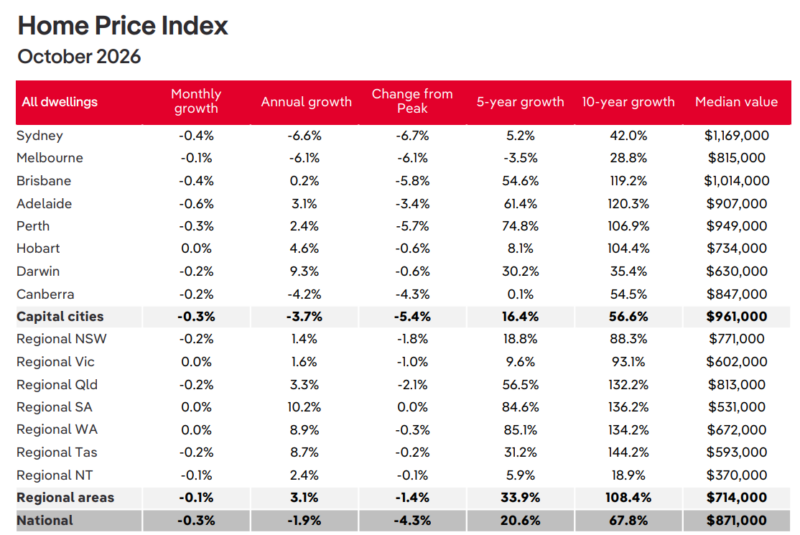
National home prices fell 0.3% in October, marking the seventh consecutive monthly decline. Prices are now 4.3% below their March peak and 1.9% lower year-on-year.
Combined capital city prices declined 0.3%, taking the correction to 5.4% from peak. Prices are 3.7% lower than a year ago.
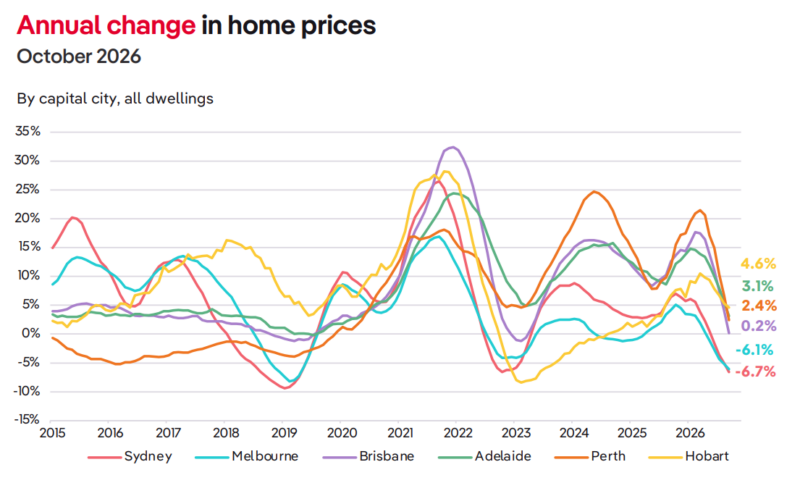
Sydney (-0.4%) has overtaken Melbourne (-0.1%) in the depth of its correction. Sydney prices are now 6.7% below peak, compared with 6.1% in Melbourne.
Adelaide (-0.6%) recorded the largest monthly decline among the capitals. Brisbane (-0.4%) and Perth (-0.3%) also continued to fall, leaving prices 5.8% and 5.7% below their respective peaks.
Melbourne remains the only capital where home prices are lower than five years ago, down 3.5%. By contrast, Brisbane, Adelaide and Perth have recorded five year growth of 54.6%, 61.4% and 74.8% respectively.
Regional home prices fell 0.1%, but remain 3.1% higher than a year ago, compared with a 3.7% annual decline across the combined capitals.
Houses continue to experience greater price pressure than units. National house prices fell 0.3% in October and are 4.6% below peak, compared with a 0.1% monthly decline and 3.0% peak to current fall for units.
A likely further interest rate increase will add to downward pressure on prices, with the cumulative impact of higher borrowing costs likely to keep prices under pressure into 2027.
Australian home prices fell for a seventh consecutive month in October, according to the latest PropTrack Home Price Index Report, with the downturn broadening and higher interest rates continuing to weigh on housing demand.
Data shows that national home prices declined 0.3% over the month and are now 4.3% below their March peak and 1.9% lower than a year ago.
Sydney has overtaken Melbourne as the capital with the deepest correction, while Brisbane and Perth have now fallen almost 6% from their recent highs. Adelaide recorded the largest monthly decline among the capitals.
Eleanor Creagh, PropTrack's Senior Economist said:
"The sharp reversal in previously strong markets highlights how higher borrowing costs and stretched affordability are increasingly constraining purchasing power.
Spring has brought more choice for buyers, but not the usual lift in market momentum. Softer auction conditions, longer selling times and subdued sales activity suggest buyers are becoming more cautious.
The adjustment remains uneven. Regional markets continue to outperform the capitals, while units have generally held up better than houses as affordability increasingly shapes demand.
With inflation proving persistent and the likely prospect of further interest rate tightening, weaker housing market conditions are likely to extend into 2027."
Housing downturn extends into a seventh month
According to PropTrack, Australia's housing downturn deepened in October, with national home prices falling 0.3% and extending the current correction into a seventh consecutive month.
Prices are now 4.3% below their March peak, while annual growth has fallen to -1.9%.
The current downturn has unfolded quickly. National prices have fallen more than 4% in seven months, with the adjustment increasingly widespread across capital city markets.
Ms Creagh further said:
"Higher interest rates remain the dominant constraint on housing demand. As mortgage rates rise, prospective buyers face reduced borrowing capacity, limiting what they can afford to pay. Higher repayments also weigh on household budgets and confidence, encouraging some buyers to delay purchasing decisions.
Sydney and Melbourne entered the correction earlier, but some of the sharpest recent declines are now occurring in Brisbane, Adelaide and Perth, where years of exceptional growth have substantially eroded affordability.
The fast reversal in these previously resilient markets points to a deepening downturn as higher borrowing costs constrain purchasing power and weigh on buyer demand."
Sydney overtakes Melbourne as the deepest capital city correction
The report highlights Sydney has overtaken Melbourne as the capital with the largest decline from peak.
Sydney home prices fell 0.4% in October and are now 6.7% below their November 2025 peak and 6.6% lower than a year ago.
Meanwhile, Melbourne prices declined a more modest 0.1% during the month, leaving them 6.1% below their October 2025 peak and 6.1% lower year-on-year.
While Sydney's correction is now deeper, Melbourne's longer period of underperformance remains. Melbourne is the only capital where home prices are lower than five years ago, down 3.5%.
According to Ms Creagh, "Higher priced housing markets can be particularly sensitive to reductions in borrowing capacity, although local supply conditions and buyer composition also influence performance."
- Also read:Latest Property Price Forecasts. Australian Property Market Outlook 2026-2027: Navigating a Market Correction

- Also read:National Weekly Auction Report – October 31st 2026 | Quiet October Home Auction Market Ends with Signs of Improvement

- Also read:Home Prices Continue to Steady Over October | Latest Property Market Stats

- Also read:This week’s Australian Property Market Update – Latest Data, State by State October 27th 2026

- Also read:Everything you need to know about the state of Australia’s property markets in 20 charts – October2026

Previously strong markets experience some of the sharpest falls
Brisbane, Adelaide and Perth are experiencing a rapid turnaround in housing market conditions, according to PropTrack.
After several years of exceptional growth, all three markets are now experiencing sustained declines as higher borrowing costs collide with substantially higher home prices.
Data show that Adelaide recorded the largest monthly fall of any capital in October, with prices declining 0.6%. Prices have now fallen for five consecutive months and are 3.4% below their May peak. Despite the correction, Adelaide home prices remain 3.1% higher than a year ago and 61.4% above levels five years earlier. Though the annual growth masks a much weaker picture in recent months.
Brisbane home prices fell 0.4% in October, extending the downturn to seven consecutive months. Prices are now 5.8% below their March peak, despite remaining marginally higher than a year ago.
Meanwhile, Perth has experienced a similarly sharp reversal. Prices declined 0.3% in October and are now 5.7% below their March peak, following seven consecutive monthly falls.
Over the past five years, Brisbane and Perth prices have increased 54.6% and 74.8% respectively. Those gains have substantially reduced the affordability advantage that previously supported demand in both markets.
Ms Creagh explained:
"The recent pace of declines is now particularly pronounced. Over the latest three months, home prices have fallen at an annualised rate of approximately 10% in Adelaide, 9.5% in Brisbane and 8.1% in Perth.
These are measures of recent momentum, not forecasts of future annual price declines, but they illustrate the speed with which conditions have changed in markets that had previously led national price growth."
Outlook
Australia's spring selling season has failed to deliver its usual lift in property market activity, with auction clearance rates remaining subdued, homes taking longer to sell and buyers becoming increasingly cautious.
While more properties coming onto the market have given purchasers greater choice and negotiating power, affordability remains the biggest obstacle.
Higher mortgage rates have reduced borrowing capacity, meaning many buyers simply cannot afford to pay what they could earlier in the year, regardless of how attractive a property may appear.
As Ms Creagh explains, the outlook for interest rates remains central to where property prices head next. With persistent inflation raising the prospect of another Reserve Bank rate increase this week, following four increases already this year, borrowing capacity and buyer confidence could come under further pressure.
And importantly, the full impact of previous rate rises is still working its way through household budgets and property prices, suggesting the market has further adjusting to do.
Changes to negative gearing and capital gains tax have added another layer of uncertainty, particularly for investors, although it's difficult to separate their impact from the broader effect of higher interest rates.
As Creagh's analysis suggests, the main driver of the current downturn is reduced purchasing power, rather than widespread financial distress among existing homeowners.
That's an important distinction. While employment conditions have softened, most homeowners continue to benefit from substantial equity buffers, and forced selling remains relatively limited.
However, should unemployment rise significantly, mortgage stress and distressed sales could become a more serious concern.
Looking ahead, further price declines appear likely over the coming months, with weaker market conditions potentially extending into 2027, particularly in capital cities where affordability has deteriorated most sharply.
Of course, property markets move in cycles, and the current adjustment will eventually create opportunities for well-prepared investors.
In my view, the key is to recognise that while higher interest rates are weighing on property values in the short term, the underlying fundamentals of Australia's housing market, particularly our structural housing shortage and growing population, will continue to influence property values over the longer term.