


Key takeaways
Cost-of-living stress is at its highest level since 2014. A net 81% of Australians report higher living costs, led by groceries, utilities and transport.
Australians are still spending, but they’re becoming more selective. More households are shopping around, switching brands and prioritising value.
Secure employment remains the key financial buffer. It is allowing many households to absorb higher costs without dramatically cutting spending.
Some household financial buffers are starting to wear thin. More Australians are drawing on savings, selling possessions or relying on family and friends to cope.
Consumer resilience shouldn’t be mistaken for financial comfort. Spending remains relatively resilient, but discretionary demand is weak and vulnerable to further cost or interest-rate pressures.
There’s something interesting happening inside Australian households right now.
Ask consumers how they’re feeling and the answer is pretty clear: they’re under pressure.
Groceries, electricity, insurance, transport and housing all cost more, while higher interest rates are squeezing borrowers and many households feel their standard of living has slipped.
Yet Australians are still spending - this apparent contradiction is one of the most interesting findings from NAB’s latest Consumer Sentiment Survey.
Consumers haven’t suddenly become comfortable with the cost of living. Instead, they’re becoming more deliberate about where their money goes, cutting back selectively, shopping around more aggressively and prioritising essentials over discretionary purchases.
Australian households are adapting, and while that adaptability has helped keep spending surprisingly resilient, there are limits to how long some households can continue absorbing higher costs before their financial buffers begin to wear thin.
Cost-of-living pressure is intensifying
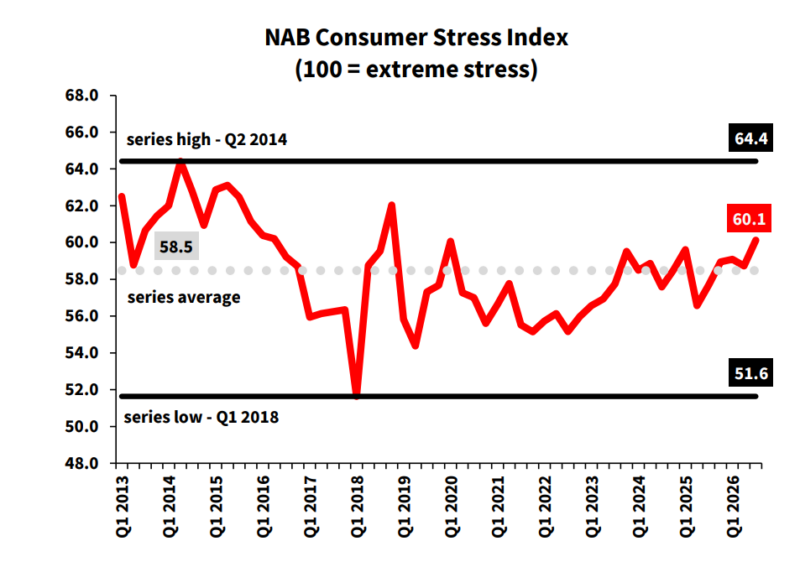
NAB’s Consumer Stress Index rose to 60.1, which is 1.6 points above its long-term average and 2.4 points higher than a year ago.
More importantly, cost-of-living stress has climbed to its highest level since mid-2014, with a net 81% of consumers reporting higher living costs.
The greatest pressure is coming from everyday expenses households find hardest to avoid: groceries, utilities and transport.
Of course you can postpone buying a new television or delay a holiday, but you still need to eat, keep the lights on and get to work.

Note: This helps explain why consumer spending can remain relatively resilient even when sentiment is weak. Higher spending doesn’t necessarily mean households are buying more or feeling wealthier. Sometimes they’re simply paying more for the same essentials.
NAB’s transaction data reinforce this. Spending increased 1.1% in August, but only 0.6% when fuel was excluded. Non-discretionary spending rose 2.2%, compared with just 0.4% for discretionary spending.
Australians are becoming more careful shoppers
One of the most revealing findings is how quickly consumer behaviour is changing.
Over the past year, the net balance of Australians saying they are more mindful about spending increased from 37% to 52%.
Those researching brands and products more carefully rose from 21% to 35%, while price-driven switching increased from 51% to 56% in the September quarter.
Consumers are comparing prices, changing providers and deciding more carefully which purchases deserve a place in their household budget. That has significant implications for businesses because every discretionary dollar is being contested more aggressively.
This is also reflected in NAB’s spending intentions. The essentials index rose to +4, while non-essential spending intentions remained deeply negative at -23. The overall index improved slightly to -10 from -11 in the previous quarter and -12 a year earlier.
So there has been some stabilisation, but little evidence of a broad discretionary spending recovery.
Employment is holding things together
Perhaps the most important part of the survey relates to employment.
Job-security stress edged higher to 45.1, but remains the only component of NAB’s Consumer Stress Index below its long-term average.
A net 10% of respondents expect their job security to improve over the next three months, while 14% expect it to strengthen over the next year.
This matters because households can tolerate financial pressure much better when they believe their income will continue arriving.
They can adjust spending, refinance debt, delay purchases, shop around or temporarily draw on savings. Once employment becomes uncertain, household behaviour can change quickly.
NAB expects unemployment to gradually rise towards 5% by 2028, so the labour market will be one of the key economic indicators to watch.
For now, relatively secure employment is allowing many Australians to adapt rather than retreat.
Some household buffers are wearing thin
Of course, averages disguise enormous differences between households.
Consumer stress among unemployed Australians has reached 70.0, compared with 57.6 among those earning more than $100,000. Among Australians aged 18 to 29, stress is now 9.6 points above its long-term average.
Mortgage holders are also feeling considerably more pressure.
Their average concern about interest rates increased from 6.8 to 7.2, while the proportion reporting high stress rose from 46% to 54%. By comparison, only 14% of outright homeowners reported high interest-rate concern.
- Also read:Melbourne housing market update | October 2026

- Also read:National Vacancy Rate Rises to 1.4% | SQM Research

- Also read:Australian housing market update | October 2026

- Also read:This week’s Australian Property Market Update – Latest Data, State by State October 13th 2026

- Also read:Latest Property Price Forecasts. Australian Property Market Outlook 2026-2027: Navigating a Market Correction

Income clearly matters, but so does the financial buffer sitting behind it. Two households earning similar amounts can experience the same economic conditions very differently depending on their mortgage, savings, job security and other commitments.
And there are signs some buffers are being depleted. When cutting expenses wasn’t enough, 34% of consumers said they were using savings faster, 19% sold possessions, 16% relied on family or friends and 11% worked more. Another 8% either accessed superannuation or reduced their contributions.
These strategies have limits. Only 24% of Australians now say higher costs are having no effect on their lifestyle, down from 28% a year ago.
Housing expectations have changed dramatically
There is also an interesting signal for those of us watching the property markets.
A net 18% of consumers now expect house prices to rise, compared with 54% in the previous quarter and 66% a year ago.
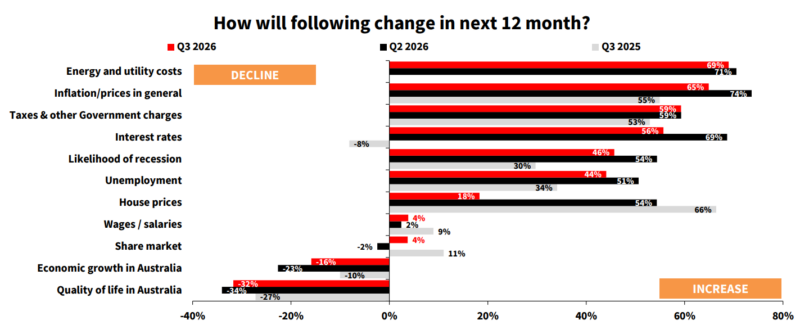
That’s a dramatic shift in a relatively short period, but not surprising with what's happening in our housing market.
Of course, consumer expectations don’t determine where property prices go. Property markets are driven by the balance between supply and demand, borrowing capacity, credit availability, population growth, household formation and the willingness of buyers and sellers to transact.
But sentiment influences behaviour. When homeowners expect their property to increase strongly in value, they tend to feel wealthier and may be more comfortable making major purchases. Softer expectations can weaken that wealth effect.
For prospective buyers, it may also reduce the fear of missing out and encourage them to negotiate more carefully.
And as I’ve said many times before, there isn’t one Australian property market. Different cities, suburbs and property types will respond differently according to their own supply, affordability and demographic fundamentals.
Resilience isn’t evenly distributed
The state figures highlight this particularly well.
South Australia recorded the highest cost-of-living balance at 89%, while Western Australians reported significant grocery and utility pressures of 86% and 83% respectively.
Yet Western Australia had the least cautious spending outlook at -5, compared with -11 in NSW/ACT and Victoria.
Similar cost pressures are producing different responses because households don’t all have the same capacity to absorb them.
A household with secure employment, reasonable savings and manageable debt can respond to higher prices by adjusting its budget. Another household facing the same inflation but carrying a large mortgage and limited savings has far fewer options.
That’s why national averages only tell part of the story.
What happens next?
There are tentative signs consumers believe some pressures may ease.
The net balance expecting living costs to increase over the next three months fell five points to 54%, although 69% still expect costs to rise over the coming year. Expectations around unemployment, recession and interest rates have also eased somewhat.
However, NAB expects another 25-basis-point RBA rate increase in late September, which would add further pressure for mortgage holders and potentially constrain discretionary spending.
For property investors and business owners, the broader lesson is that consumer resilience shouldn’t be confused with unlimited financial capacity.
Households have absorbed higher mortgage repayments, rents, groceries, utilities and insurance costs by continually rearranging their finances. They have postponed purchases, switched providers, searched harder for value and, in some cases, drawn down savings.
Secure employment has allowed many households to keep doing this. If unemployment rises meaningfully while essential costs remain elevated, those options become more limited.
The bottom line
Note: The NAB survey paints a picture of Australian consumers who are under considerable pressure but remain remarkably adaptable.
Continued spending doesn’t necessarily mean households feel financially secure. Much of the resilience we’re seeing is being sustained by employment, careful budgeting, changing purchasing behaviour and, for some households, the gradual use of financial buffers.
The encouraging part is that Australians have repeatedly shown an ability to adjust to changing economic conditions. We saw households adapt through the pandemic, the inflation surge and the subsequent interest-rate cycle, and we’re seeing that adaptability again today.
Eventually, economic cycles turn, as they always have. The households that tend to emerge in the strongest position are those that maintain buffers, manage debt carefully and make deliberate decisions rather than reacting to every piece of economic news.
The same principle applies to property investors. We can’t control interest rates, consumer confidence or government policy, but we can control the quality of the assets we own, how much debt we take on, the buffers we maintain and how long we remain invested.
And history suggests that investors who maintain that perspective through the more difficult stages of the cycle are usually well placed when conditions eventually improve.