Key takeaways
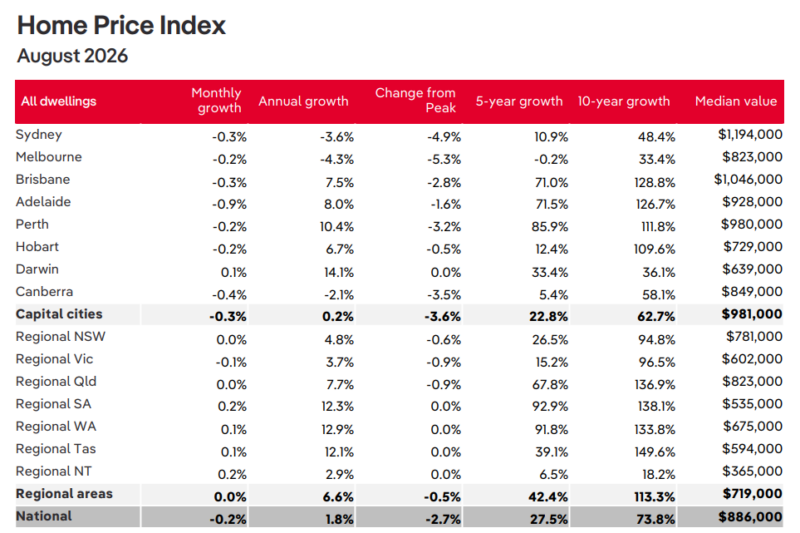
National home prices fell 0.2% in August, marking the fifth consecutive monthly decline. Prices are now 2.7% below their March peak, but remain 1.8% higher year-on-year.
Capital-city prices declined 0.3% and are now 3.6% below peak. Annual growth across the capitals has slowed to just 0.2%.
Adelaide (-0.9%) recorded the largest capital-city fall in August, followed by Canberra (-0.4%), while Sydney and Brisbane both fell 0.3%.
Darwin (+0.1%) was the only capital to record price growth in August, reaching a new peak. It remains the strongest-performing capital over the past year, with prices up 14.1%.
Regional prices were unchanged in August, remain 6.6% higher year-on-year, and sit just 0.5% below peak.
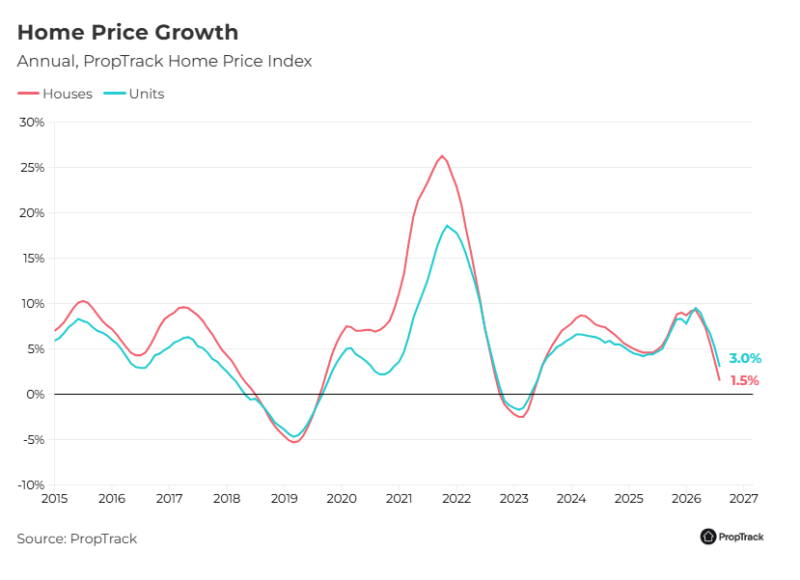
Units continued to outperform houses. National unit prices are 3.0% higher than a year ago, compared with 1.5% growth for houses.
Australian home prices fell for a fifth consecutive month in August, according to the latest PropTrack Home Price Index Report, as higher interest rates continued to weigh on borrowing capacities and housing demand.
Data shows that national home prices declined 0.2% over the month and are now 2.7% below their March 2026 peak.
Despite the recent falls, prices remain 1.8% higher than a year ago and 27.5% higher than five years ago, though annual growth is moderating sharply.
Capital city markets are bearing more of the adjustment to higher interest rates, while regional markets and more affordable property types continue to show greater resilience.
Higher interest rates continue to weigh on home prices
PropTrack's data show that Australian home prices have now fallen for five consecutive months, as the cumulative impact of higher interest rates increasingly flows through to housing demand.
Budget tax changes are also likely impacting buyer demand, and ongoing price falls could be driving some to delay purchasing until prices stabilise.
Eleanor Creagh, PropTrack's Senior Economist said:
"The Reserve Bank has increased the cash rate by 75 basis points this year, as a result existing borrowers face higher repayments, reducing disposable income, while prospective buyers face lower borrowing capacities, directly reducing how much they can bid for a property.
That adjustment is now evident in prices. National home prices have fallen 2.7% from their March peak, while the combined capital cities are 3.6% below peak."
Sydney and Melbourne have experienced the largest corrections
The current downturn remains most advanced in Australia's two largest housing markets, according to PropTrack.
Sydney home prices fell 0.3% in August and are now 4.9% below peak and 3.6% lower than a year ago.
Meanwhile, Melbourne prices declined 0.2%, leaving them 5.3% below peak and 4.3% lower year-on-year.
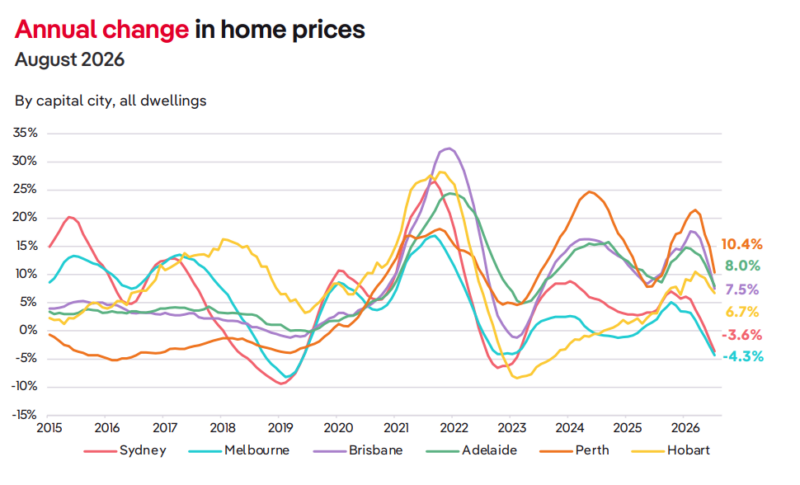
Data also reported that the divergence between capital-city and regional housing performance has become more pronounced.
Combined capital-city prices fell 0.3% in August and are now just 0.2% higher than a year ago. Prices are 3.6% below their peak.
By comparison, regional prices were unchanged over August, remain 6.6% higher year-on-year, and are just 0.5% below peak.
Affordability is shaping which properties outperform
Units continue to outperform houses nationally, with unit prices 3.0% higher than a year ago, compared with 1.5% growth for houses.
- Also read:This week’s Australian Property Market Update – Latest Data, State by State October 13th 2026

- Also read:National Weekly Auction Report – October 10th 2026 | Auction Markets Remain Generally Subdued as Listings Surge

- Also read:Latest Property Price Forecasts. Australian Property Market Outlook 2026-2027: Navigating a Market Correction

- Also read:Unsold Stock Drives 21.6% Annual Jump in Listings as Spring Season Opens | Latest SQM Listing Data
- Also read:Home Prices Down Again Over September – But Not as Much | Latest Property Market Stats

Data from PropTrack also highlight that units have also experienced a smaller correction from peak. Nationally, unit prices are around 1.8% below peak, compared with around 2.9% for houses.
Ms Creagh explains:
"Affordability is likely an important contributor.
Higher interest rates reduce borrowing capacities, forcing some buyers to adjust their expectations around location, property type or size. As the amount households can borrow falls, relatively affordable properties become accessible to a larger pool of potential buyers than more expensive alternatives.
This is particularly evident in some of the major capitals. In Sydney, house prices are around 5.8% below peak, compared with 3.2% for units. In Melbourne, houses are around 6.3% below peak, compared with 2.2% for units."
Outlook
According to Ms Creagh, home prices are likely to fall further over the coming months, particularly across the capital cities.
She further said:
"Higher interest rates have already reduced borrowing capacities and weakened housing demand, while the latest inflation data have increased the possibility that interest rates lift again before the end of the year."
She notes that the spring selling season will be an important test.
"The key variable will be the balance between the flow of new listings coming onto the market and the depth of buyer demand. If the usual spring increase in listings occurs while borrowing capacities remain constrained, buyers will have more choice and vendors may face greater competition, creating additional downward pressure on prices," says Ms Creagh.
Conversely, if listings remain relatively constrained, this dynamic could place a floor under prices in many markets.
Ms Creagh also highlighted that more broadly, Australia continues to face a structural shortage of housing relative to population growth, while rents and construction costs remain elevated.
She explained further:
"Those conditions support the underlying value of established housing and make the current cycle very different from a downturn characterised by widespread excess housing supply. The more significant downside risk would be a combination of restrictive interest rates and a deterioration in labour market conditions.
Employment and household income ultimately determine borrowers' ability to service their mortgages, and a substantial rise in forced selling would change the character of the downturn."
At present, the evidence is more consistent with an orderly adjustment to reduced borrowing capacity than a disorderly housing correction.