
Key takeaways
Australia has changed enormously since 1981. We are larger, older, more multicultural, better educated and healthier.
The way Australians work has transformed. Manufacturing has declined while services, knowledge industries, healthcare and education have grown.
Australians are living longer and ageing differently. Longer, healthier lives are reshaping retirement, housing needs and government services.
Australia could grow towards 40 million people in the coming decades. We need to plan housing, infrastructure and future cities well before that growth arrives.
Demographic change creates long-term opportunities for property investors. Focus on quality locations benefiting from population, employment, infrastructure and lifestyle trends.
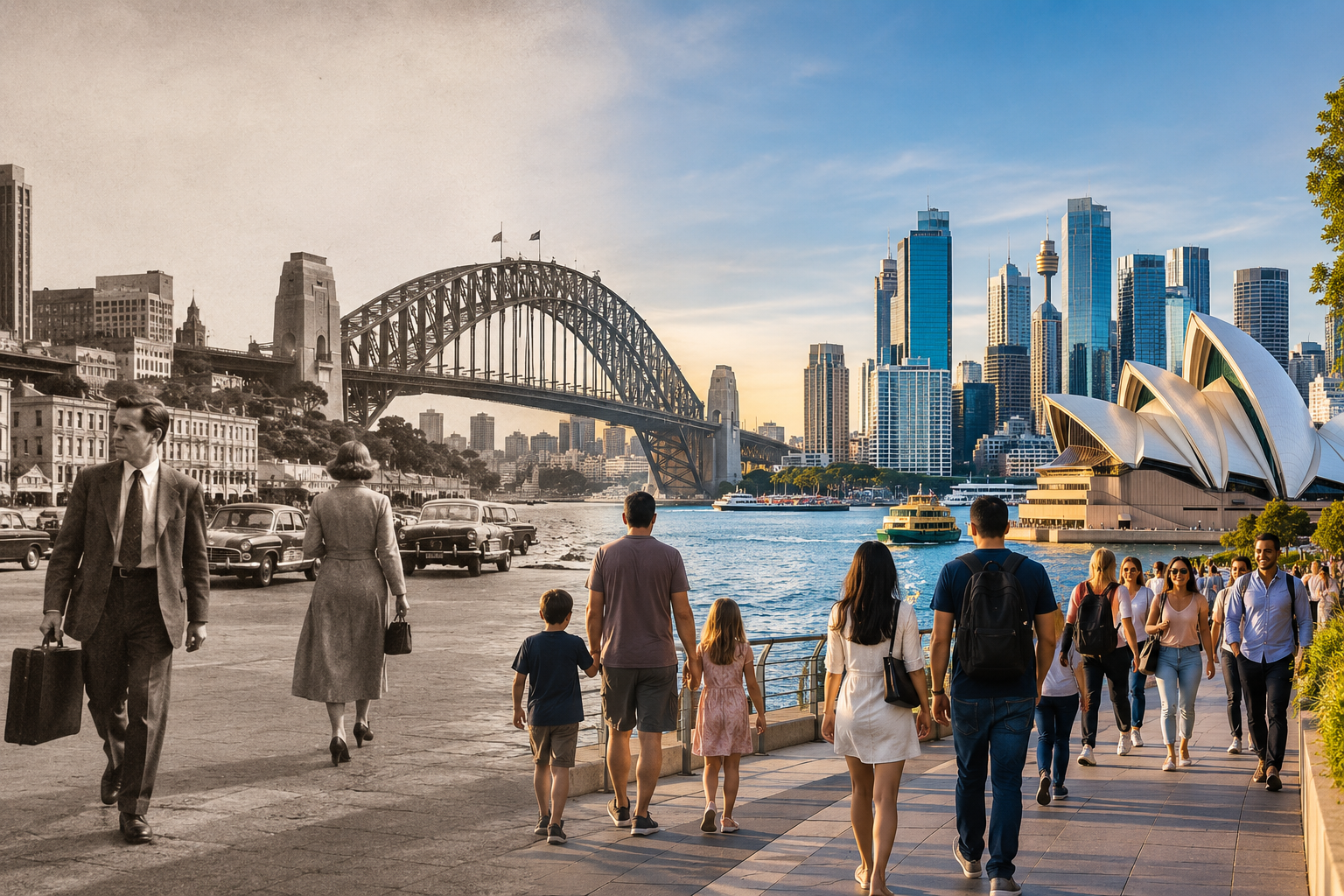
If you could step back into Australia in 1981, you would recognise the country, but much of everyday life would feel surprisingly foreign.
Australia was younger, smaller, less diverse and more traditional.
Families were larger, manufacturing played a much bigger role in employment, overseas travel was a luxury, and the typical worker was more likely to make something with their hands than spend their day behind a computer.
Fast-forward 45 years and Australia has been transformed.
Our population has roughly doubled, our cities have expanded enormously, our workforce has shifted towards services and knowledge industries, women participate in the workforce at much higher rates, Australians live longer and healthier lives, and our society is considerably more multicultural.
It can be tempting to romanticise the past, particularly when Australians today are struggling with housing affordability, higher living costs, congestion and concerns about social cohesion.
Yet when you take a longer view, Australia has made extraordinary progress.
And there are some important lessons in those changes about where our country is heading next.

For weekly insights, subscribe to the Demographics Decoded podcast, where we will continue to explore these trends and their implications in greater detail.
Subscribe now on your favourite Podcast player:
Australia has become a very different society
One of the biggest changes has been the way Australians connect with each other.
In previous generations, larger families, religious organisations, unions and political parties provided many people with a strong sense of community and belonging. Participation in most of these institutions has declined significantly.
As demographer Simon Kuestenmacher explains, that means Australians have fewer obvious places where they regularly experience a sense of being part of something larger.
"We increasingly took away opportunities to feel like one in one way or another," Simon explains.
Of course, the Australia of the past wasn't quite as socially cohesive as nostalgia sometimes suggests. There were significant divisions between religious groups, social classes and different sections of the community.
However, one of the institutions that still manages to bring Australians together is sport.
Whether we're cheering for the Socceroos, watching our swimmers at the Olympics or supporting our local football club, Simon argues that sport now performs an increasingly important role as "social glue" in Australian society.
That matters because Australia is going to become larger and even more culturally diverse over the decades ahead. Creating shared institutions, experiences and public spaces where Australians feel connected will become increasingly important.
The Australian worker has been transformed
The workplace has changed just as dramatically.
If you asked a cartoonist in 1981 to draw the typical Australian worker, Simon suggests they probably would have drawn a father heading off to a factory.
Today, they would be more likely to draw a knowledge worker sitting in an office, working with information and technology or perhaps connecting to the workplace remotely.
We still have manufacturers, tradespeople, warehouse workers, and people producing physical goods, but Australia's economy has steadily shifted towards services, professional occupations, healthcare, education, and knowledge-based industries.
There's an interesting property lesson here.

Tip: It's easy to assume that because many knowledge workers cluster in major CBDs, investors should focus exclusively on properties close to the centre of our capital cities. Yet employment is much more dispersed than that.
Hospitals, schools, shopping centres, industrial precincts, logistics hubs and suburban offices employ enormous numbers of Australians. Many people will spend their entire careers travelling between suburbs rather than commuting into the CBD.
Our transport infrastructure hasn't always caught up with that reality. Australian cities remain heavily influenced by the traditional hub-and-spoke model, where major transport networks funnel people towards the centre.
For property investors, this reinforces something I've argued for years.

Note: Location matters enormously, but proximity to the CBD is far too simplistic a measure of a good location. Access to multiple employment centres, transport, education, healthcare, shopping and lifestyle amenities can be equally important.
We have become a more open and diverse Australia
The transformation of Australian society can also be seen in the way people identify themselves.
In the 1981 Census, around 160,000 Australians identified as Aboriginal or Torres Strait Islander. By the 2021 Census, that number had risen to more than 800,000.
This doesn't mean the Indigenous population simply increased fivefold while Australia's overall population roughly doubled.
Simon argues that a significant part of the change reflects Australians becoming more comfortable identifying their Indigenous heritage.
"More people felt comfortable and safe enough and proud enough to self-identify as Indigenous on a census form," he explains.
He sees this as evidence of a more open society, while acknowledging there are still significant challenges to address.
Australia has also become considerably more multicultural.
Today, around one-third of Australians were born overseas, and our country has access to cultures, cuisines, ideas and international connections that would have been difficult to imagine in 1981.
Of course, increasing diversity brings responsibilities as well as benefits. Successful immigration requires integration, adequate infrastructure and opportunities for new arrivals to participate fully in Australian life.
But overall, Australia today offers opportunities to a much broader range of people than it did four decades ago.
Australians are living longer and better
Perhaps one of the easiest improvements to overlook is also one of the most profound. We live longer, we are better educated, healthcare has improved enormously, workplaces are generally safer and many jobs are less physically demanding.
ABS historical data shows just how substantial the longevity improvement has been.
Life expectancy for Australian males was 71.4 years in 1981 and 78.4 years for females. By 2021, those figures had risen to 81.3 and 85.4 years respectively.
Even something as ordinary as taking an overseas holiday illustrates how dramatically Australian life has changed.
In the early 1980s, international travel remained relatively unusual for middle-income Australians. Flying overseas was an event, and people often dressed for the occasion because it represented something special and expensive.
- Also read:This week’s Australian Property Market Update – Latest Data, State by State October 13th 2026

- Also read:Latest Property Price Forecasts. Australian Property Market Outlook 2026-2027: Navigating a Market Correction

- Also read:Brisbane Property Market Forecast [2026 & Beyond] – What The Olympics Decade Means for Investors.
- Also read:Sydney property market forecast for 2026 and 2027 | Why the short-term softness is a long-term opportunity
- Also read:Melbourne property market forecast for 2026 & 2027 | Separating the fundamentals from the sentiment
Today, international travel is accessible to a much larger proportion of the population.
Perhaps an even greater transformation has occurred later in life.
As Simon points out, being 65 today is a completely different experience from being 65 in 1981.
Many people four decades ago had spent their working lives doing physically demanding jobs and entered retirement with worn-out bodies and relatively few healthy years ahead of them.
Today's 65-year-olds may be exercising, travelling internationally, helping with grandchildren, running businesses or continuing their careers.
"The whole experience of growing old is orders of magnitude better than it was 45 years ago," Simon says.
That's an enormous achievement, although longevity also creates challenges. Australians must fund longer retirements, while governments face increasing pressure to provide healthcare and services to an older population.
The next Australia will require better planning
Looking backwards is interesting, but the more important issue is what happens next.
Simon believes Australia could be home to around 40 million people within the coming decades, depending on migration, fertility and government policy.
We are also likely to be older, more multicultural and increasingly living in smaller households.
Note: Longer lives and changing attitudes towards marriage and children will probably increase the number of people living alone. And smaller households have major implications for housing because we need more dwellings to accommodate the same number of people.
At the same time, Australia's shift towards technology and knowledge-based employment will continue.
Simon is relatively optimistic about artificial intelligence and robotics. While these technologies will become embedded throughout the economy, he doesn't subscribe to the idea that humans will simply become redundant.
"We'll still need humans," he says. "I'm not a pessimist about the human future of Australia at all."
I share that optimism, but our biggest challenge will be whether governments plan early enough for the Australia we already know is coming.
We need to build for tomorrow's Australia
One of Simon's more interesting suggestions is that Australia should begin planning entirely new cities rather than simply squeezing millions more residents into Sydney, Melbourne, Brisbane and our other established capitals.
He would like to see several new Gold Coast-sized cities developed along Australia's eastern seaboard over the decades ahead.
That doesn't mean building them tomorrow. It means deciding where future growth should occur and reserving land for railway corridors, roads, employment centres and other infrastructure before development makes these projects enormously expensive.
Australia has too often done things the other way around.
We allow population growth to occur first and then scramble to provide infrastructure afterwards. Roads become congested, schools overflow and governments eventually spend billions retrofitting transport infrastructure into established suburbs.
Simon argues we should plan for the most likely future rather than continually responding to yesterday's growth.
Demographics gives us a considerable advantage because many of tomorrow's challenges are already visible today.
We know Australia is likely to become larger and older. We know household structures are changing. We know our population will become more culturally diverse, and we know millions more Australians will need somewhere to live.
These trends move slowly, but their consequences are enormous.
What this means for property investors
There is also an important lesson here for property investors.
Successful investing has never been about predicting what will happen next month or even next year. The bigger opportunities are created by understanding the structural forces reshaping our cities over decades.
Population growth will create more housing demand, but that doesn't mean every property will perform well.
Changing employment patterns will create new economic hubs, but that doesn't mean every outer suburb will become an investment hotspot.
Smaller households will require more dwellings, but Australians will continue to value desirable neighbourhoods, amenity, convenience and lifestyle.
This is why I continue to believe investors should focus on investment-grade properties in locations where multiple long-term demographic, economic and lifestyle factors come together, rather than chasing short-term forecasts or the latest fashionable location.
Australia has changed before, and it will change again
It's easy to look at today's challenges and become pessimistic.
Housing is expensive, infrastructure is under pressure, governments face difficult fiscal choices, and many Australians feel financially stretched.
But looking back to 1981 provides some useful perspective.
Australia has become healthier, better educated, more connected to the world and more open to people from different backgrounds. Our workplaces are safer, our opportunities are broader and our retirement years can be healthier and more active than previous generations could reasonably have expected.
We certainly didn't achieve all of this through perfect planning, and we've made plenty of mistakes along the way.
The next stage of Australia's development will bring another set of challenges, particularly as our population grows and our cities absorb millions of additional residents.
But demographics gives us a reasonably clear view of what's coming.
The people who will shape the Australia of the 2060s are already alive today, and many of the decisions that will determine how successfully we accommodate that future population will be made over the next decade or two.
Australia's transformation since 1981 shows just how much a country can change within a single lifetime.
Note: If we combine that proven ability to adapt with better long-term planning around housing, infrastructure, employment and our cities, I remain optimistic about the Australia our children and grandchildren will inherit.
The future will certainly be different from today, just as today's Australia would have been difficult to imagine in 1981.
Our opportunity is to prepare for it rather than simply wait for it to arrive.