
Key takeaways
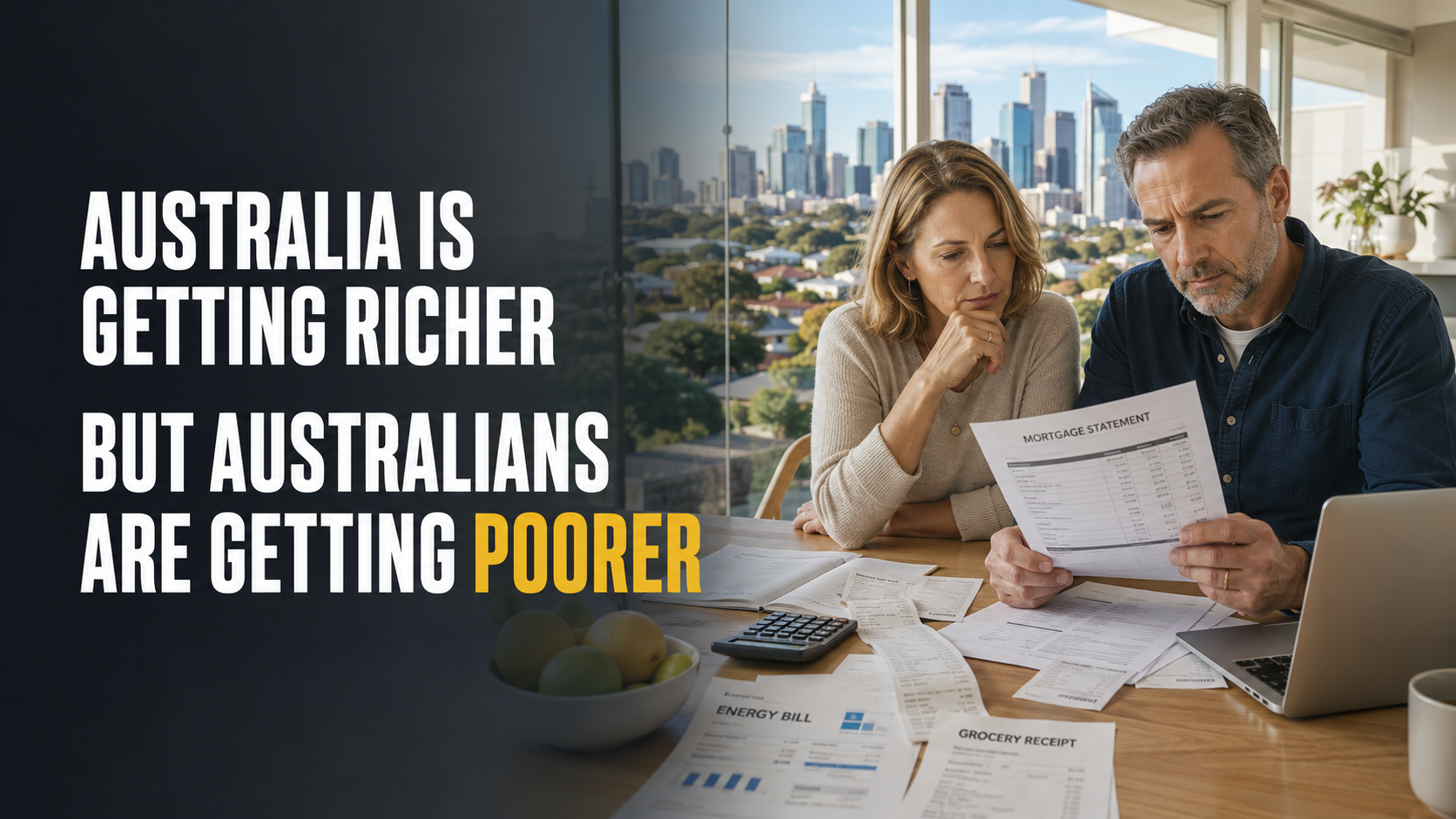
Australia is heading towards its weakest decade of growth in living standards since the 1910s.
GDP per person has increased by only around 4 per cent so far during the 2020s, compared with 25 per cent during the 1990s.
Australia’s total GDP continues to grow, but rapid population growth is masking weak economic performance on a per-person basis.
Real wages have fallen by approximately 5 per cent over the past five years, placing Australia among the weakest performers in the OECD.
Weak productivity, inadequate business investment, bracket creep, housing shortages and rising government spending are all contributing to the decline.
Housing has become both a symptom and a cause of falling living standards, as population growth continues to outpace the delivery of homes and infrastructure.
Meaningful improvement will require productivity-enhancing reform rather than another round of grants, subsidies and short-term cost-of-living relief.
For property investors, continued housing undersupply is likely to support rents and well-located property values, although weaker household finances will make market selection increasingly important.
Australia remains one of the wealthiest countries in the world, yet many Australians feel as though they are working harder simply to stand still.
That feeling is now being confirmed by the economic data.
Australia is heading towards its weakest decade of growth in living standards since the First World War, with GDP per person increasing by only around 4 per cent so far during the 2020s.
Meanwhile, real wages have fallen, housing costs have surged, taxes are consuming a larger share of household incomes, and the infrastructure Australians rely on has struggled to keep pace with population growth.
The Australian economy may be growing, but the economic pie is being divided among many more people, leaving the average Australian with very little additional prosperity.
And, in my mind, this should be one of the most important economic and political conversations taking place in Australia today.
The economy is growing, but that does not tell the whole story
Politicians frequently point to Australia’s continuing economic growth as evidence that the economy is performing reasonably well.
However, total GDP is a poor measure of whether individual Australians are becoming better off, particularly when the population is growing rapidly.
A country can produce more goods and services simply because it has more workers, consumers and residents. That larger economy does not automatically give each person a better standard of living.
GDP per capita provides a more useful measure because it divides economic output by the number of people sharing it.
On that measure, Australia’s recent performance has been disappointing.
GDP per person has increased by only about 4 per cent so far this decade. By comparison, it grew by approximately 25 per cent during the 1990s, 17 per cent during the 2000s and 11 per cent during the 2010s.
Each successive decade has delivered less improvement than the one before it.
Former Reserve Bank governor Philip Lowe recently described this stagnation as Australia’s fundamental economic problem, pointing out that per capita incomes had previously risen by around 1.5 per cent a year for almost three decades.
That compounding improvement made an enormous difference to wages, household wealth and government revenues. Once it disappears, living standards begin to feel increasingly constrained.
Why Australians feel poorer
Living standards involve considerably more than the number printed on a payslip.
They reflect what households can buy after allowing for inflation, taxes, mortgage payments, rent, energy, insurance, transport and other essential expenses.
The OECD reports that Australian real wages have fallen by around 5 per cent over the past five years, one of the weakest results among its 38 member countries.
At the same time, bracket creep has pushed many workers into higher tax bands as their nominal wages increased, even when those wage rises failed to compensate for inflation.
Households have therefore experienced a widening gap between what they earn on paper and what they can afford in the real world.
Mortgage holders have faced higher interest costs, tenants have endured substantial rent increases, and almost everyone has been affected by higher food, energy, insurance and service costs.
This explains why official economic commentary can sound quite disconnected from the experiences of ordinary Australians.
The economy can technically avoid recession while households experience what feels like a prolonged personal recession.
Productivity is the missing ingredient
Over the long term, sustainable improvements in wages and living standards come from productivity growth.
Productivity simply means producing more value from each hour worked. Businesses achieve this through better technology, improved skills, more efficient systems, stronger infrastructure and additional investment.
When productivity improves, employers can afford to pay higher real wages without continually passing higher costs on to consumers.
Unfortunately, Australian labour productivity has barely improved since 2016, and the ABS reports that the long-term rate of productivity growth has slowed substantially.
This is one of the reasons wages have struggled to grow in real terms.
Australia has relied heavily on population growth, rising commodity prices, expanding government expenditure and increasing household debt to support economic activity. These can lift headline GDP, but they do not provide the same enduring improvement in prosperity as productivity growth.
As Philip Lowe observed, Australia’s productive capital stock has failed to keep pace with population growth.
In practical terms, we have added millions of people without building enough homes, roads, public transport, hospitals, schools, energy capacity and other productive infrastructure to maintain the previous standard per person.
Australia needs business investment
As I see it, productivity can’t be improved through government announcements alone.
Businesses need the confidence and financial incentive to invest, expand, innovate and employ people.
Yet Australian businesses are navigating higher energy costs, complex workplace regulation, planning delays, uncertain tax settings and frequent changes in government policy.
Capital is mobile, particularly in a global economy, and investors will direct it towards places offering greater certainty and a more attractive return.
In my mind, Australia should be encouraging entrepreneurship and rewarding businesses prepared to take risks, adopt new technology and create productive jobs.
Instead, too much of the national debate is focused on how existing wealth should be divided, with too little attention given to how the country can create more wealth in the first place.
A more prosperous society has more resources available for healthcare, education, housing and social support. Redistribution becomes increasingly difficult when the underlying economy is barely growing on a per-person basis.
Government is occupying a larger part of the economy
AMP chief economist Shane Oliver has highlighted that public final demand is now running at around 28 per cent of GDP, compared with a long-term average of about 22.6 per cent.
Government spending can be valuable when it produces infrastructure, education or services that improve the country’s productive capacity.
However, a growing public sector also competes with private enterprise for workers, capital and construction resources.
When governments expand rapidly while the supply of labour and materials remains constrained, costs increase and private projects become harder to deliver.
- Also read:Latest Property Price Forecasts. Australian Property Market Outlook 2026-2027: Navigating a Market Correction

- Also read:Brisbane Property Market Forecast [2026 & Beyond] – What The Olympics Decade Means for Investors.
- Also read:Melbourne property market forecast for 2026 & 2027 | Separating the fundamentals from the sentiment
- Also read:Sydney property market forecast for 2026 and 2027 | Why the short-term softness is a long-term opportunity

- Also read:This week’s Australian Property Market Update – Latest Data, State by State October 27th 2026

Australia needs to examine the quality as well as the quantity of government spending. Borrowing billions of dollars and calling it economic growth tells us little about whether the spending will make future Australians more productive.
Housing is central to the decline in living standards
Australia’s housing crisis sits at the intersection of almost every problem discussed above.
Governments have allowed population growth to run well ahead of dwelling construction and infrastructure delivery, while simultaneously making it more expensive and difficult to build homes.
Planning delays, high construction costs, infrastructure charges, taxes, labour shortages and layers of regulation have all restricted supply.
Then, when affordability worsens, governments introduce buyer incentives and subsidies that stimulate demand even further without addressing the underlying shortage.
This approach may help some buyers enter the market, as it adds more purchasing power to a housing system that cannot produce enough homes.
Housing costs absorb an increasing share of household income, leaving Australians with less money to spend or invest elsewhere. Long commutes caused by inadequate infrastructure also reduce productivity and quality of life.
Businesses ultimately pay a price as well because high housing costs make it harder to attract workers to our major cities.
Australia can’t sustain rapid population growth without a corresponding increase in housing and productive infrastructure. Migration policy, housing policy and infrastructure planning need to operate together rather than as separate arms of government.
The decline has been decades in the making
It would be convenient to blame the pandemic, the wars in Ukraine or the Middle East, or the recent inflation outbreak for Australia’s economic position.
Sure, these events made matters worse, but the slowdown began long before them.
The economic reforms introduced by the Hawke, Keating and Howard governments helped deliver decades of stronger productivity and rising household incomes.
Many of those gains have now been exhausted, while successive governments have avoided reforms that impose short-term political costs.
Tax reform is repeatedly discussed and postponed. Planning systems remain slow and fragmented, workplace relations have become more complex, and competition in several industries has weakened.
Meanwhile, governments increasingly reach for temporary subsidies, rebates and grants because they provide an immediate political announcement.
Such measures can offer welcome relief to struggling households, but they rarely increase the country’s productive capacity.
We need a grown-up discussion about reform
Australia’s living standards will not be restored by one policy change.
We need a serious reform program that encourages business investment, improves competition, delivers stable energy policy, simplifies regulation and aligns population growth with housing and infrastructure capacity.
The tax system also requires attention.
Australia relies heavily on personal income tax, while bracket creep steadily increases the burden on workers. A more efficient tax mix could reduce the penalties placed on earning, saving and investing, although any reform would need to protect lower-income households.
Housing reform should focus on expanding genuine supply in the locations where people want to live, particularly through appropriate medium-density development in established suburbs with employment, transport and amenities.
Governments should also measure major policies against a simple standard: will this improve productivity and living standards per person?
That test would produce a very different policy agenda from the one Australia has followed over recent years.
What does this mean for property investors?
Declining national living standards doesn’t automatically mean property prices will fall.
Property values are shaped by local supply and demand, household formation, access to credit, incomes and the scarcity of desirable land. Australia’s chronic housing shortage is likely to continue supporting rents and the value of well-located properties.
However, investors should expect the market to become increasingly fragmented.
Households whose incomes are being squeezed will have less capacity to pay higher prices and rents, particularly in areas where wages are low and employment is insecure.
This makes affluent, established suburbs with diverse employment, strong owner-occupier demand and limited new housing supply even more attractive from an investment perspective.
Cheap property in locations where residents remain vulnerable to rising living costs may appear affordable, but affordability alone does not create long-term capital growth.
Of course, investors should also maintain appropriate financial buffers because weak productivity and persistent inflation could produce an uneven interest-rate environment.
My final thoughts
Australians have become accustomed to every generation enjoying a better standard of living than the one before it. That outcome is no longer guaranteed.
The country still has enormous advantages, including abundant natural resources, strong institutions, a skilled workforce, attractive cities and proximity to the fastest-growing region in the world.
However, those advantages can be squandered through complacency and short-term policymaking.
Australia can continue growing its population and reporting a larger economy, while households become poorer on a per-person basis. Unless productivity, housing supply and business investment improve, that is the direction in which we are heading.
Economic growth should ultimately improve people’s lives. If Australians are working more, paying more tax and spending more on housing while receiving little improvement in real income, the policy settings are failing them.
Navigate the future with a proven strategy
Australia’s economic environment is becoming more complicated, and the years ahead are likely to create both challenges and significant opportunities for property investors.
The investors who succeed will be those with a clear, evidence-based plan suited to their financial position, risk profile and long-term goals.
If you would like help building or reviewing your investment strategy, why not book a complimentary Wealth Discovery Session with a Metropole Wealth Strategist?
We’ll help you understand where you are today, identify the gaps in your current approach and develop a roadmap to help you safely grow, protect and pass on your wealth.
Click here to book your complimentary Wealth Discovery Session and gain greater clarity about your financial future.