
Key takeaways
Australia's latest Intergenerational Report shows younger generations are working longer and finding it harder to build wealth and buy a home than those before them.
Australia's population is projected to grow from about 28 million to 39.3 million by 2065-66, although annual population growth will slow to an average of 0.9 per cent.
Net overseas migration will become the main source of population growth as the fertility rate falls to 1.34 children per woman and deaths eventually exceed births.
Falling fertility and an aging population are also expected to reshape the economy and put greater pressure on government spending in the next 40 years.
The economy is expected to be about two and a quarter times larger, while real gross national income per person rises 55 per cent, provided productivity improves as Treasury assumes.
Housing has become the sharpest fault line in intergenerational wealth, with home ownership among 25 to 34 year olds well below the rates enjoyed four decades ago.
Housing demand will remain strong, but future capital growth is likely to be increasingly uneven and concentrated in locations with scarce supply, good infrastructure, jobs and affluent households.
Australia will have almost 40 million people by 2066, our economy will be more than twice as large and average real incomes will be considerably higher.
Yet beneath those reassuring headline numbers, Treasury's latest Intergenerational Report describes a country that is growing more slowly, ageing rapidly and relying heavily on migration, productivity and housing policy to maintain living standards.
For property investors, the report is far more than a distant economic forecast.
It explains the demographic and financial forces that will shape where Australians live, the types of homes they need, and the growing divide between households that own property and those that do not.

A guide to the direction of travel
This is the seventh Intergenerational Report, and it projects Australia's economy, population and federal budget over the 40 years to 2065-66.
Of course, forty-year projections should be treated with caution because small changes in fertility, migration, participation or productivity compound to produce very different outcomes. Their value lies in showing the direction of the major pressures and the policy choices Australia will face.
Australia will keep growing but migration will do more of the work
Treasury expects Australia's population to reach 39.3 million by 2065-66, up from around 28 million today.
That represents substantial growth, although the annual growth rate is projected to slow from an average of 1.4 per cent over the past 40 years to 0.9 per cent over the next 40.
The fertility rate is projected to fall to 1.34 children per woman, well below the replacement rate, and the number of deaths is expected to exceed births in the 2060s. Treasury therefore assumes long-run net overseas migration of 235,000 people per year to keep the population and working-age cohort growing.
That has an obvious implication for housing…
Even with slower percentage growth, another 11 million Australians will need homes, infrastructure and services, while smaller household sizes will increase the number of dwellings required for each million people.
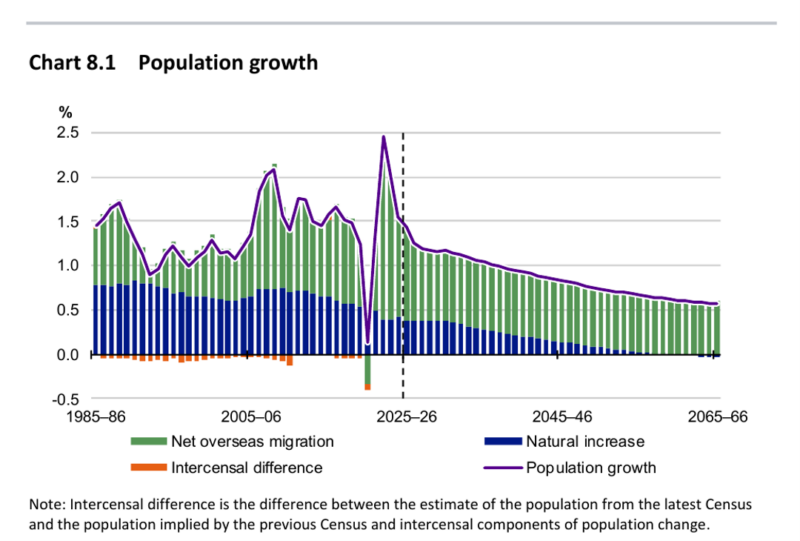
Population growth increasingly depends on net overseas migration. Source Australian Treasury 2026 Intergenerational Report
An older Australia will need different housing
Australians will live longer, with life expectancy projected to reach 89.5 years for women and 86.1 years for men.
The number of people aged 65 and over will almost double and the population aged 85 and over will triple.
This will increase demand for health, aged care and in-home support, but it will also change the housing market.
More Australians will seek low-maintenance homes near shops, transport, medical services and family, increasing demand for well-designed apartments, townhouses and villas in established suburbs.
Australia has discussed downsizing for years, yet planning systems and local opposition have constrained the supply of suitable homes in many of the neighbourhoods where older owners already live. Sensible medium-density development in amenity-rich locations will become an economic and social necessity.
The economy gets bigger but productivity carries much of the load
Treasury projects that the real economy will be about two and a quarter times larger in 2065-66, with real GDP per person 59 per cent higher and real gross national income per person 55 per cent higher.
The Intergenerational Report’s projections for growth in real GDP per person – a key measure of living standards – are almost entirely underpinned by labour productivity growing at the same level it did over the past 40 years.
Treasury believes artificial intelligence, business investment, skills and regulatory reform can help achieve that rate, even though recent productivity performance has been weak.
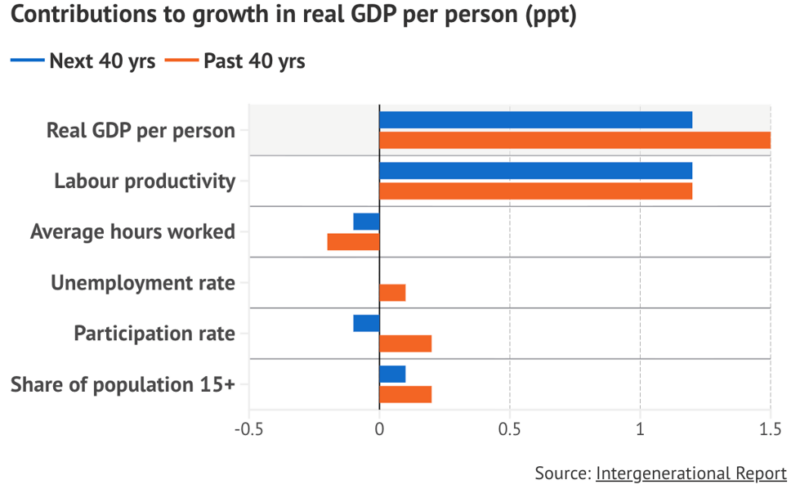
The report's sensitivity analysis shows how much is at stake. A 0.4 percentage point difference in annual productivity growth would leave real GDP, wages and nominal GDP about 15 per cent higher or lower by 2065-66.
In my view, this is the report's biggest assumption. Population growth can make the economy larger, but productivity growth is what enables individual Australians to enjoy higher living standards and higher real wages.
AI could help lift Australia’s economic growth
Despite Australia’s ageing population, Treasury now expects government spending, deficits and debt to be lower than it forecast in 2023.
The budget is projected to return to surplus from 2029-30 for about two decades before rising health, aged care and other pressures push it back into deficit.
Health remains one of the largest challenges, with Commonwealth spending projected to rise from 4 per cent to 6.2 per cent of GDP. Public hospitals are expected to account for more than 60 per cent of this additional spending.
The transition to electric vehicles will also reshape government revenue. As petrol and diesel use declines, net fuel excise is projected to fall to only 0.1 per cent of GDP by 2065-66, increasing the likelihood of a national road-user charge for electric vehicles.
Treasury expects productivity growth to remain below its historical average, although it sees artificial intelligence as a major opportunity.
AI could lift economic output and living standards over the next 40 years, but the benefits will depend on how effectively Australian businesses, workers and governments adopt the technology and use it to improve productivity.
Housing is widening the generational wealth gap
The report's housing findings are sobering.
- Also read:This week’s Australian Property Market Update – Latest Data, State by State October 13th 2026

- Also read:Latest Property Price Forecasts. Australian Property Market Outlook 2026-2027: Navigating a Market Correction

- Also read:Brisbane Property Market Forecast [2026 & Beyond] – What The Olympics Decade Means for Investors.
- Also read:Sydney property market forecast for 2026 and 2027 | Why the short-term softness is a long-term opportunity

- Also read:Melbourne property market forecast for 2026 & 2027 | Separating the fundamentals from the sentiment
Home ownership among households aged 25 to 34 has fallen 17 percentage points between 1981 and 2021, and Treasury estimates around 250,000 more young households would own a home if the 1981 ownership rates had been maintained.
In 2021, only half of households aged 30 to 34 and about one-third of those aged 25 to 29 owned their home.
This matters because housing remains the main way most Australians build wealth and achieve financial security in retirement.
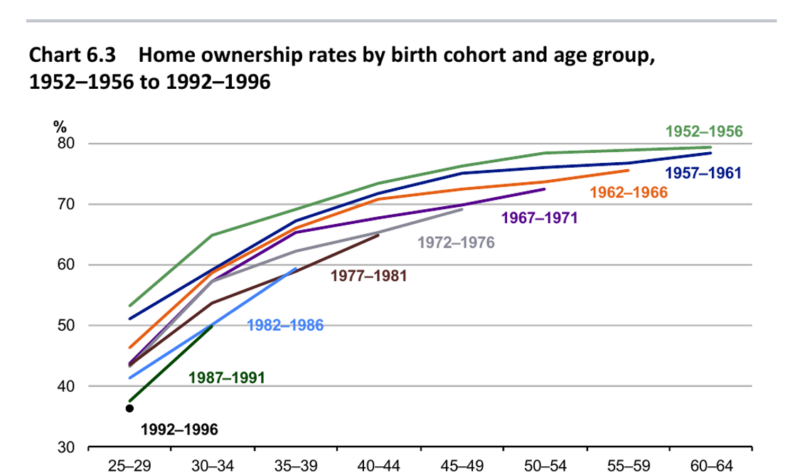
Younger cohorts are entering home ownership later and at lower rates. Source Australian Treasury 2026 Intergenerational Report
Treasury says dwelling prices rose 400 per cent between May 1999 and May 2026, more than twice as fast as average incomes.
Median housing prices increased from about four times average full-time earnings in 1999-2000 to around eight times earnings in 2025-26.
The estimated time required to save a 20 per cent deposit increased from 7.1 years in 2002 to 11.2 years in 2025.
That helps explain why parental assistance (The Bank of Mum and Dad) and the transfer of family wealth are playing a growing role in who can buy and when they can buy.
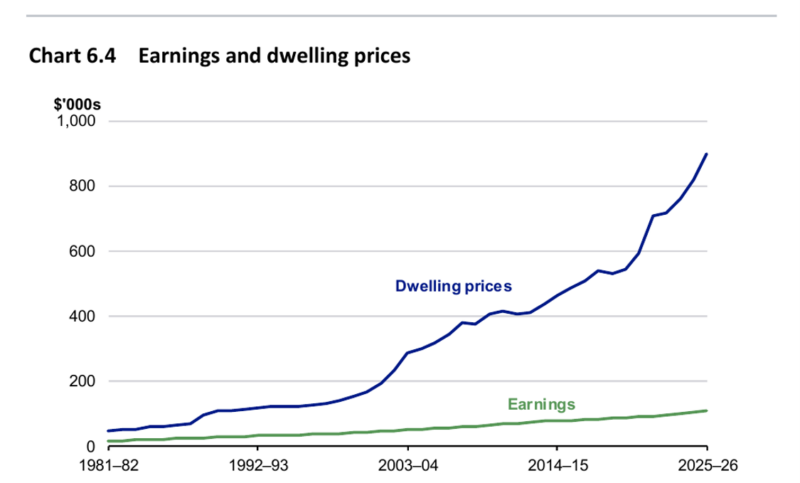
Dwelling prices have grown much faster than earnings. Source Australian Treasury 2026 Intergenerational Report
The supply problem remains the central problem
Treasury correctly identifies supply as the most important factor in housing affordability.
Australia now builds about half as many dwellings for each hour worked in housing construction as it did 30 years ago, while planning delays, infrastructure shortages, labour constraints and high construction costs continue to hold back completions.
The report also argues that negative gearing and the capital gains tax discount have increased investor ownership, noting that 80 to 90 per cent of investor housing lending since 2019 has financed established properties.
The government says its recent tax reforms will add about 75,000 owner-occupiers over a decade.
I believe that part of the diagnosis is too convenient. Investors buy established homes, but they also provide the overwhelming majority of private rental accommodation, and moving an existing dwelling from a landlord to an owner-occupier does not increase the number of homes available.
Policies that reduce investor demand may change who owns a dwelling, while the underlying shortage remains and fewer rentals are available.
A durable solution requires more feasible projects, faster approvals, adequate infrastructure and incentives that bring additional dwellings to market.
The budget will put more pressure on working Australians
An ageing population will increase spending on health and aged care.
Health spending is projected to rise from around 4 per cent of GDP to 6.2 per cent, while total government payments increase from 26.6 per cent to 27.7 per cent of GDP.
The underlying cash deficit is projected to widen to 1.8 per cent of GDP by 2065-66, and personal income tax rises from 12.3 per cent to 14.1 per cent of GDP before the report's assumed tax cap takes effect.
That creates an ongoing political struggle over who pays for an older population and how the burden is divided between labour, capital and consumption.
Superannuation provides Australia with an important buffer. Treasury expects the median super balance of people aged 65 to 69 to rise from about $204,000 in 2024 to approach $450,000 in nominal terms by the end of the medium term, reducing some pressure on the Age Pension.
Housing security will still be critical because retired renters face much higher living costs.
The report says 67 per cent of private renter retirees live in poverty, compared with 11 per cent of retired homeowners, which makes falling ownership rates a future retirement policy problem as well as a current affordability problem.
What this means for property investors
The Intergenerational Report reinforces several long-term trends that strategic investors should already have in their sights.
Australia will have millions more residents and migration will be central to growth, but demand will remain concentrated in our major employment centres and the established suburbs with transport, education, health care and lifestyle amenities.
An older population and smaller households will support demand for well-located, accessible and low-maintenance dwellings. At the same time, weaker productivity and affordability constraints mean buyers will become more selective, widening the gap between investment-grade property and secondary stock.
Investors should also expect continued policy risk. Housing tax settings are now part of a wider debate about intergenerational equity, even though the rental market still depends heavily on private landlords.
The sensible response is to maintain financial buffers, avoid speculative locations that rely on one short-term demographic story and own scarce properties in markets where household incomes can support rising values and rents over time.
The report's broader message is that Australia's future remains positive, although the gains will be distributed unevenly. Households that plan early, own quality assets and structure their wealth carefully will be better placed to navigate the demographic, economic and tax changes ahead.