Key takeaways
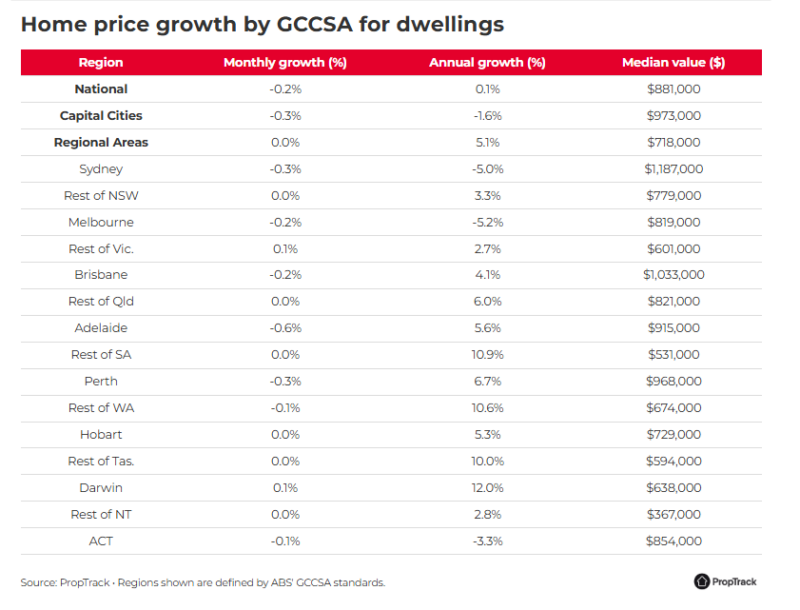
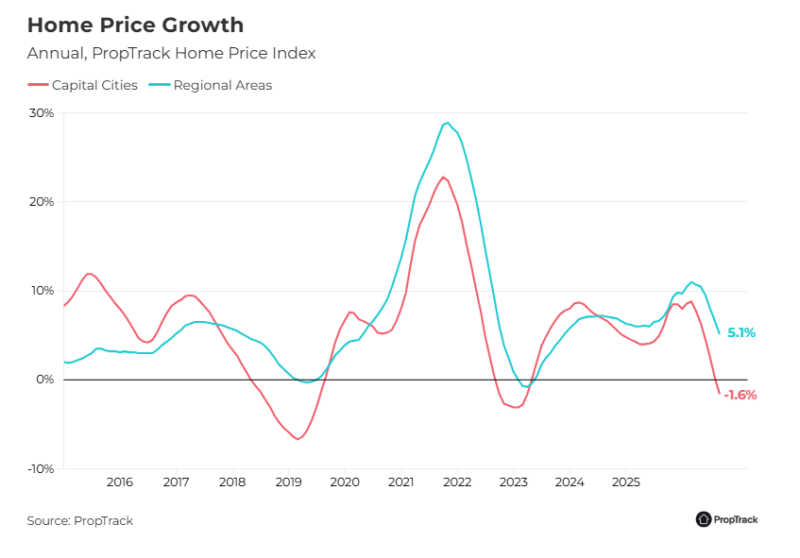
National home prices fell 0.2% in September, marking the sixth consecutive monthly decline. Prices are now 3.3% below their March peak and just 0.1% higher year-on-year.
Combined capital city prices fell 0.3% and are now 4.3% below peak and 1.6% lower than a year ago.
Adelaide (-0.6%) recorded the largest capital-city fall in September, followed by Sydney (-0.3%) and Perth (-0.3%). Brisbane and Melbourne both fell 0.2%.
Darwin (+0.1%) was the only capital to record price growth, reaching a fresh peak. Prices are 12.0% higher than a year ago.
Regional home prices were unchanged in September and remain 5.1% higher year-on-year and just 0.7% below peak.
Houses continue to experience greater price pressure than units. National house prices fell 0.3% in September and are 0.4% lower year-on-year, while unit prices were broadly unchanged and remain 1.8% higher than a year ago.
Sydney and Melbourne remain the deepest capital city corrections, at 5.5% and 5.7% below peak respectively.
But recent momentum has deteriorated sharply in previously stronger markets. Over the latest three months, price declines equate to an annualised rate of around 8.6% in Adelaide, 7.9% in Brisbane and 7.4% in Perth.
Australian home prices fell for a sixth consecutive month in September, according to the latest PropTrack Home Price Index Report, as higher interest rates continued to constrain borrowing capacity and weigh on housing demand.
Data show that national home prices declined 0.2% over the month and are now 3.3% below their March 2026 peak. Annual growth has slowed to just 0.1%.
Sydney and Melbourne continued their price falls, but downward momentum has strengthened in Adelaide, Brisbane and Perth - all markets that had previously proved more resilient.
Eleanor Creagh, PropTrack's Senior Economist said:
"The spring selling season has so far failed to deliver the usual lift in momentum. Softer auction clearance rates, longer selling times and weaker sales volumes point to subdued buyer demand and a wider gap between buyer and seller price expectations.
However, conditions remain uneven. Regional markets continue to outperform the capitals, while units are proving more resilient than houses as affordability shapes buyer demand."
Housing downturn deepens in September
PropTrack's data highlight national home prices fell 0.2% in September, extending the current downturn into a sixth consecutive month.
Prices are now 3.3% below their March peak, while annual growth has slowed from 1.8% in August to just 0.1% in September.
Ms Creagh further said:
"Higher interest rates remain the dominant headwind for housing demand. As mortgage rates rise, prospective buyers face lower borrowing capacities, reducing the amount they can afford to bid up property prices. Existing mortgage holders also face higher repayments, reducing disposable income.
But September's data reveal an important shift in the character of the downturn. Sydney and Melbourne entered the correction first and remain furthest below peak. Increasingly, however, price weakness has spread into Adelaide, Brisbane and Perth, which had continued to record strong growth for longer.
Brisbane, Adelaide and Perth remain 4.1%, 5.6% and 6.7% higher than a year ago respectively, but in recent months all three are now recording comparatively sharp falls."
Sydney and Melbourne remain the deepest corrections
Australia's two largest housing markets remain the furthest below their peaks.
According to the data, Sydney home prices fell 0.3% in September and are now 5.5% below their November 2025 peak and 5.0% lower than a year ago.
Melbourne prices declined 0.2%, leaving them 5.7% below their October 2025 peak and 5.2% lower year-on-year, the largest annual decline of any capital.
The correction has been particularly pronounced for houses. Sydney house prices fell 0.5% in September and are now 6.9% below peak and 6.5% lower than a year ago. Melbourne house prices declined 0.2% and are 6.6% below peak and 6.2% lower year-on-year after 11 consecutive months of falls.
By contrast, unit prices were broadly unchanged in both Sydney and Melbourne during September.
Downturn gathers pace in Adelaide, Brisbane and Perth
Adelaide recorded the largest capital city fall during the month, with prices declining 0.6%. Prices have now fallen for four consecutive months and are 2.5% below their May peak, according to PropTrack.
The shift in momentum has been sharp. Adelaide's price decline over the latest three months equates to an annualised rate of around 8.6%, the weakest of any capital.
Brisbane and Perth have now both recorded six consecutive monthly declines. Brisbane prices fell 0.2% in September and are 3.9% below their March peak. Perth fell 0.3% and is now 4.2% below peak.
Over the latest three months, Brisbane prices have declined at an annualised pace of around 7.9%, while Perth's equivalent rate is around 7.4%. That compares with 6.9% in Sydney and 4.8% in Melbourne.
Ms Creagh said that these figures do not mean prices will continue to fall at those annualised rates. Rather, they illustrate the recent shift in momentum, whereby the sharpest falls are now occurring in markets that had previously been the strongest performers.
- Also read:Latest Property Price Forecasts. Australian Property Market Outlook 2026-2027: Navigating a Market Correction

- Also read:Home Prices Down Again Over September – But Not as Much | Latest Property Market Stats

- Also read:Unemployment rises, student numbers fall and Melbourne still leads the auction market | Property Insiders

- Also read:This week’s Australian Property Market Update – Latest Data, State by State September 29th 2026

- Also read:National Weekly Auction Report – September 26th 2026 | Mixed Auction Results Over AFL Grand Final Week

Affordability is shaping the downturn
Ms Creagh highlights that the divergence between houses and units provides another indication of how reduced borrowing capacity is reshaping buyer behaviour.
She further explained:
"National house prices fell 0.3% in September and are now 0.4% lower than a year ago. Unit prices were broadly unchanged during the month and remain 1.8% higher year-on-year. Houses have also experienced a larger correction from peak, national house prices are 3.6% below their March high, compared with 2.2% for units.
The difference is particularly pronounced in Sydney and Melbourne. Sydney house prices are 6.9% below peak, compared with a 2.9% decline for units. In Melbourne, houses are 6.6% below peak, compared with 2.7% for units. Unit prices were broadly unchanged in both cities in September, even as house prices continued to fall.
As borrowing capacity falls, some buyers who might previously have purchased a house may adjust their expectations around property type, location or size. This helps support demand for relatively affordable units compared to houses."
Outlook
The spring selling season has not delivered the usual lift in market momentum. Auction clearance rates remain soft, homes are taking longer to sell and sales volumes are below last year's levels, all pointing to a continued gap between buyer and seller price expectations.
Buyers have become more cautious as higher interest rates have reduced borrowing capacity, while many vendors remain anchored to the stronger prices achieved during the previous upswing.
Importantly, however, softer conditions are not being accompanied by widespread forced selling, and that distinction matters for what happens next.
Higher rates have reduced how much prospective buyers can borrow and increased repayments for existing mortgage holders, weakening demand and limiting the prices buyers are able and willing to pay. Yet employment remains resilient and most existing homeowners have substantial equity buffers.
The Reserve Bank's March Financial Stability Review found housing loan arrears remained low, with fewer than 1% of mortgagors estimated to be in negative equity. Most borrowers also retained substantial liquidity and equity buffers.
In other words, reduced purchasing power remains the dominant force behind falling prices rather than widespread seller distress.
As Eleanor Creagh explains, higher interest rates remain the major headwind for home prices because they directly reduce borrowing capacity. This week's rate rise takes the cumulative tightening this year to 100 basis points, further shrinking buyer budgets and adding to the downward pressure already evident in prices and sales activity.
And there is usually a lag.
It takes time for higher rates to fully flow through household budgets, borrowing decisions and transaction prices, which means the full effect of tighter financial conditions is still working its way through the housing market.
That suggests home prices are likely to remain under pressure over the coming months, particularly across the capital cities.
Much will depend on the balance between buyer demand and the number of properties coming onto the market. If listings rise while borrowing capacity remains constrained, buyers will have more choice and greater negotiating power, meaning some vendors will need to adjust their expectations to meet the market.
At the same time, there are important buffers beneath the market. Employment remains resilient, forced selling is limited and many homeowners have substantial equity. Australia also continues to face a structural shortage of housing relative to population growth, while the supply of new homes remains constrained.
These factors should help put a floor under the downturn rather than prevent prices from falling altogether.
What about the changes to negative gearing and capital gains tax?
The impact of the federal budget changes on housing demand is more difficult to isolate.
The reforms are likely contributing to weaker investor demand, particularly for established housing, creating another headwind for some segments of the market. However, interest rates remain the more powerful influence because they affect borrowing capacity for owner-occupiers and investors alike, while the tax changes are concentrated primarily on investors.
With borrowing capacity already constrained, weaker investor participation can further reduce competition for properties and add to downward pressure on prices.
However, it is still too early to determine how much of the recent decline can be attributed specifically to the tax reforms. For now, the evidence suggests tighter financial conditions remain the main force driving the housing market adjustment.