

Key takeaways
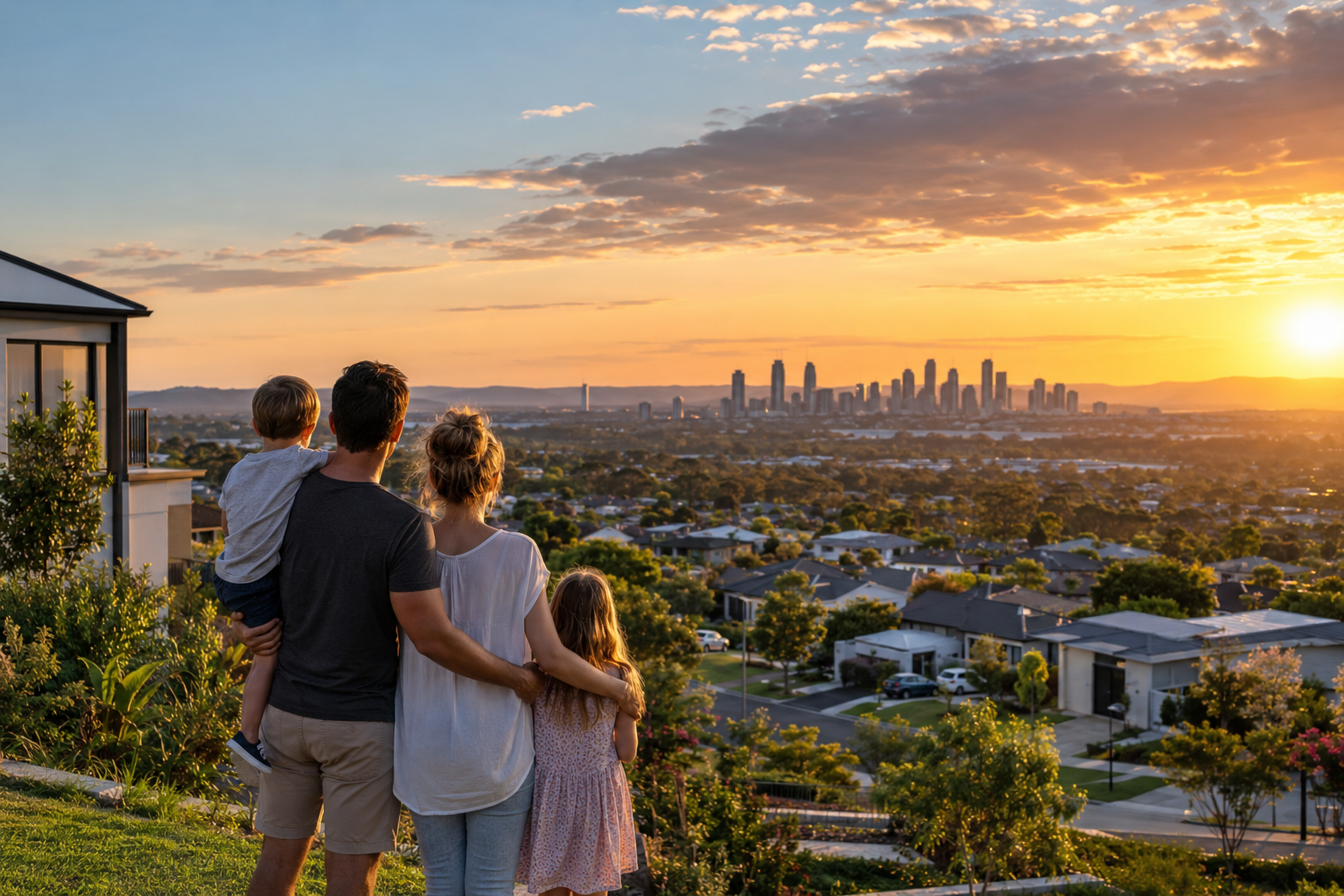
Millennials are Australia’s largest generation. As they enter family formation and peak spending years, their housing needs will increasingly shape the market.
Millennials need more space. Three or four bedrooms, home offices, storage and outdoor areas are becoming more important as families grow.
Many millennials will move further from the CBD. Affordable family-sized housing is pushing them towards middle and outer suburbs, supported by hybrid working.
Townhouses and family-friendly apartments should benefit. The opportunity lies in well-designed, scarce housing that meets family needs rather than commoditised high-rise apartments.
Demographics will reshape our suburbs for decades. The Millennial Mountain will drive near-term demand, while ageing baby boomers will eventually accelerate redevelopment and density in established middle suburbs.
For the last 20 years, one of the defining stories of Australian housing has been the rise of the apartment.
Look at the skylines of Sydney, Melbourne and Brisbane and you can see the evidence everywhere. Cranes filled our CBDs, high-rise towers appeared around transport hubs and former industrial precincts were transformed into dense residential neighbourhoods.
There were good reasons for this. A large generation of young Australians wanted to live close to universities, professional jobs, restaurants, entertainment and public transport.
They were prepared to trade private space for convenience and lifestyle, while strong overseas migration added another layer of demand.
But something important is changing.
The generation that helped drive Australia's apartment boom is growing older, forming families and entering a very different stage of life. And when the housing needs of such a large group change at roughly the same time, the effects are likely to ripple through our property markets for decades.
Leading demographer Simon Kuestenmacher calls this enormous cohort the "Millennial Mountain."
And that mountain is moving.

For weekly insights, subscribe to the Demographics Decoded podcast, where we will continue to explore these trends and their implications in greater detail.
Subscribe now on your favourite Podcast player:
The Millennial Mountain is moving
Australia has around 6.4 million millennials, compared with approximately 5.8 million Gen Xers, 5.5 million members of Gen Z and 4.7 million baby boomers.
Migration over the past two decades has also added significantly to the millennial population, helping make it Australia's largest generation.
But their importance goes well beyond sheer numbers.

Note: Millennials are entering the years traditionally associated with higher incomes, family formation, home ownership and peak household spending.
Simon explains that people tend to reach their highest spending stage around their mid-40s, meaning millennials will increasingly dominate Australian consumption over the coming decade simply because there are so many of them moving through this stage simultaneously.
This is what Simon means by the Millennial Mountain. Imagine Australia's population plotted by age, with a large bulge representing millennials moving through the demographic landscape each year.
As Simon explains,
"as you move this Millennial Mountain from one stage of the life cycle to the next, the millennials will impact and shape this particular stage of the life cycle."
We saw something similar with baby boomers as their sheer numbers affected schools, universities, workplaces, housing markets and eventually retirement systems.
Now millennials are doing the same, and housing is where their influence could become particularly significant.
From inner-city apartments to family homes
Millennials were unusually well suited to inner-city living during their younger years.
They attended university at higher rates than previous generations and then disproportionately moved into knowledge-based professional jobs, both of which were heavily concentrated around our CBDs.
Small apartments worked reasonably well for students, singles and young couples. What they lacked in private space could be compensated for by cafes, restaurants, parks and other places where people could meet and socialise.
Simon argues that millennials even helped turbocharge Australia's eating-out and cafe culture partly because their smaller homes weren't necessarily designed for entertaining large groups.
They also delayed having children compared with earlier generations, allowing them to remain in smaller dwellings for longer.
Now family formation is changing the equation.
Add children, working from home, toys, bicycles, prams and storage requirements to a one- or two-bedroom apartment and suddenly space becomes much more important.
Millennials increasingly want three or four bedrooms, a home office or flexible working space, access to good schools and some private outdoor area.
Importantly, Simon doesn't believe millennials are necessarily rejecting apartments.
Many would probably remain in their preferred inner suburbs if suitable three- and four-bedroom apartments were available at prices they could afford. The problem is that they're generally not.
Note: Australians will compromise on location, dwelling type and tenure, Simon says, but are much less willing to compromise on the number of bedrooms their household requires.
That means the real demographic shift isn't simply from apartments to houses. It's towards family-sized housing.
Why millennials are heading outwards
Governments would prefer much of Australia's future population growth to occur within our existing urban footprint, particularly around transport hubs where infrastructure already exists.
The logic is understandable, but planning theory eventually meets economic reality.
Simon points out that developing a square metre of housing on the urban fringe can cost roughly half as much as delivering the same amount of housing through infill development in established suburbs.
That helps explain why Australian cities continue sprawling despite decades of policies designed to encourage greater density.
If a millennial family needs three or four bedrooms but cannot afford a suitable dwelling in the inner or middle suburbs, eventually something has to give.
Increasingly, that compromise will be location.
Simon believes moving millennials from inner-city neighbourhoods towards the urban fringe will be "the single biggest movement on the property market in the coming decade."
Hybrid working makes this easier. If you only commute into the CBD two or three days a week, living further away becomes more manageable, while working from home simultaneously increases demand for that third bedroom or study.
Interestingly, millennials are also taking their lifestyles with them.
- Also read:This week’s Australian Property Market Update – Latest Data, State by State September 15th 2026

- Also read:Latest Property Price Forecasts. Australian Property Market Outlook 2026-2027: Navigating a Market Correction

- Also read:Brisbane Property Market Forecast [2026 & Beyond] – What The Olympics Decade Means for Investors.
- Also read:Melbourne property market forecast for 2026 & 2027 | Separating the fundamentals from the sentiment
- Also read:Sydney property market forecast for 2026 and 2027 | Why the short-term softness is a long-term opportunity
Simon describes this as the "hipsterisation" of the outer suburbs. Cafes improve, hospitality changes and services evolve as the people who helped create inner-city cafe culture begin pushing prams around suburban neighbourhoods.
The missing middle
There should theoretically be another option between a CBD apartment and a detached house 40 kilometres from the city.
This is Australia's famous "missing middle."
Well-planned cities tend to transition from very high density in their centres through medium-density neighbourhoods before eventually reaching lower-density suburbs.
Australia largely skipped that middle stage. Our major cities can move remarkably quickly from skyscrapers to streets dominated by detached houses.
Retrofitting medium density into established neighbourhoods is difficult because land ownership is fragmented and redevelopment costs are high.
As Simon explains, assembling enough neighbouring blocks to deliver medium-density housing at scale can make the land so expensive that developers ultimately need much greater height to make projects financially viable.

Tip: That's why townhouses and duplexes are likely to become increasingly important.
A well-designed townhouse on a compact block can provide three bedrooms, usable living space, privacy and some outdoor area without requiring the land component of a traditional detached home.
There will also remain an important role for apartments, but investors need to distinguish between commoditised high-rise stock and genuinely scarce, family-friendly apartments in established suburbs.
I've long preferred apartments with good floor plans, natural light, storage, usable balconies, acoustic privacy and an attributable share of valuable underlying land. Many older Art Deco apartments and established low-rise developments possess precisely these characteristics.
Note: Demographic change doesn't make apartments obsolete. It just changes which type of apartment is likely to be most desirable.
The Baby Boomer factor
Another force is complicating this transition.
Baby boomers remain heavily represented in established middle-ring suburbs, often occupying large family homes long after their children have moved away. Despite decades of predictions about mass downsizing, many prefer to age in place.
That restricts the supply of larger established homes available to younger families.
At the same time, boomers are increasingly helping their children into the property market through the Bank of Mum and Dad.
Simon points out that financial assistance in your 30s can have an enormous long-term effect because it may remove the deposit hurdle or substantially reduce the size of a mortgage.
However, this also risks widening the divide between families with property wealth and those without it. Families with substantial housing equity can help the next generation acquire assets, while those without that wealth cannot.
And that matters well beyond today's housing affordability debate.
Home ownership plays an important role in Australia's retirement system because retirees who own their homes generally have much lower ongoing housing costs than lifelong renters.
If a significant proportion of millennials eventually reach retirement still renting, their superannuation and other savings will have to cover housing costs previous generations largely avoided.
The middle suburbs will eventually change
The next decade may be dominated by millennial families moving towards outer suburbs and growth corridors, but another significant shift is likely to follow.
As baby boomers eventually leave their established homes, many of those properties are unlikely to remain single-family dwellings.
Instead, ageing houses on larger blocks will increasingly be demolished and replaced with two or three townhouses.
Simon expects this process to accelerate from the mid-2030s through the 2040s, substantially increasing density across Australia's middle suburbs.
Of course, that will create challenges.
More families will mean greater demand for schools, transport, parks, medical services and community facilities in suburbs that weren't designed for substantially larger populations.
It also highlights why headline population growth figures tell property investors surprisingly little on their own.
Note: You need to understand who the additional people are, where they are in their lifecycle, what type of household they're forming and what sort of housing they'll require.
What this means for property investors
Demographics should never be used as a shortcut for choosing an investment property. A suburb can experience strong population growth and still deliver mediocre investment returns if the wrong housing is being supplied, local incomes are weak or abundant developable land creates endless competition from newer properties.
But demographics provide an important window into future demand.
The Millennial Mountain suggests that family-friendly housing in well-connected locations is likely to become increasingly valuable. That doesn't mean rushing out and buying anything with three bedrooms.
Note: Property selection still needs to consider scarcity, land value, local incomes, neighbourhood quality, infrastructure, employment access and the property's appeal to a broad owner-occupier market.
It does, however, reinforce a principle I've believed in for decades.
Successful property investment involves looking beyond today's headlines and understanding what Australians are likely to want tomorrow.
The bottom line
Australia's housing markets are entering another important demographic transition.
The millennials who helped populate our inner-city apartments, fill our cafes and reshape our CBDs are becoming parents, moving through their peak earning years and looking for homes better suited to family life.
Some will move to the urban fringe. Others will choose townhouses, duplexes or family-friendly apartments. Later, our middle suburbs will become denser as older housing stock is progressively redeveloped.
For property investors, these changes will play out over decades, rather than months.
There will always be short-term distractions - interest rate decisions, elections, tax changes and forecasts about the next property boom or downturn. Underneath them sit much slower and more predictable demographic forces.
The Millennial Mountain is already moving through Australia's housing market, and over the next decade its influence will become increasingly visible in the homes we build, the suburbs we choose and the cities we create.
Investors who understand where that demand is heading will be better placed to own the type of property future Australians will want to live in, rather than the type developers found convenient to build yesterday.