

Key takeaways
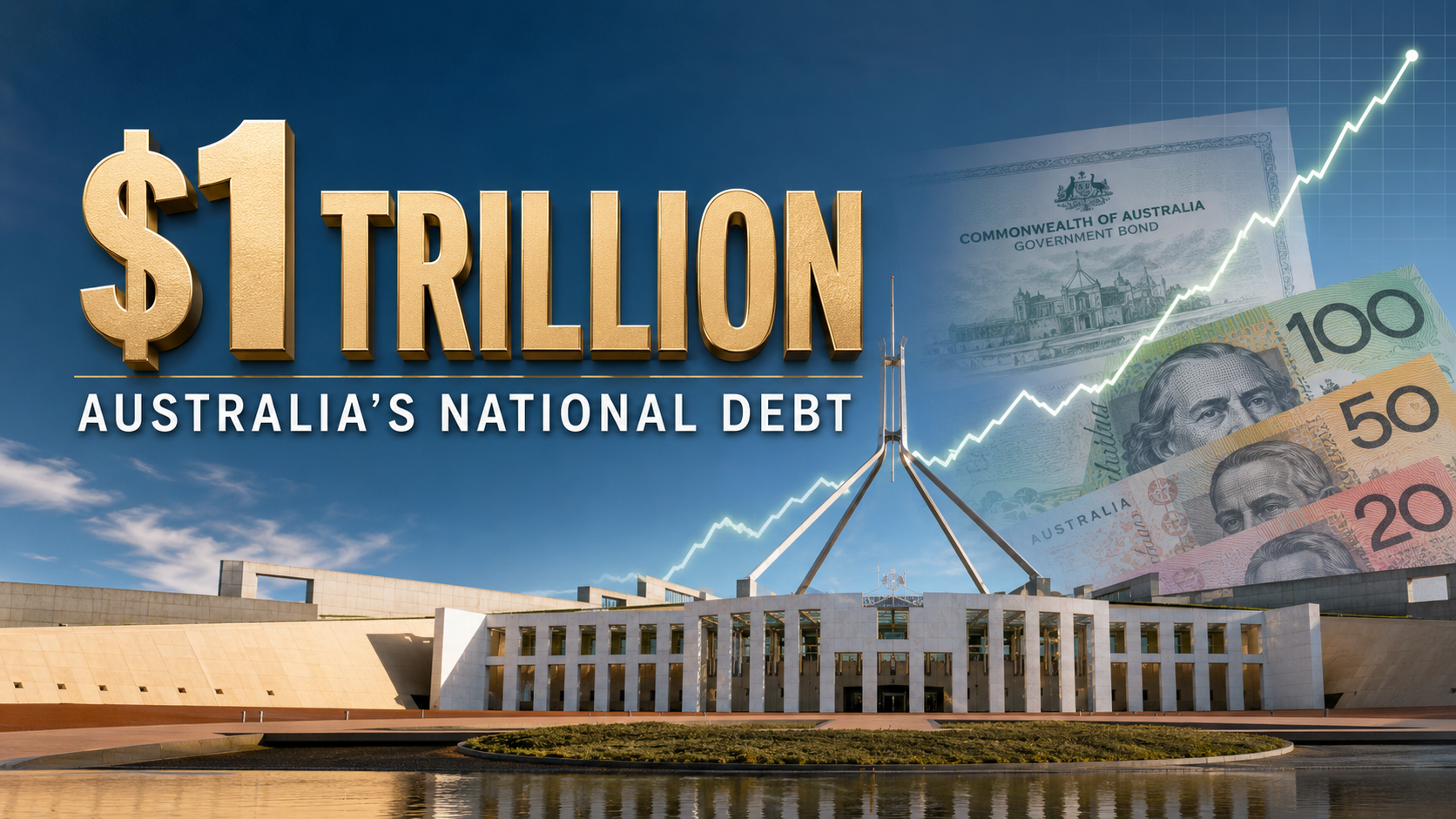
Australia’s government debt has passed $1 trillion for the first time, equivalent to one thousand billion dollars.
Governments borrow when their spending exceeds the revenue they collect through taxes and other sources.
Borrowing can help fund essential services and support the economy, although rising debt brings a growing interest bill.
Australia’s debt remains relatively manageable compared with many other developed economies when measured against the size of our economy.
The real concern is whether borrowed money improves Australia’s future productive capacity or simply finances ongoing spending.
Persistent deficits could eventually mean higher taxes, reduced services or fewer choices for future governments.
Australia’s government debt has passed $1 trillion for the first time, and the sheer size of that figure naturally attracts some alarming headlines.
As a trillion dollars is so far beyond the amounts we deal with in everyday life, it is difficult to understand what it actually represents, let alone decide whether we should be worried about it.
One trillion dollars is $1,000,000,000,000. It is one thousand billion dollars, or one million lots of one million dollars.
To put that into a different perspective, one million seconds is around 11½ days, while one billion seconds is almost 32 years. One trillion seconds would take us back nearly 31,700 years.
Spread across Australia’s population, $1 trillion works out at roughly $35,000 for every man, woman and child, although Australians won’t personally receive a bill for that amount.
The milestone arrived in the same week that United States government debt passed US$40 trillion, equivalent to approximately A$56 trillion. The annual interest bill on America’s debt alone has now climbed above US$1 trillion.
Clearly, Australia’s position is nowhere near that extreme, but crossing the trillion-dollar threshold should encourage a sensible discussion about what government debt means and how much borrowing is sustainable.
Why does the government borrow money?
Government debt is the money the Commonwealth owes to people and institutions that have lent it funds.
Those lenders include Australian investors, superannuation funds, banks and international investment funds. They buy government bonds because Australia is considered a reliable borrower that can repay its obligations and make the required interest payments.
The government uses the borrowed money to cover the gap when its spending exceeds the revenue it collects, mainly through taxation.
For example, the government may need to fund the NDIS, build hospitals and roads, provide income support and respond to a natural disaster in the same year.
When the cost of these commitments exceeds its revenue, it records a budget deficit and borrows the difference.
Borrowing is a normal part of government financial management and can be particularly valuable during recessions, emergencies and major economic disruptions.
Australia relied heavily on government borrowing during the pandemic to support households, protect jobs and keep businesses operating. Allowing the economy to collapse would probably have created far greater long-term financial and social costs.
The quality of the spending matters, though.
Debt used for productive infrastructure, education and projects that expand the economy can benefit future generations who will help repay it.
On the other hand, borrowing to fund recurring expenditure without improving productivity leaves future taxpayers with the interest bill and little to show for it.
When does the debt get repaid?
A government can begin reducing its debt when it runs a budget surplus, meaning it collects more revenue than it spends during the year.
- Also read:Latest Property Price Forecasts. Australian Property Market Outlook 2026-2027: Navigating a Market Correction

- Also read:This week’s Australian Property Market Update – Latest Data, State by State August 25th 2026

- Also read:Melbourne property market forecast for 2026 & 2027 | Separating the fundamentals from the sentiment

- Also read:Brisbane Property Market Forecast [2026 & Beyond] – What The Olympics Decade Means for Investors.

- Also read:Sydney property market forecast for 2026 and 2027 | Why the short-term softness is a long-term opportunity

Australia recorded budget surpluses in 2023 and 2024, helped by strong employment, commodity prices and higher-than-expected tax receipts. However, the budget returned to deficit from 2025, causing debt to begin rising again.
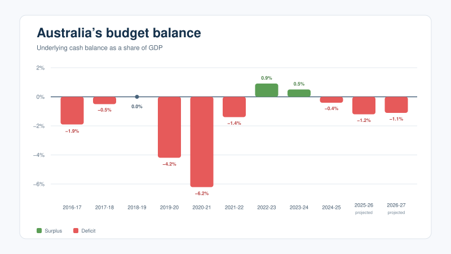
The Parliamentary Budget Office forecasts that the budget could return to surplus by 2034-35.
Part of that improvement is expected to come from bracket creep. As wages rise, more Australians move into higher tax brackets, allowing the government to collect additional revenue even when tax rates remain unchanged.
Changes to eligibility for the National Disability Insurance Scheme are also expected to slow the rate at which spending on the program grows.
In the meantime, the headline debt figure is expected to keep climbing and could reach $1.1 trillion within the next two years.
Should Australians be worried?
The trillion-dollar figure matters, but it doesn’t really tell us whether the debt is affordable.
Economists generally compare government debt with the size of the economy using the debt-to-GDP ratio.
A larger and growing economy has a greater capacity to service debt, much as a household with a higher income can generally manage a larger mortgage.
Australia’s debt-to-GDP ratio is around half and remains relatively low by international standards. That means the Commonwealth continues to be viewed as a low-risk borrower, which helps it access funding at comparatively favourable interest rates.

Note: However, low relative debt should not become an excuse for complacency.
As debt grows, so does the amount of public money required to service it. Every dollar spent on interest is a dollar unavailable for hospitals, education, infrastructure, defence or tax relief.
Higher government borrowing may also place upward pressure on interest rates if it adds too much demand to an economy already operating close to capacity.
What does this mean for property investors?
Australia’s debt passing $1 trillion will not, by itself, cause property prices to fall or interest rates to rise.
Property investors should pay closer attention to the government’s future choices, including taxation, infrastructure spending, housing policy and whether persistent deficits contribute to inflation.
My concern is less about the trillion-dollar milestone and more about how effectively the borrowed money is being used.
Australia can afford its current debt, but affordability today does not guarantee good financial management tomorrow. Governments, like investors, need a long-term strategy, an adequate financial buffer and a clear understanding that every borrowing decision carries an opportunity cost.
This symbolic milestone should remind us that today’s government spending shapes tomorrow’s taxes, services and economic choices. Australia remains in a stronger position than many comparable countries, but the benefits of that advantage will depend on how carefully it is managed.