
Key takeaways
Australia is set for major population growth with another 8 million people could call Australia home by 2050.
Population growth will be uneven with Melbourne, satellite cities and lifestyle locations likely to capture a large share of future growth.
Population growth alone doesn't make all properties good investments. Instead look for economic diversity, employment growth, rising incomes and strong owner-occupier demand.
Be careful, some regional markets carry significant risks. One-industry towns and ageing "sponge towns" can have weaker long-term fundamentals despite apparent growth.
On the other ur established suburbs will change dramatically. Baby Boomer housing turnover and redevelopment could accelerate medium-density housing in desirable middle-ring suburbs.
By the time many of today’s Gen Z Australians buy their first home, the map of Australia will look very different.
Melbourne is on track to overtake Sydney as our largest city. Canberra is expected to become bigger than Newcastle. Geelong could overtake Wollongong, while lifestyle destinations such as the Sunshine Coast, Hervey Bay, Busselton, Airlie Beach and Warragul-Drouin are likely to grow strongly.
At the same time, some regional communities will stagnate or shrink.
For property investors, this matters because population growth drives demand for housing, infrastructure, jobs and services.
But knowing Australia is growing is only the starting point. The real issue is where those extra people will live, why they will choose those locations and whether those places have the economic depth to support sustainable growth.
Research from The Demographics Group examined population trends across 98 of Australia's largest cities and towns from 2000 to 2025, then projected them out to 2050.
Simon Kuestenmacher describes these assumptions as "well measured, well tempered population data", rather than an aggressive high-migration scenario.

For weekly insights, subscribe to the Demographics Decoded podcast, where we will continue to explore these trends and their implications in greater detail.
Subscribe now on your favourite Podcast player:
Australia could add another eight million people
Australia added around eight million people between 2000 and 2025, and it is plausible that we will add roughly another eight million by 2050.
Simon points out that this would simply continue a much longer trend - Australia had a population of around seven million at the end of the Second World War and has roughly quadrupled since then.
Strong population growth has been part of the Australian story for decades, but the difference going forward is that migration will do even more of the heavy lifting.
Our birth rate is falling, and eventually deaths will exceed births, meaning Australia would ultimately shrink without ongoing migration. That makes sustained migration highly likely, particularly given our skills shortages and ageing population.
But that growth won't be evenly spread - people will continue to cluster around jobs, education, infrastructure, affordability and lifestyle.
Meaning some locations will absorb a disproportionate share of the growth, while others will miss out.
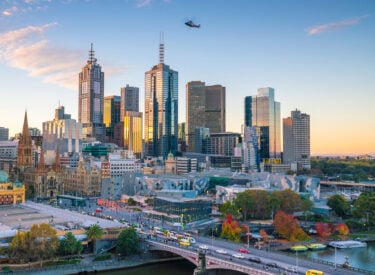
Melbourne is likely to overtake Sydney
Melbourne has been growing faster than Sydney, adding roughly 100,000 people a year compared with about 80,000 in Sydney.
Maintain that gap long enough, and Melbourne eventually becomes Australia's largest city.
The explanation is largely about geography and affordability.dem
Sydney is constrained by the Blue Mountains, national parks and water, so adding more housing increasingly requires expensive vertical development.
Melbourne has far more room to expand north and west, making it easier to provide lower-cost housing on the urban fringe.
As Simon jokes, "Melbourne can sprawl until it hits Adelaide."
Melbourne also attracts a large share of international students and skilled migrants, supported by its universities and diverse employment base.

Tip: For investors, however, this is not a signal to simply "buy Melbourne". Population growth creates opportunity, but investment performance will still depend on choosing the right suburb and the right property within it.
Australia's satellite cities will keep growing
Cities such as Geelong and the Gold Coast are also likely to strengthen their position.
Simon describes them as affordable satellite cities.
They benefit from their proximity to larger capitals, but increasingly have substantial employment bases, healthcare infrastructure and commercial centres of their own.
Hybrid work has reinforced this trend. If someone only needs to travel into a CBD once or twice a week, living an hour or two away becomes far more practical.
But investors need to be selective - Simon makes the distinction between towns within roughly a two-hour drive of major CBDs and those further away.
Locations beyond that commuting radius generally need a genuine economic reason to attract and retain residents. They need jobs, industries and services, not simply cheap housing.

Note: Cheap property on its own is rarely a compelling investment case. The better question is whether more people with higher incomes will want to live there in the future.
The rise of the lifestyle towns
The research also highlights fast-growing lifestyle locations including the Sunshine Coast, Hervey Bay, Busselton, Airlie Beach and Warragul-Drouin.
Their common attraction is lifestyle.
Australians have always placed a high value on where and how they live, and demographic change is reinforcing that preference.
Retiring Baby Boomers, hybrid workers and households seeking more affordable housing are widening the range of locations they are willing to consider.
Simon explains that once workers are less tied to a daily commute, they can place more emphasis on climate, nature, housing, healthcare and amenity.
- Also read:This week’s Australian Property Market Update – Latest Data, State by State October 13th 2026

- Also read:Latest Property Price Forecasts. Australian Property Market Outlook 2026-2027: Navigating a Market Correction

- Also read:Brisbane Property Market Forecast [2026 & Beyond] – What The Olympics Decade Means for Investors.
- Also read:Sydney property market forecast for 2026 and 2027 | Why the short-term softness is a long-term opportunity
- Also read:Melbourne property market forecast for 2026 & 2027 | Separating the fundamentals from the sentiment
Even so, population growth alone is not enough.
Tip: Investors still need to ask whether infrastructure will keep pace, whether there is a deep employment base and whether future owner-occupiers will want to buy in that location.
That's important because owner-occupiers ultimately drive property values. As an investor, I want to own the type of property they will compete for.
Be careful with one-industry towns
Some regional towns exist largely because of one dominant industry - Karratha and Port Hedland are obvious examples.
Their local economies ultimately depend heavily on the resources sector.
When that industry is booming, wages and housing demand can be strong, but their concentration also makes them vulnerable to changes in commodity prices or employment.
On the other hand, Canberra is different.
It has a clear economic purpose as the national capital, meaning government employment is unlikely to disappear.
Simon therefore sees Canberra as relatively safe compared with towns that depend heavily on a single commodity.
This reinforces a principle I have long followed: economic diversity matters.
Note: I would rather invest in a location with multiple employment sectors, rising incomes and a broad range of reasons for people to live there than chase a temporarily high yield in a one-industry town.
Some population growth can be misleading
Investors also need to understand what Simon calls "sponge towns".
A larger regional centre such as Horsham can grow by attracting older residents from surrounding farming communities who move closer to healthcare and services.
On paper, the population rises, but the workforce and productive economy may barely grow.
That type of growth creates demand for healthcare and aged care, but it differs from growth driven by young families, skilled migrants, and expanding industries.
Meanwhile, smaller surrounding communities may continue losing population and eventually lose shops, sporting clubs and other services.
So headline population growth needs context - two towns can grow at the same rate and still have very different long-term property prospects.
Baby Boomers will reshape the middle suburbs
One of the biggest changes over the next two decades is likely to occur in the established middle-ring suburbs of our major capitals.
Australia's Baby Boomers hold enormous residential property wealth, and as this generation ages and passes away, many well-located homes will return to the market.
Simon expects a significant number of these properties to be redeveloped into two or three townhouses, helping create the "missing middle" housing our cities badly need.
This could reshape many established suburbs.
The combination of ageing owners, planning reform, affordability pressures and demand for medium-density housing should create opportunities in locations that already have strong infrastructure, transport and amenity.
Tip: For investors, the future is about established suburbs with scarcity, strong owner-occupier demand and redevelopment potential.
Follow demographics, but don't blindly follow population
By 2050 Australia could have another eight million residents with Melbourne likely to be our largest city.
At the same time, satellite cities and lifestyle destinations will continue to expand, while some smaller regional communities may struggle.
But the investment lesson is broader than chasing the fastest-growing postcode.
Demographics should be one layer of a sound investment strategy. I look for locations with economic diversity, rising incomes, strong employment, good infrastructure, limited supply and the type of amenity that attracts owner-occupiers.
Then you still need to buy the right property, because even a strong suburb can contain secondary assets that underperform.
While interest rates, governments and tax policies will change, demographic trends move more slowly, but they shape housing demand over decades.
Simon describes Australians as a "life embracing population", and our preference for lifestyle will continue to influence where we choose to live.
That gives me plenty of reason to remain optimistic.
Australia will continue to grow, and that growth will require more homes, more infrastructure, more businesses and more investment.
The locations that combine population growth with jobs, amenity, economic depth and strong owner-occupier appeal are likely to be the ones that prosper.
For investors, the opportunity will be substantial. Success will come from understanding which growth is sustainable, which markets have genuine depth and which properties tomorrow's buyers will still want to own.