


Key takeaways
This looks more like a correction than a crash. National prices are falling, but the decline remains within the range of previous property cycles.
Interest rates remain a key risk. Inflation is easing, but weak productivity and persistent costs mean another rate rise cannot be ruled out.
Lending and confidence are major headwinds. Housing finance is contracting and consumer sentiment remains extremely weak, limiting the prospects of a quick recovery.
There are early signs the downturn is losing momentum. Asking-price declines in Sydney and Melbourne are slowing, suggesting the sharpest falls may be behind us.
A meaningful recovery is more likely in 2027. The spring selling season will provide an important test of whether this downturn develops into a soft landing or has further to run.
Are you wondering where property prices are headed and how long we will remain in the doldrums?
Every property cycle eventually poses the same question to investors: is this a genuine crash, a soft landing, or something in between?
Right now, with national prices falling and confidence at near record lows, those questions are louder than ever.
Here's what the data is actually telling us, and where this cycle is likely headed.

Rates on Hold, But the RBA Isn't Relaxed
The Reserve Bank has again left interest rates unchanged. While that will offer some short-term comfort to borrowers, it doesn't mean the inflation story is settled.
The good news is that the RBA has brought forward its forecast for inflation to return to the 2–3% target band, now expecting it in late 2027.
However, it is unlikely that we will see a short-term reprieve in areas such as Energy, Housing, and Tobacco. Fuel and rents are likely to follow suit, meaning the risk of an interest rate hike is far from over.
One of the RBA's central concerns is productivity, and the data here is worth looking at carefully.
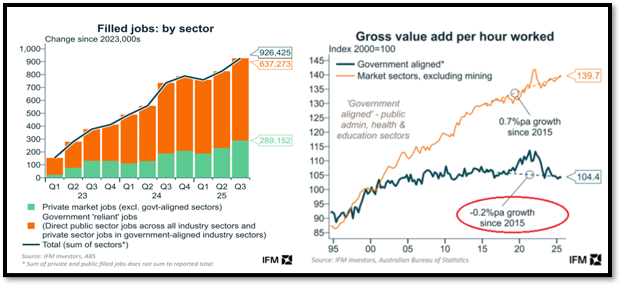
Over the past two and a half years, roughly 69% of new jobs created in the economy have come from the government sector, compared with the private market.
At the same time, productivity per hour has declined by about 0.2% per annum since 2015.
In plain terms: we're spending more as an economy without a corresponding increase in output.
The property sector is a clear example of this. Years of accumulating regulation and red tape have added costs and friction without delivering proportional benefits.
In short, we are spending more but falling behind on housing targets and on previous years’ completions.
It's a trend the Reserve Bank is watching closely, and one that has direct implications for how quickly inflation , and therefore interest rates, can normalise.
Putting This Downturn in Historical Context
To understand where this cycle might land, it helps to look at the past decade of property cycles.
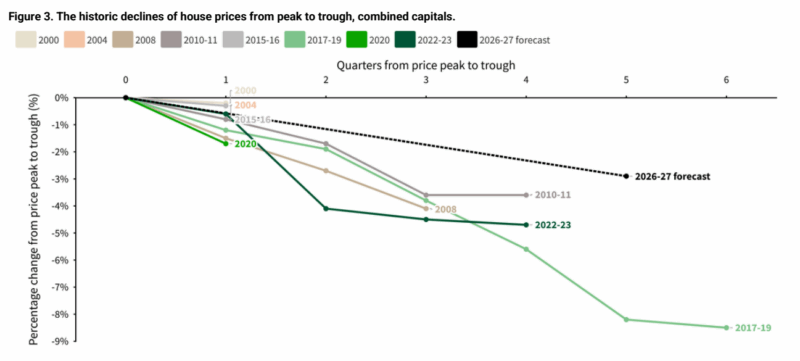
There have been four distinct downturns in that time - an unusually high number, reflecting just how volatile market conditions have been:
- 2017–2019: Saw the largest correction on record, with prices falling around 9% nationally, driven by APRA's credit tightening and reduced borrowing capacity.
- 2022–2023: The COVID-related pullback of roughly 4.5–5%.
- Several smaller corrections in between.
That 9% figure is the benchmark to keep in mind as forecasts for this cycle start to roll in, since national property prices have never fallen by double digits before. Sure, certain markets and some suburbs saw bigger price falls than that, but nationally, we haven't had a double-digit property price correction.
Where the Market Sits Right Now
The latest data (July results) shows:
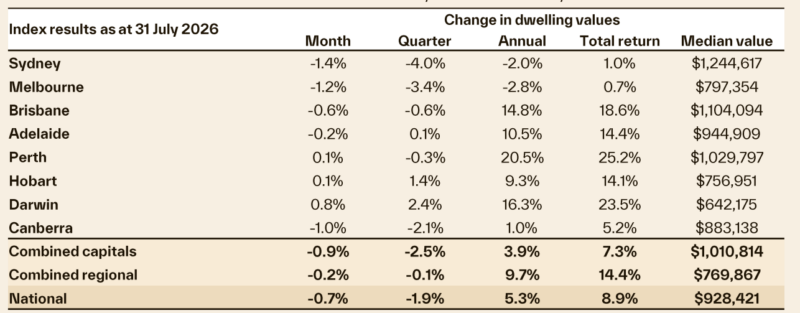
Nationally, including the Regions, prices are down, on average 1.9% over the quarter, with capital cities down by 2.5%. Sydney and Melbourne have led this downturn, at 4% and 3.4%, and the other capitals are now also in negative territory.
Interestingly, our more affordable markets, like Hobart and Darwin, remain in positive territory and are trending above average.
Lending Is Pulling Back Sharply
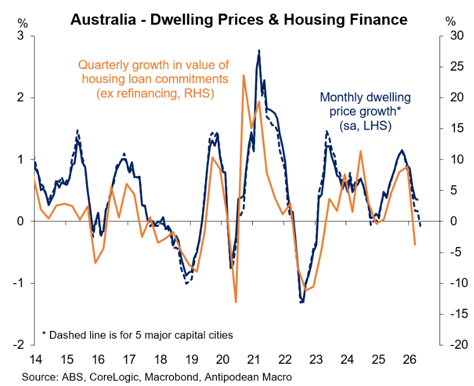
Loan commitment data from the ABS tells a consistent story:
- Also read:Melbourne housing market update | October 2026

- Also read:National Vacancy Rate Rises to 1.4% | SQM Research

- Also read:Australian housing market update | October 2026

- Also read:This week’s Australian Property Market Update – Latest Data, State by State October 13th 2026

- Also read:Latest Property Price Forecasts. Australian Property Market Outlook 2026-2027: Navigating a Market Correction

More specifically, ANZ reported a roughly 13% drop in lending, while CBA's finance commitments have fallen closer to 23%, with NAB and WBC in the middle.
Across the five capital cities, housing finance is trending into negative territory for the first time in this cycle, and there's no clear sign yet that the trend is reversing.
Confidence Has Collapsed
There is no doubt that Consumer Confidence is at record lows and Business Confidence is not far behind.
More specifically, a property survey reports that in Q3 2024, at the peak of the last upswing, when Brisbane, Perth and Adelaide were surging, 62% of respondents felt positive about the market.
Fast forward to today, and only 24% feel positive, while 48% feel negative and 28% are neutral.
Fact is, confidence tends to lag price movements, and a genuine bottom is unlikely to form until sentiment stabilises.
That shift hasn't happened yet , but there are early signs worth watching, because confidence really is the X factor.
Asking Prices Are Adjusting
Since the recent budget was introduced, price falls have been evident across the board. That part of the story is not new.
But looking at the rolling average data for Sydney and Melbourne specifically, the pace of weekly declines appears to be easing rather than accelerating.
Of course, that doesn't mean values are rising again; it means the rate of decline is slowing, which is often the first technical sign that a market is approaching a bottom.
Sydney and Melbourne led the downturn, and history suggests they may also be among the first to recover - something worth watching closely over the coming months.
Weekly asking price data shows a similar pattern.
A month ago, rolling averages showed Sydney down around 2%, with Melbourne at 3%. More recent weekly figures show falls softening to around 0.7–1.2%.
This kind of adjustment with sellers gradually meeting buyers' expectations typically follows a predictable pattern after a shock: the sharpest falls tend to occur in the first four to six weeks, as uncertainty peaks.
As more information becomes available and both buyers and sellers recalibrate, the pace of decline naturally moderates. And that appears to be exactly what's happening now with asking prices, even if it's much too early to call the bottom on sale prices themselves.
So, How Far Will Prices Fall? And For How Long?
The major forecasters are starting to stake out their positions, and there's a significant spread among them.
Domain is suggesting a decline of around 3% over the next 15 months, while ANZ are suggesting closer to 10.6% to round out 2027.
Other banks have only released their thoughts on the remainder of 2026, with NAB modelling a 6% decline and CBA a 7% decline.
While a figure and a time frame will always provide more certainty for these types of events, it will be more prudent to keep an eye on different markets as they begin to segment.
The Bottom Line
This looks less like a crash and more like a drawn-out correction - one shaped as much by confidence and lending conditions as by any single economic shock.
The signs of stabilisation in Sydney and Melbourne, alongside softer asking-price declines, suggest the sharpest phase of the downturn may be short-lived.
But with lending still contracting and confidence yet to recover, a genuine turnaround is more likely a 2027 story than a 2026 one.
The spring selling season will be the next major test. If buyer activity and confidence pick up as expected, this cycle may prove to be a soft landing rather than anything more severe, with a return to more normal conditions likely by this time next year.
The data over the next few months will tell us a lot. What's your read - soft landing, or is there further to fall?